

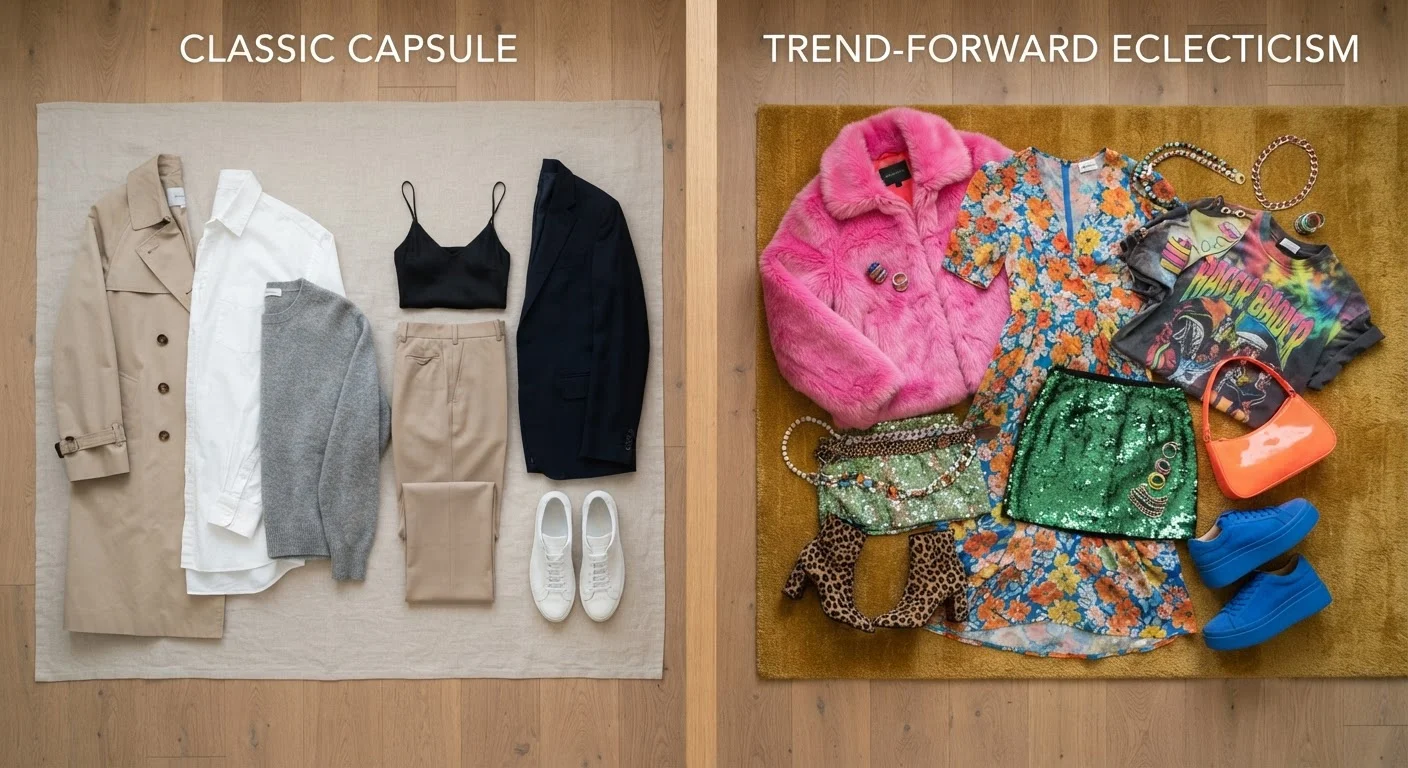
Option A
Capsule Wardrobe
The deliberate, less-is-more approach to dressing.
Best for: People who want a streamlined closet of versatile, long-lasting pieces that work across multiple occasions without constant refreshing.
Option B
Trend-Driven Shopping
The expressive, seasonally refreshed way to dress.
Best for: People who find energy and creativity in staying current with fashion cycles and enjoy experimenting with evolving styles.
What Each Philosophy Actually Means
The term capsule wardrobe was popularized in the 1970s by London boutique owner Susie Faux, who advocated building a small collection of essential, high-quality pieces that could be mixed and matched indefinitely. The idea gained broader cultural traction when American designer Donna Karan released a seven-piece travel collection in 1985 built on the same premise. Today, a capsule wardrobe typically means owning somewhere between 30 and 50 items — including clothing, shoes, and outerwear — selected for longevity and versatility rather than seasonal novelty.
Trend-driven shopping, by contrast, means orienting your wardrobe around what's current — whether that's runway-influenced silhouettes, colors declared dominant by forecasters, or styles spreading rapidly through social media. As explored in our piece on how color trend forecasting works, these cycles are shaped by a complex network of industry insiders, cultural signals, and commercial timelines. Trend-driven shoppers refresh their wardrobes more frequently, often several times a year.
| Criterion | Capsule Wardrobe | Trend-Driven Shopping |
|---|---|---|
| Core philosophy | Fewer, versatile, timeless pieces | Seasonally refreshed, current styles |
| Typical wardrobe size | 30–50 items total | Varies; refreshed multiple times yearly |
| Upfront cost | Often higher per item | Often lower per item |
| Ongoing spending | Lower frequency of purchases | Higher frequency of purchases |
| Decision fatigue | Reduced — pieces coordinate by design | Higher — more choice and variety |
| Self-expression range | Narrower, cohesive aesthetic | Broader, evolving aesthetic |
| Environmental footprint | Potentially lower (fewer items) | Potentially higher (more turnover) |
| Trend awareness required | Minimal | Central to the approach |
The Real Trade-Offs: Time, Money, and Identity
One of the most frequently cited benefits of the capsule approach is reduced decision fatigue. With a wardrobe where pieces are pre-selected to work together, the daily question of what to wear becomes substantially simpler. Some research in consumer behavior suggests that fewer choices can actually increase satisfaction — though personal temperament plays a large role in whether constraint feels liberating or limiting.
Financially, capsule dressing is often framed as the more economical path, but the reality is nuanced. Capsule advocates typically emphasize investing in fewer, better-made items — which means higher upfront costs. Over several years, this can reduce total spending for some people, but only if the items hold up and remain wearable. As our coverage of fast fashion versus slow fashion makes clear, the economics of clothing quality and longevity vary considerably depending on how and where pieces are sourced.
Trend-driven shopping carries its own financial rhythm — regular, smaller purchases that add up across a year. The upside is lower commitment per item. The downside, for some, is a closet full of pieces that feel dated within a season or two. That said, for many shoppers, participating in fashion trends is genuinely enjoyable and tied to identity, community, and self-expression — not just consumption.
~$1,700
Average annual U.S. apparel spend per household
According to the U.S. Bureau of Labor Statistics Consumer Expenditure Survey, American households spend roughly this amount on clothing and apparel each year on average.
30%
Clothing in average wardrobe rarely or never worn
Various consumer surveys and closet-audit studies have consistently found that a significant share of owned clothing goes unworn, a pattern the capsule philosophy directly addresses.
~100 billion
Garments produced globally each year
Industry estimates from organizations including the Ellen MacArthur Foundation suggest global fashion production has roughly doubled over the past two decades, driven substantially by trend-cycle acceleration.
Where These Approaches Intersect With Broader Fashion Culture
It's worth noting that the capsule wardrobe philosophy sits comfortably alongside other shifts reshaping how Americans think about clothing. The quiet luxury aesthetic, which emphasizes understated, timeless dressing, draws on similar values: restraint, quality, and intentionality. For those building a capsule, quiet luxury's neutral palette and minimal branding can make an appealing starting framework.
Trend-driven dressing, meanwhile, intersects with the growing conversation around gender-neutral fashion. As covered in our look at gender-neutral wardrobe trends, many of the silhouettes and styles gaining traction today deliberately blur traditional category lines — and those shifts spread largely through trend culture, not timeless basics.
If you're thinking about either philosophy through a sustainability lens, our companion piece on secondhand and rental wardrobes offers a fuller picture of how ownership models themselves are evolving. And for practical guidance regardless of which philosophy you lean toward, building a wardrobe that survives trend cycles is worth a read.
Neither Approach Is All-or-Nothing
Most people who describe themselves as capsule dressers still buy something trend-influenced occasionally. And many trend-focused shoppers anchor their wardrobe around a handful of reliable basics. The philosophies are better understood as poles on a spectrum than as rigid camps. Understanding where you naturally fall — and why — is often more useful than committing to either label wholesale.
The content on this site is for informational purposes only and is not a substitute for professional advice. Always consult a qualified professional for guidance specific to your situation.