

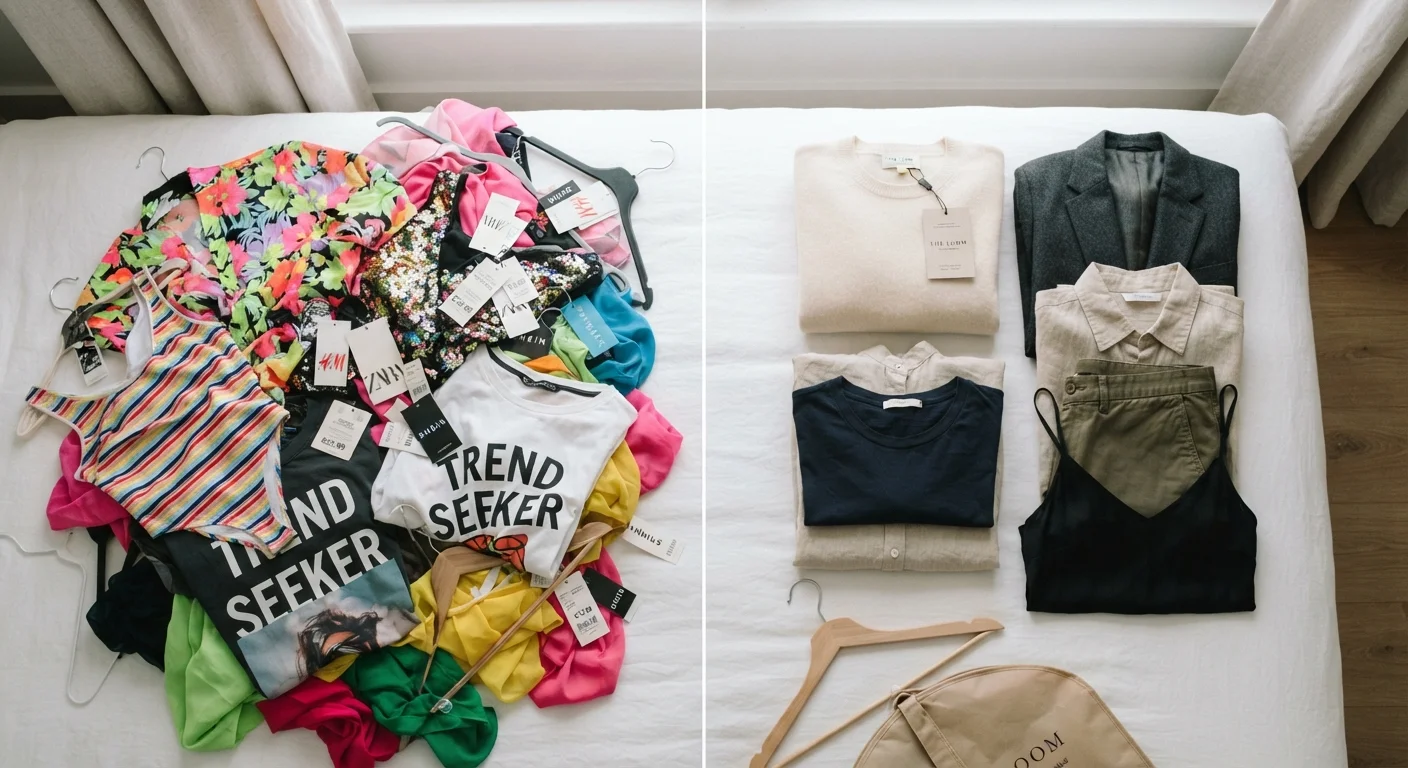
Option A
Fast Fashion
The high-volume, trend-first production model.
Best for: Shoppers seeking immediate access to current trends at accessible price points.
Option B
Slow Fashion
The intentional, quality-over-quantity alternative.
Best for: Consumers prioritizing garment longevity, ethical production, and reduced environmental impact.
Defining Fast Fashion: Speed, Volume, and the Trend Cycle
Fast fashion is a production and retail model built around one core idea: compress the time between a trend appearing on a runway or social media feed and that trend landing on a store shelf. Historically, fashion operated on two main seasonal collections per year. Fast fashion disrupted that rhythm dramatically — some major retailers now rotate new styles weekly or even more frequently.
The model depends on offshore manufacturing at scale, synthetic materials that keep per-unit costs low, and aggressive trend-tracking. The result is clothing priced accessibly enough that consumers treat it as nearly disposable — buying more, wearing items fewer times, and discarding them quickly as the next wave arrives.
The environmental consequences are well-documented in aggregate. Textile waste, water consumption in dyeing processes, and microplastic shedding from synthetic fabrics are among the frequently cited concerns. For a deeper look at what clothes are actually made of and why it matters, see this guide to fabrics shaping American fashion.
| Criterion | Fast Fashion | Slow Fashion |
|---|---|---|
| Production speed | Weeks from trend to shelf | Longer development timelines |
| Price per item | Generally lower upfront | Often higher upfront |
| Garment lifespan | Shorter — designed for trend cycles | Longer — designed for durability |
| Supply chain transparency | Typically limited | Central to the philosophy |
| Environmental emphasis | Lower priority in production model | Core consideration |
| Labor practices focus | Cost-minimization driven | Ethical wages and conditions emphasized |
| Trend responsiveness | Extremely high | Lower — favors classic styles |
Defining Slow Fashion: Intention, Quality, and Supply Chain Awareness
Slow fashion emerged as a direct counterpoint to the fast model. The term, popularized in fashion criticism in the mid-2000s, borrows the spirit of the slow food movement: favor quality, know where things come from, and resist the pressure to consume at an unsustainable pace.
In practice, slow fashion encompasses several overlapping ideas. It values garments designed to last — through better construction, quality natural or responsibly sourced materials, and classic silhouettes that don't read as dated after a single season. It also tends to center supply chain transparency, asking who made the garment and under what conditions.
Crucially, slow fashion is a philosophy rather than a price tier. Buying secondhand, repairing worn items, or simply buying less — regardless of where — all fit within its framework. That said, thoughtfully produced new clothing often carries a higher retail price, which is a real access consideration worth acknowledging honestly.
"Slow Fashion" Has No Legal Definition
The term slow fashion is not regulated or certified by any official body in the United States or internationally. Any brand can use the language in marketing without meeting a defined standard. When evaluating claims, look for independently verified certifications rather than self-applied labels. Third-party organizations like the Fair Trade USA program or the Global Organic Textile Standard (GOTS) offer more verifiable benchmarks.
The overlap between slow fashion and adjacent concepts like capsule wardrobes is significant. Capsule wardrobe vs. trend-driven shopping explores how those shopping philosophies compare in practical terms.
What the Labels Don't Tell You
Neither "fast fashion" nor "slow fashion" is a regulated term. No governing body certifies a brand as one or the other, which means the labels function more as descriptors of philosophy and practice than as reliable consumer guides.
Greenwashing — the practice of marketing products as sustainable or ethical without substantive evidence — is a genuine challenge in this space. A brand may use slow-fashion language in its marketing while maintaining opaque supply chains or producing at volumes inconsistent with the philosophy. Consumers looking to evaluate claims more rigorously may find it useful to look for third-party certifications (such as Fair Trade or GOTS for organic textiles) rather than relying on brand self-description alone.
It's also worth noting that slow fashion is sometimes mischaracterized as automatically superior on every dimension. The reality is more nuanced — secondhand garments aren't always sustainably sourced, and natural fibers aren't automatically low-impact. Common misconceptions about sustainable fashion examines several of these widely repeated claims.
~10%
Global carbon emissions from fashion industry
The United Nations Environment Programme has estimated the fashion industry accounts for roughly 10% of annual global carbon emissions, making it one of the more resource-intensive consumer sectors.
3x
Increase in garments purchased per person since 2000
According to research cited by the Ellen MacArthur Foundation, consumers globally bought approximately three times as many garments in the mid-2010s compared to the year 2000.
~35%
Microplastics in oceans from synthetic textiles
The International Union for Conservation of Nature has estimated that synthetic textile washing contributes roughly 35% of microplastics released into the world's oceans.
For readers interested in how these production philosophies connect to broader aesthetic movements, quiet luxury vs. loud fashion offers relevant cultural context.
The content on this site is for informational purposes only and is not a substitute for professional advice. Always consult a qualified professional for guidance specific to your situation.