

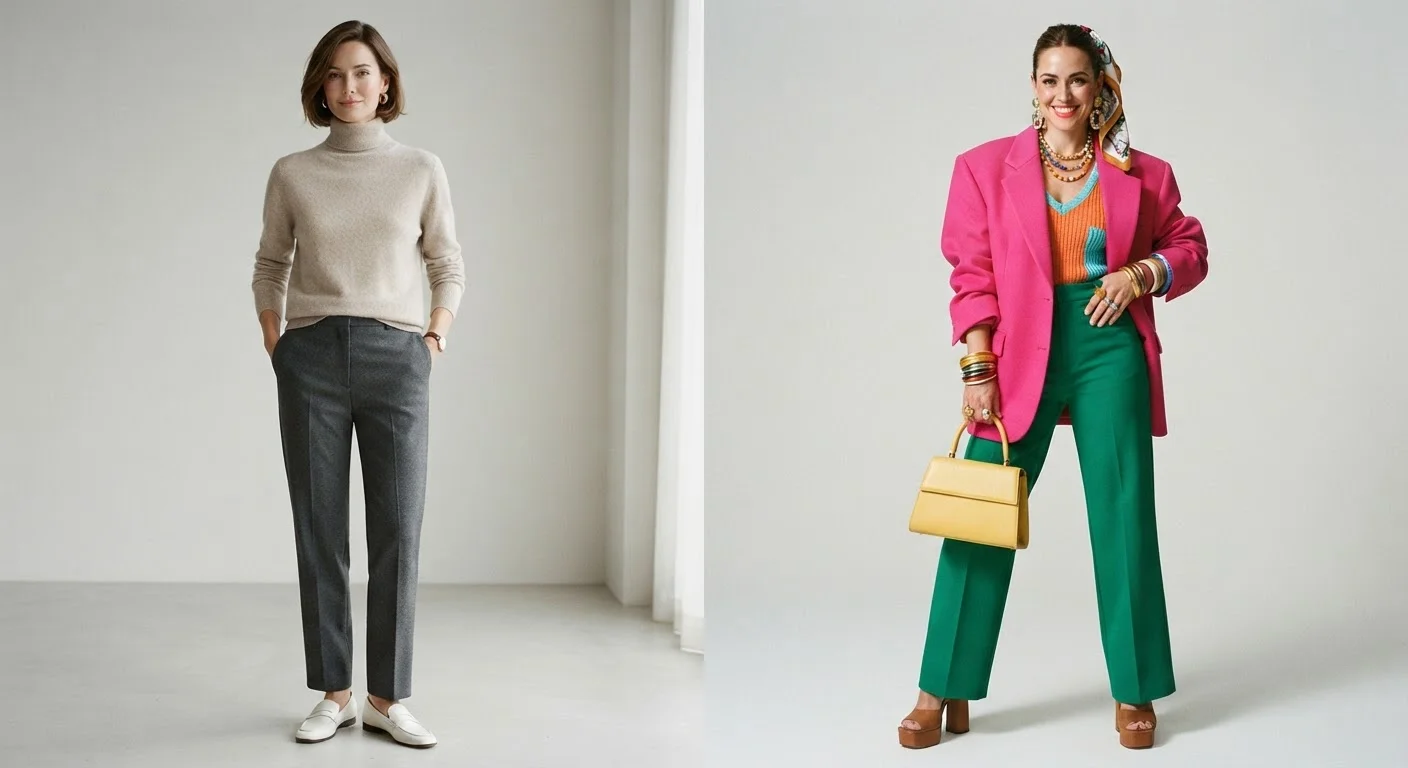
Option A
Quiet Luxury
The understated, status-through-subtlety aesthetic.
Best for: Those who gravitate toward timeless pieces, neutral palettes, and a less-is-more philosophy of dressing.
Option B
Loud Fashion
The maximalist, expressive, more-is-more movement.
Best for: Those who see clothing as a canvas for bold self-expression, cultural identity, and joyful excess.
What These Two Aesthetics Actually Mean
American fashion has always been a cultural barometer, and right now two competing philosophies are dominating closets, comment sections, and cultural conversations alike. Quiet luxury — sometimes called "stealth wealth" — leans into tonal dressing, impeccable tailoring, and a pointed absence of visible logos. Think cashmere in oatmeal, perfectly fitted trousers, and accessories that whisper rather than shout. The aesthetic gained enormous traction after television dramas like Succession made its muted palette feel aspirational.
Loud fashion, by contrast, is a broad umbrella covering maximalism, bold color-blocking, statement prints, and an embrace of visible branding — particularly within communities where conspicuous style has long served as a language of cultural pride and achievement. It draws from streetwear, Black American fashion traditions, Latinx style culture, and global youth movements. For many wearers, "loud" isn't about excess — it's about visibility, joy, and identity.
To explore quiet luxury in greater depth, see our full explainer on the quiet luxury aesthetic.
| Criterion | Quiet Luxury | Loud Fashion |
|---|---|---|
| Color palette | Neutrals, earth tones, monochrome | Bold, bright, pattern-mixed |
| Branding visibility | Minimal to none | Often prominent or celebrated |
| Core value | Restraint as sophistication | Visibility as identity |
| Cultural roots | Old-money European, prep traditions | Streetwear, Black & Latinx fashion culture |
| Social media presence | "Stealth wealth" aspirational content | Viral statement looks, community hauls |
| Wardrobe longevity | Emphasized as a core value | Varies; can embrace thrift and resale |
| Accessibility | Often higher price point for quality basics | Wide range from fast fashion to vintage |
The Cultural Stakes Behind the Style War
These aren't just wardrobe preferences — they're expressions of distinct worldviews. Quiet luxury, critics note, can carry an exclusionary undercurrent: its "effortless" neutrality often requires expensive basics that look plain precisely because they cost more to produce well. The aesthetic's appeal is, in part, that insiders recognize quality while outsiders may not notice anything at all. That invisibility can itself be a form of privilege.
Loud fashion pushes back against that framework. Many of its practitioners argue that dressing boldly — in maximalist prints, oversized silhouettes, or culturally resonant patterns — is a deliberate rejection of the idea that restraint equals sophistication. Style scholars and cultural critics have pointed to the deep roots of expressive dressing in communities that have historically used fashion as a form of resistance, celebration, and community-building.
A Note on Cultural Context
Describing fashion as "loud" or "quiet" carries inherited assumptions worth interrogating. Historically, expressive dressing in communities of color has sometimes been dismissed as excessive by mainstream fashion gatekeepers — even as those same aesthetics were later absorbed into high fashion. Both terms are used here descriptively, not hierarchically. Neither aesthetic is inherently superior; each reflects a distinct and valid relationship between personal style and cultural identity.
Social media has accelerated both movements simultaneously, which is part of what makes this moment so interesting. TikTok feeds can serve up quiet-luxury "get ready with me" videos and maximalist vintage hauls on the same scroll. The deinfluencing movement adds another layer: some creators are actively pushing back against trend consumption altogether, whether the trend in question is understated or maximalist.
Where Americans Are Landing — and Why It Matters
Most American wardrobes aren't fully committed to either camp. Surveys of consumer behavior and retail trend data consistently suggest that shoppers mix registers — pairing a quiet-luxury-coded blazer with a bold printed bag, or grounding a statement co-ord set with neutral footwear. The debate between capsule wardrobes and trend-driven shopping runs parallel to this one, and many of the same values are in play.
What matters culturally is that both aesthetics are active rejections of a previous norm. The quiet-luxury wearer is often pushing back against logo saturation and fast-fashion churn. The loud-fashion enthusiast is rejecting the idea that subdued equals elevated. Both positions carry a kind of intentionality — a sense that getting dressed is a statement worth making carefully, whether the statement is "I don't need to try hard" or "watch me shine."
The production ethics behind the clothing matter too. Neither aesthetic is automatically more sustainable — a cashmere wardrobe can still be wasteful, and maximalist secondhand dressing can be among the most responsible choices a consumer makes. For more on that angle, the secondhand style shift is worth exploring.
Fashion, ultimately, has always been a mirror. Right now, it's reflecting an America that is simultaneously tired of performing wealth and hungry to celebrate individuality — sometimes in the very same closet.
The content on this site is for informational purposes only and is not a substitute for professional advice. Always consult a qualified professional for guidance specific to your situation.