

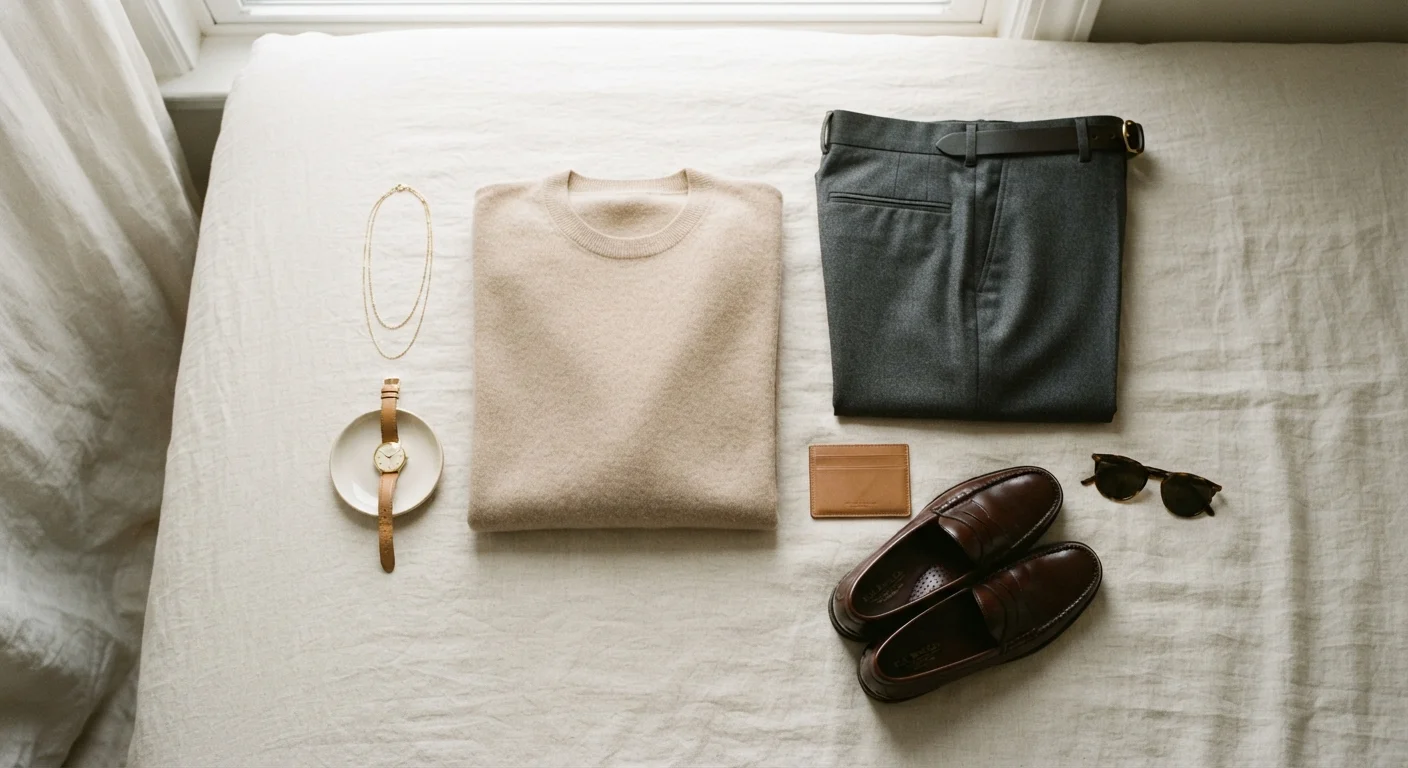
The Look and Its Logic
Walk into any American city's better-dressed neighborhoods today and you'll notice a shift: fewer statement logos, more quietly confident neutrals. Cashmere crewnecks. Perfectly cut trousers. Leather loafers that whisper rather than shout. This is quiet luxury in practice — a wardrobe philosophy that communicates taste through what it leaves out as much as what it puts in.
The core visual grammar is consistent: a muted palette anchored in camel, cream, ivory, navy, and soft grey; fabrics chosen for hand-feel and drape rather than sheen; and silhouettes that are tailored but never theatrical. Visible logos are largely absent. The clothing is meant to look as though it has always existed in the wearer's wardrobe — and perhaps it has.
“The most powerful thing a garment can do is make you forget you're wearing it. That invisibility — when clothes simply let a person exist — is the hardest thing to achieve and the most lasting.”
— Tim Gunn, Fashion consultant and educator, known for decades of commentary on American style
This restraint is intentional. Where earlier luxury fashion cycles rewarded visibility — bold monograms, loud color-blocking, instantly recognizable prints — quiet luxury inverts the logic. Knowing the difference between good cloth and great cloth becomes the private signal, one visible only to others who share that knowledge.
How It Went Mainstream
The aesthetic has long-standing precedents — think of the pared-back elegance associated with certain American prep traditions or the European sensibility of buying fewer, better things. But quiet luxury's recent cultural moment is more specific. Prestige television in the early 2020s put characters dressed in understated, wealth-coded clothing in front of enormous audiences, making the visual language widely legible. Social media accelerated the spread, with creators dissecting 'stealth wealth' and 'old money' dressing frame by frame.
67%
Shoppers prioritizing quality over quantity
A 2023 McKinsey & Company survey found that a majority of consumers reported intention to buy fewer, higher-quality items — a preference aligned with quiet luxury values.
Top 10
Fashion search trends featuring 'quiet luxury'
Google Trends data from 2023 showed 'quiet luxury' among the fastest-rising fashion search terms in the United States, reflecting its rapid shift from insider vocabulary to mainstream awareness.
3x
Growth in 'stealth wealth' fashion content
Social listening analyses from fashion analytics platforms tracked roughly a threefold increase in 'stealth wealth' and 'old money aesthetic' content across major social platforms between 2021 and 2023.
The timing mattered. Following years of maximalism — oversized streetwear branding, neon logomania — a quieter countermovement had natural appeal. For some consumers, it represented a deliberate step away from the visibility contest that fashion had become. For others, it simply felt more grown-up, more versatile, more wearable across the contexts of modern life.
It also coincided with broader conversations about how Americans think about consumption. The rise of resale culture and intentional buying — explored in depth in pieces like the resale shift in American fashion — created an audience already primed to value longevity over novelty.
Quiet Luxury and the Capsule Wardrobe Connection
Quiet luxury and capsule wardrobe thinking are distinct concepts, but they share important values. Both treat clothing as a long-term investment rather than a disposable seasonal experiment. Both favor versatile pieces that work across multiple contexts. And both push back, in different ways, against the churn of fast fashion trend cycles.
The key difference: a capsule wardrobe is a practical strategy for organizing what you own, while quiet luxury is an aesthetic sensibility about how things should look and feel. You can build a capsule wardrobe in bright prints; you can dress in quiet luxury without keeping your wardrobe lean. But in practice, the two philosophies often produce similar outcomes — a smaller, more intentional closet. Comparing capsule and trend-driven approaches shows how these mindsets play out in real shopping decisions.
Quiet luxury also intersects with the broader rethinking of ownership that's reshaping American fashion. How Americans are rethinking what they own traces a wider shift toward quality-over-quantity thinking that quiet luxury fits neatly within.
The Critiques Worth Knowing
Quiet luxury isn't without its tensions. Critics point out that the aesthetic, despite its visual modesty, is often built on the assumption of significant spending power — that 'effortless' refinement is effortless precisely because it's expensive. When the look is positioned as the pinnacle of taste, it can quietly encode class hierarchies as style wisdom.
There's also a question of individuality. An aesthetic defined by restraint and neutrality can flatten personal expression, producing a kind of conformity that's just as rigid as any logo-heavy trend — only less obviously so. The tension between quiet luxury and louder fashion movements explores how these competing sensibilities reflect deeper questions about identity and self-presentation.
And the gender dimensions are worth noting. Quiet luxury has been applied broadly, but its visual codes often draw heavily from traditional menswear tailoring traditions. As clothing categories evolve — a shift gender-neutral fashion trends are reshaping — the aesthetic is being reinterpreted in more expansive ways.
None of this makes quiet luxury invalid as a personal style choice. But understanding these critiques helps clarify what the trend is actually doing culturally, and why it resonates so differently with different people.
Frequently Asked Questions
Quiet luxury is a style philosophy that emphasizes understated, high-quality clothing with minimal branding. Think neutral tones, refined fabrics, and timeless cuts rather than statement logos or trend-driven pieces. The goal is to project elegance through restraint.
The aesthetic has roots in old-money dressing traditions but gained fresh cultural energy in the early 2020s. Prestige TV shows featuring wealthy characters in understated wardrobes, along with social media accounts dedicated to 'stealth wealth' dressing, helped push it into mainstream awareness.
Not necessarily. The aesthetic is as much about editing and intention as it is about price tags. Choosing well-fitting, neutral basics in quality fabrics — whether from heritage brands or budget-friendly sources — captures the spirit of the look.
A capsule wardrobe is a practical wardrobe-building strategy focused on versatility and fewer pieces. Quiet luxury is an aesthetic sensibility. The two often overlap — capsule thinking naturally favors the kind of timeless, minimal pieces quiet luxury prizes — but they are distinct concepts.
Fashion cycles quickly, but quiet luxury's emphasis on quality and longevity works against rapid obsolescence. While the term itself may fade as a trending hashtag, the underlying preference for refined basics has historically proven durable across decades.
Neutral earth tones — camel, cream, navy, grey, and white — dominate the palette. Preferred fabrics include cashmere, merino wool, fine linen, supple leather, and silk. The emphasis is on materials that look and feel refined without announcing themselves loudly.
The content on this site is for informational purposes only and is not a substitute for professional advice. Always consult a qualified professional for guidance specific to your situation.