

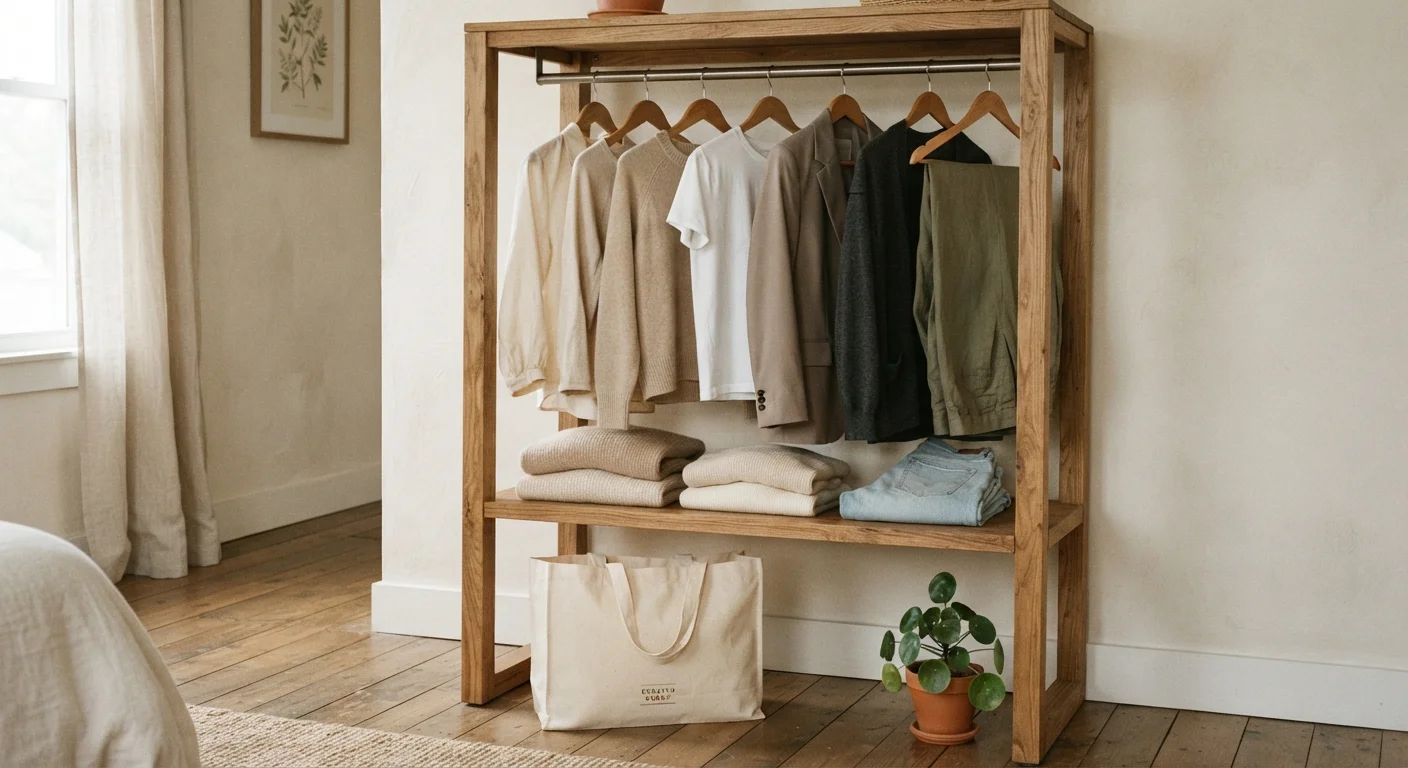
A New Relationship With the Closet
Americans are quietly renegotiating their relationship with clothing ownership. After decades of fast fashion conditioning — more, cheaper, faster — a visible countermovement has taken hold. It isn't one unified philosophy; it's a cluster of overlapping behaviors: shopping secondhand, renting for occasions, building smaller but more intentional wardrobes. What they share is a skepticism toward the old default of buying new and storing indefinitely.
This shift shows up in how people talk about getting dressed, in the growth of resale platforms, and in the renewed interest in wardrobe fundamentals. It also connects to broader lifestyle reconsiderations — about space, spending, and what accumulation actually buys. For more on how the thrift and resale shift is reshaping American fashion, the cultural and economic forces at play run deeper than any single trend cycle. Here's a closer look at the key approaches and what each one actually involves.
Start with What You Already Own
Before exploring rental subscriptions or secondhand platforms, a closet audit often reveals items you already have but forgot about — effectively expanding your wardrobe for free. Tracking what you actually wear over a few weeks can clarify which gaps are genuine and which are impulse-driven. This inventory step makes any subsequent purchases, rentals, or swaps more intentional.
Six Ways Americans Are Rethinking What They Own
Resale Figures Vary by Source
Market size estimates for secondhand and rental clothing vary depending on the methodology used — some include peer-to-peer sales, others focus on organized retail. When evaluating industry claims about growth, it helps to note who commissioned the research, as platform-sponsored reports may use broader definitions. Independent academic and trade analyses tend to offer a more conservative baseline.
Secondhand shopping has gone fully mainstream
What was once associated with budget necessity or niche vintage hunting now occupies prime digital real estate. Resale platforms have grown rapidly over the past decade, drawing in shoppers who are just as motivated by value and uniqueness as by any environmental consideration. According to data published by resale platform ThredUp in its annual Resale Report, the U.S. secondhand market has been growing significantly faster than the broader apparel sector.
The appeal is layered: buyers find items at a fraction of original retail price, sellers recoup some cost from clothes they no longer wear, and the whole exchange sidesteps new production. That said, not all secondhand purchases are automatically greener — shipping, packaging, and repeat browsing all carry their own footprints. The category has diversified too, from luxury consignment to peer-to-peer app sales to large-scale thrift chains.
Resale platforms have grown far faster than the broader U.S. apparel market.
Clothing rental lets people access without owning
Renting clothing — particularly for weddings, galas, and other occasions that demand a one-time look — has become a more structured marketplace. Subscription-based rental services allow members to rotate through garments on a seasonal or as-needed basis, avoiding the wardrobe pileup that often follows a single-use purchase. The model mirrors shifts seen in other consumption categories: access over ownership, experience over accumulation.
The trade-offs are real, though. Fit and condition can vary, and the logistics of returning items on time add friction. Rental also makes less sense for everyday basics that get heavy use. Where it genuinely shines is in reducing the purchase of items worn once and rarely touched again — a pattern many closets quietly document. This idea of access-over-ownership echoes broader renting vs. owning debates happening across American life.
Rental makes the most sense for high-cost, low-frequency occasion wear.
Capsule wardrobes turn restraint into a strategy
A capsule wardrobe — typically defined as a small, intentional collection of versatile, high-quality pieces that work together — flips the default shopping script. Rather than accumulating items and editing later, capsule thinking starts with deliberate selection. The concept, popularized decades ago in retail circles, has found renewed energy alongside minimalist lifestyle movements and a growing fatigue with disposable fashion.
Done well, a capsule wardrobe reduces decision fatigue, stretches the cost-per-wear value of each piece, and eases the closet clutter that accumulates through impulse buying. Done poorly, it can become an excuse to spend heavily on "investment pieces" without a clear plan. The contrast between capsule thinking and trend-driven shopping is genuinely philosophical, not just practical.
A capsule wardrobe succeeds through deliberate selection, not just owning fewer things.
The environmental picture is more complicated than the marketing
All three approaches — secondhand, rental, and capsule — are frequently framed as environmentally responsible choices, and each can be. But the picture is rarely as clean as promotional messaging suggests. Secondhand shipping generates emissions. Rental services dry-clean garments repeatedly using industrial chemicals. Capsule wardrobes sometimes push buyers toward higher-end materials whose production chains are not necessarily transparent.
Researchers studying textile and fashion sustainability consistently note that the most impactful single action is simply buying and discarding less overall — regardless of method. Understanding what clothes are actually made of is a useful first step, since fiber type affects durability, washability, and end-of-life disposal significantly.
Buying and discarding less overall remains the most meaningful environmental lever.
Identity and self-expression are still driving decisions
Amid all the practical reasoning, fashion remains personal. The rise of secondhand hasn't dampened style experimentation — if anything, thrift and resale have expanded access to a wider range of aesthetics at lower financial risk. Rental opens the door to wearing pieces that might never make sense as permanent purchases. Capsule thinking, meanwhile, often aligns with identity clarity: knowing what you like and ignoring what you don't.
These shifts don't exist in a vacuum. They intersect with conversations about how Americans use clothing to signal identity, about gender and self-presentation, and about what "enough" looks like in a consumer culture that has long defined success partly through accumulation. The wardrobe, it turns out, is never just about clothes.
Secondhand and rental have expanded access to style experimentation without the full financial commitment.
Mixing all three approaches is increasingly common
Few people who rent a dress for a wedding also live by a strict ten-piece capsule wardrobe and source every item secondhand. In practice, many Americans now move fluidly between approaches depending on the occasion, budget, and item category. Everyday basics might come from a carefully maintained core wardrobe; occasion wear might be rented; vintage finds might supplement the rest.
This hybrid model reflects how consumer behavior actually works: values-driven in broad strokes, pragmatic in the details. Building a wardrobe that survives trend cycles doesn't require committing to one philosophy wholesale — it requires knowing which principles actually serve your real life, your storage space, and your budget.
Most Americans now blend secondhand, rental, and intentional buying rather than following one strict model.
The Bigger Picture
Taken together, these shifts suggest that the default relationship between Americans and their wardrobes is genuinely changing — even if the pace varies widely by income, geography, and personal priority. The conversation has moved well beyond sustainability buzzwords into practical questions about what ownership actually costs in time, money, and space.
None of these approaches is frictionless, and none is a perfect solution to the environmental pressures the fashion industry generates. But each represents a different way of asking the same underlying question: what do I actually need, and what am I just holding onto out of habit? That question, once asked seriously, tends to produce more deliberate answers — and occasionally a much lighter closet. For readers curious about how wardrobe decisions can outlast shifting trend cycles, the principles behind each approach offer a useful starting framework.
The content on this site is for informational purposes only and is not a substitute for professional advice. Always consult a qualified professional for guidance specific to your situation.