

Why Clothing Categories Are Being Questioned
Walk through any American department store and the floor plan tells a familiar story: men's on one side, women's on the other, children's tucked somewhere in between. This layout has organized retail for over a century. What's new is a growing number of designers, shoppers, and retailers openly asking whether that division still makes sense — or whether it ever fully did.
The push to rethink clothing categories isn't simply a fashion trend. It reflects a broader cultural conversation about how gender identity is understood and expressed in everyday American life. For many shoppers — especially younger ones — the idea that a blazer or a pair of trousers carries a mandatory gender assignment feels increasingly arbitrary. This sentiment is reshaping how some brands design, market, and sell clothes.
The movement also connects to other shifts in how Americans approach their wardrobes. The resale and thrift culture explored in our look at secondhand style has made gender-fluid dressing easier by default — when you're browsing by item rather than department, binary labels matter less.
56%
Gen Z shoppers open to gender-neutral clothing
A 2019 Barneys New York survey found that 56% of Gen Z respondents said they shopped outside their assigned gender section at least occasionally.
$3.5B+
Estimated U.S. gender-neutral apparel market value
Industry analysts at Global Industry Analysts have projected substantial growth in gender-inclusive apparel as consumer interest and retail investment expand.
2
Decades of runway gender-fluid experimentation
American and European designers have been presenting gender-fluid collections on major runways since at least the early 2000s, with mainstream retail adoption accelerating after 2015.
What Gender-Neutral Design Actually Looks Like
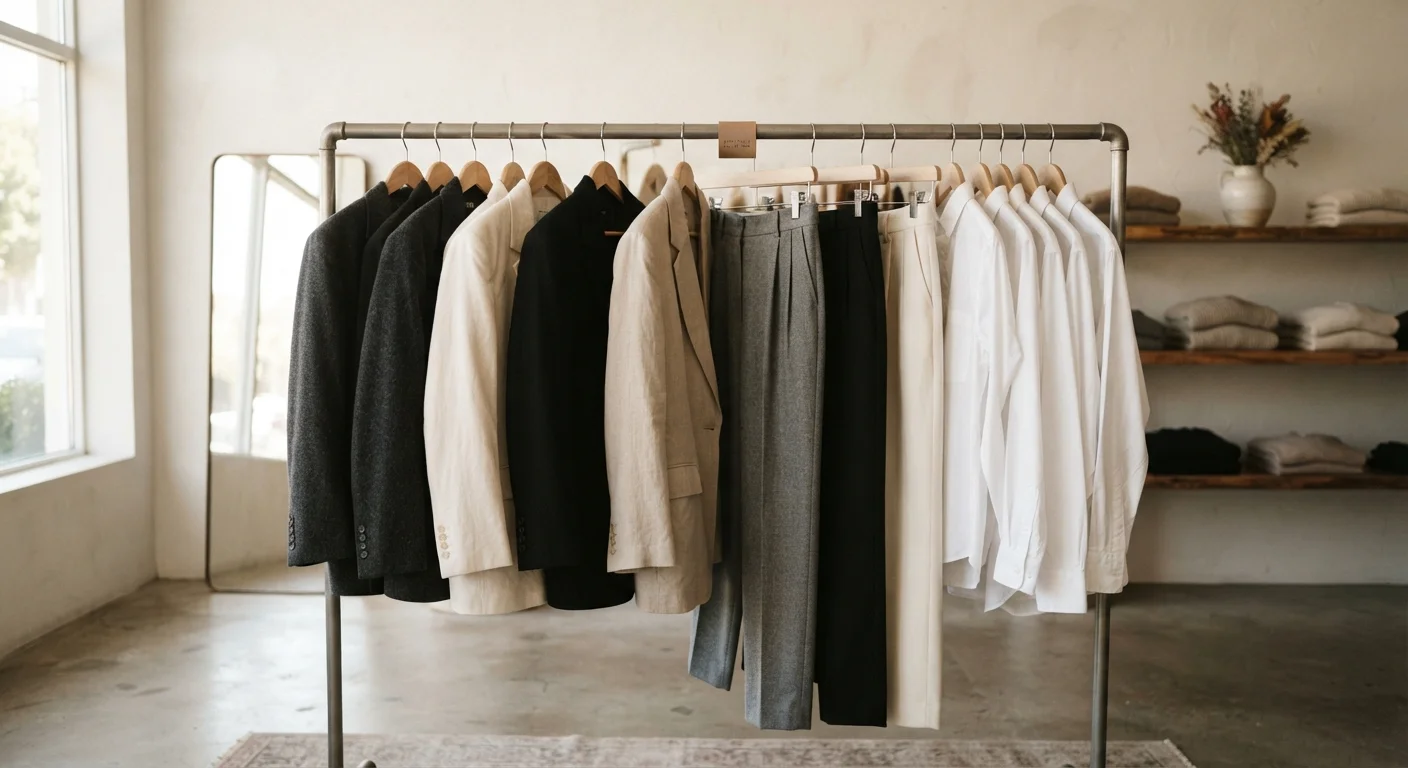
Gender-neutral fashion isn't one aesthetic. It can look like an oversized linen blazer with no defined waist, a straight-leg trouser cut to fit a range of hip-to-waist ratios, or a simple crewneck sweater sized on a numeric rather than gendered scale. The common thread is that the garment doesn't signal a target wearer based on gender — it signals a silhouette, a material, a function.
Some designers approach this by stripping away decoration associated with femininity or masculinity. Others focus on proportions — creating roomier cuts that don't assume a specific body shape. Fabric choice matters too; materials like performance blends and natural fibers appear frequently in gender-neutral lines because they prioritize comfort and versatility over silhouette-shaping.
Sizing is one of the stickiest challenges. Traditional gendered sizing systems were built on different measurement assumptions for men's and women's bodies. Gender-neutral lines have approached this variously — some use waist measurements, some use simple alphabetical sizing, and some offer detailed fit guides. No single solution has emerged as standard, which remains a practical friction point for shoppers.
How American Retail Is Responding
The retail response to gender-neutral fashion has been uneven, ranging from genuine structural changes to surface-level marketing. Some stores have merged sections or removed gendered signage. Others have launched dedicated gender-inclusive collections as standalone capsules rather than integrating them into the main floor.
The shift is most visible in certain categories. Loungewear, outerwear, and basics have proved more adaptable to gender-neutral presentation than tailored or formal wear, where fit expectations remain more entrenched. Streetwear — a movement that has long blurred gendered boundaries — has been particularly influential. Streetwear's journey into mainstream American fashion helped normalize oversized silhouettes and cross-category dressing long before gender-neutral became a headline.
Younger consumers are a significant force here. Surveys conducted by various market research firms have consistently found that Gen Z shoppers are more likely than older generations to buy clothing marketed outside traditional gender categories — and more likely to say that a garment's gender label influences their perception of it negatively. This demographic reality gives retailers a commercial reason, beyond the cultural one, to experiment.
For a wider view of how clothing norms are evolving, this overview of gender-neutral wardrobe trends traces the cultural forces at work.
Shopping Gender-Neutral Lines: What to Look For
When exploring gender-neutral clothing, focus on measurement-based sizing guides rather than S/M/L defaults, which can vary widely between brands. Look for garment descriptions that emphasize fit type (relaxed, tailored, oversized) rather than body type. Many gender-neutral pieces are designed with slightly more fabric through the hip and shoulder to accommodate varied proportions, so checking brand-specific measurements is more reliable than guessing from a label.
What This Means for Everyday Shoppers
For most American consumers, gender-neutral fashion doesn't require a philosophical commitment — it's often just practical. A person who wants a well-made, relaxed-fit shirt that comes in their measurements rather than a gendered cut benefits directly from the expansion of these lines. So does anyone who has ever found that clothing marketed to their gender simply didn't fit their body well.
The trend also connects naturally to the growing interest in smaller, more intentional wardrobes. When clothes aren't divided by gender, they can more easily be shared, borrowed, or restyled. Capsule wardrobe thinking and gender-neutral design share an underlying logic: fewer, more versatile pieces that work across more contexts.
It's also worth noting that gender-neutral fashion exists alongside, not instead of, other approaches to style. It's one strand in a diverse fashion landscape that simultaneously includes maximalist expression and the refined restraint of quiet luxury aesthetics. American wardrobes have always been eclectic, and the expansion of gender-neutral options adds to that range rather than replacing anything.
The clearest takeaway for shoppers: the question isn't whether to adopt a label, but whether a garment fits, functions, and feels right. That, after all, is how most people have always made clothing decisions — the industry is simply catching up.
Frequently Asked Questions
Unisex clothing traditionally meant adapting a standard (often masculine) cut for all wearers. Gender-neutral design starts without a gendered template, often rethinking proportions, sizing, and silhouette from scratch to accommodate a wider range of bodies.
Not at all. Gender-neutral clothing is worn by people across the entire gender spectrum, including those who simply prefer relaxed fits or aren't interested in clothing marketed along binary lines. It's about design flexibility, not a single identity.
Sizing in gender-neutral lines varies widely by brand. Some use numeric sizing (28, 30, 32 waist), others use simple XS–XXL scales, and some are experimenting with measurement-based systems. There isn't yet a universal industry standard.
Several major retailers have introduced gender-neutral or gender-inclusive sections, either as dedicated floors or integrated racks. The approach differs significantly from store to store, and the trend continues to evolve in mainstream retail.
Price varies as widely as in any clothing category. Some gender-neutral lines are positioned as premium, while thrift and resale markets have made gender-inclusive secondhand clothing widely accessible at lower price points.
Its roots stretch back decades — from androgynous 1970s rock culture to Japanese avant-garde design in the 1980s. The contemporary American version accelerated significantly in the 2010s alongside cultural conversations about gender identity and expression.
The content on this site is for informational purposes only and is not a substitute for professional advice. Always consult a qualified professional for guidance specific to your situation.