

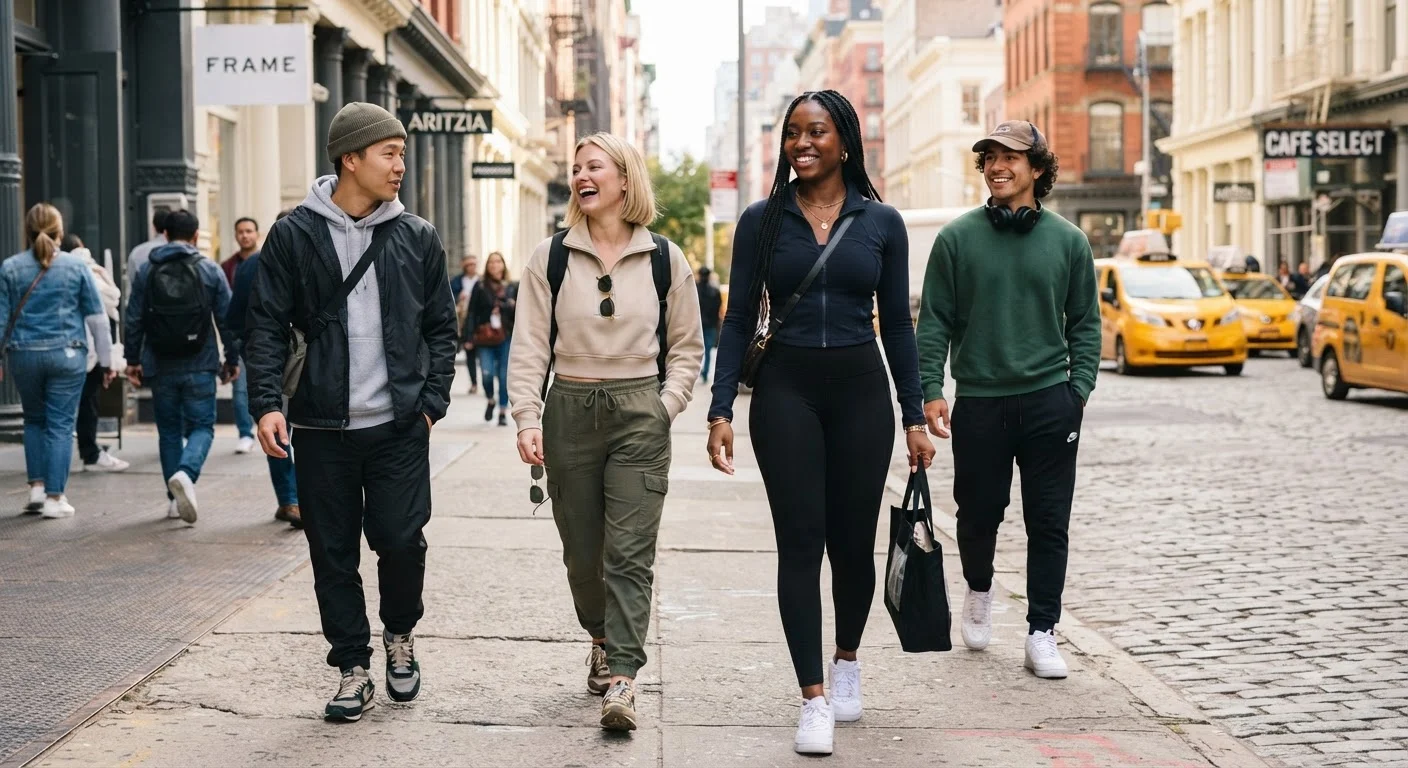
What Athleisure Actually Means
Athleisure is a portmanteau that gets thrown around a lot, but it has a specific meaning worth pinning down. At its core, athleisure describes garments engineered for physical activity that people wear comfortably and intentionally outside athletic contexts — at coffee shops, on errands, at dinner, or at the office. Think fitted leggings paired with a blazer, jogger pants worn with leather sneakers, or a zip-up hoodie layered over a dress.
What separates athleisure from simply wearing gym clothes in public is intentionality. Athleisure pieces are designed with both performance and aesthetics in mind. They carry the moisture-wicking, four-way-stretch, odor-resistant properties of sportswear but are cut and styled to read as a complete outfit rather than an afterthought. That dual purpose — functional and presentable — is what gave the category its staying power.
For a deeper look at the materials making this dual purpose possible, see our guide to performance fabrics shaping American fashion.
How the Category Took Hold
The early 2010s marked athleisure's breakout moment in the American mainstream. Wellness culture was surging, boutique fitness studios were multiplying across cities, and the idea of an active lifestyle was becoming a social signifier as much as a health choice. Wearing activewear signaled a life organized around movement — and people wanted that signal visible beyond the spin class.
By mid-decade, athletic silhouettes had migrated fully into non-gym settings. Retailers and designers responded quickly, blurring the distinction between sportswear and casual clothing at every price tier. The trend aligned naturally with streetwear's rise as a mainstream fashion force, which was simultaneously pulling high-fashion aesthetics toward casual and utilitarian references.
$662B
Global activewear market projected value
Industry analysts have projected the global activewear market to approach or exceed $662 billion by the early 2030s, reflecting sustained demand growth.
79%
Americans who wear athletic clothing outside exercise
A survey by the NPD Group found a large majority of American consumers regularly wear athletic or activewear in non-exercise settings.
Top 3
Athleisure among fastest-growing U.S. apparel segments
Market analysts have consistently ranked athleisure among the fastest-growing segments of the U.S. apparel industry over the past decade.
Then the pandemic arrived in 2020 and compressed years of gradual adoption into months. With remote work eliminating workplace dress codes overnight, Americans dressed almost exclusively for comfort. Sweatpants, leggings, and hoodies became daily staples for tens of millions of people — and those habits didn't simply dissolve when offices reopened.
The Cultural Forces Behind the Shift
Athleisure didn't rise in a vacuum. Several overlapping cultural currents made the soil fertile. Wellness became a dominant American aspiration in the 2010s, with fitness tracking, yoga, and clean eating all ascending as mainstream lifestyle markers. Dressing in athletic clothing reinforced a self-image tied to health and vitality, even for people who weren't heading to a workout.
Social media accelerated the aesthetic. Fitness influencers and lifestyle accounts showed athleisure styled in aspirational everyday settings — not just in the gym but in cities, on travel, at brunch. The visual language of looking effortlessly active became broadly desirable, and the clothing category that communicated it grew accordingly. Sports fandom also contributed, weaving team colors and athletic silhouettes deeper into everyday American identity — a connection explored in how sports fandom shapes American culture.
Anchor athleisure outfits with one structured element — a tailored jacket, leather belt, or structured bag — to signal intentionality and broaden where the look reads as appropriate.
Styling studies and fashion editorial consensus consistently show that contrast between relaxed and structured pieces elevates an outfit's perceived polish without sacrificing comfort.
When building an athleisure-forward wardrobe, prioritize neutral base pieces in consistent tones — charcoal, navy, olive, stone — so athletic silhouettes mix freely with whatever else you own.
Versatility is athleisure's core promise; a cohesive color palette maximizes the number of functional outfits without requiring a large closet.
Generational dynamics played a role too. Millennials and Gen Z have consistently favored comfort and versatility over formality, and they brought those preferences into adulthood and eventually into professional life, nudging workplace norms along the way.
Athleisure Meets the Workplace
The office has been a contested frontier for athleisure. For a stretch, particularly during peak remote-work years, the category dominated what people wore to video calls — but the return to in-person work introduced real friction. Some employers pushed back toward structured dress expectations, a tension documented in the ongoing reinvention of post-pandemic office dressing.
What emerged, however, wasn't a full retreat from athleisure — it was hybridization. Tailored joggers in neutral fabrics, sleek pull-on trousers with stretch waistbands, and structured bomber jackets now navigate the gap between athletic and professional. Many workplaces have quietly updated their expectations to accommodate the reality of how their employees actually want to dress, particularly in tech, creative, and healthcare sectors.
The office-athleisure negotiation is still playing out, and its resolution will likely look different by industry, city, and company culture. What seems clear is that full formality — the rigid suit-and-tie standard — is unlikely to reclaim the ground it has lost.
Fabric Innovation as a Driver
Much of athleisure's credibility as a legitimate wardrobe category rests on what the clothes are actually made of. Performance fabric technology has evolved dramatically over the past two decades. Materials engineered for athletic use — four-way stretch blends, moisture-management finishes, brushed interior fleeces — deliver genuine comfort advantages over traditional casual fabrics like raw cotton or rigid denim.
These properties translate directly to all-day wearability. A pair of joggers in a ponte-knit or recycled polyester blend doesn't wrinkle through a workday, moves freely on a commute, and requires minimal care between wears. That functional case is hard to argue with, and it has persuaded consumers who might otherwise resist the aesthetic shift.
Sustainability has also entered the conversation. Many athleisure producers have incorporated recycled materials into their supply chains, responding to consumer interest in lower-impact clothing. This intersection of performance and environmental consideration connects athleisure to broader shifts in how Americans think about what their clothes are made of — a topic covered in depth in our guide to fabrics shaping American fashion.
Where Athleisure Is Heading
Athleisure has cleared its most important hurdle: it is no longer a trend to be evaluated — it is a baseline category in American dress. The question is no longer whether it belongs in the wardrobe but how it continues to evolve within one.
Several directions look plausible. The crossover with more elevated and tailored aesthetics will likely deepen, producing pieces that are indistinguishable from traditional casual or even business-casual clothing in silhouette while retaining performance properties underneath. The secondhand and resale market is also intersecting with athleisure, as consumers look to extend the life of pricier performance pieces — a dynamic explored in the thrift and resale shift reshaping American fashion.
Meanwhile, the category will keep pushing into new settings — travel, formalwear adjacents, and occasion dressing — testing how far its elasticity (literally and figuratively) can stretch. Americans have made clear they won't trade comfort for convention without good reason. Athleisure, in its many evolving forms, is the wardrobe answer to that preference.
For those rethinking their entire clothing approach, capsule wardrobes and clothing ownership strategies offer frameworks that pair naturally with athleisure's versatility-first logic.
The content on this site is for informational purposes only and is not a substitute for professional advice. Always consult a qualified professional for guidance specific to your situation.