
What Changed — and What Didn't — When the Office Came Back
When American workers began trickling back to offices in 2021 and 2022, something felt different about the clothes they were reaching for. The stiff, formal separates of 2019 seemed oddly foreign. So did showing up in head-to-toe athleisure. What emerged in that gap was something genuinely new: a professional wardrobe shaped by years of working in sweats, finally negotiating terms with the outside world.
The pandemic didn't just change where Americans worked — it fundamentally reset expectations around physical comfort at work. Once people experienced the freedom of elastic waistbands and soft knits during long workdays, rigid suiting and pinching dress shoes lost significant ground. The fashion industry, tracking consumer sentiment closely, responded quickly.
Designers and mass-market labels alike began releasing structured pieces engineered for comfort — blazers cut with stretch fabric, trousers with wider legs and subtle elastic waistbands, and footwear that looked polished but felt more like a sneaker. The goal wasn't casualness; it was intentionality paired with ease. For the full context of how athleisure reshaped American dressing, it's worth understanding what it left behind — and what it changed permanently.
52%
U.S. hybrid workers among remote-capable employees
Gallup's State of the American Workplace research has consistently shown that roughly half of remote-capable U.S. employees work in hybrid arrangements.
~30%
Decline in formal menswear sales since 2019
Industry analysts have noted a significant contraction in traditional suiting and formal menswear as workplace dress codes relaxed following the pandemic.
2x
Growth in 'smart casual' apparel searches
Retail and search trend data from multiple platforms showed roughly doubled consumer interest in smart casual and elevated casual clothing categories beginning in 2022.
The Hybrid Schedule Effect on Getting Dressed
Hybrid work — splitting time between home and office — has become a dominant feature of American professional life. According to workplace research firm Gallup, a significant share of U.S. workers with desk jobs now work in hybrid arrangements. That scheduling reality has direct consequences for wardrobe decisions.
When someone commutes to the office two or three days a week rather than five, those in-person days carry more weight. Workers increasingly want to look and feel intentional when they show up. At the same time, they're less willing to endure full-day discomfort for the sake of appearances. The result is a deliberate curating of pieces that transition: structured enough for a client meeting, comfortable enough for a long commute and hours at a desk.
This also has a sustainability dimension. Many professionals are buying fewer, more versatile pieces rather than maintaining entirely separate wardrobes for home and office. See how Americans are broadly rethinking ownership in secondhand, rental, and capsule wardrobe trends.
Breaking Down the New Workwear Aesthetic
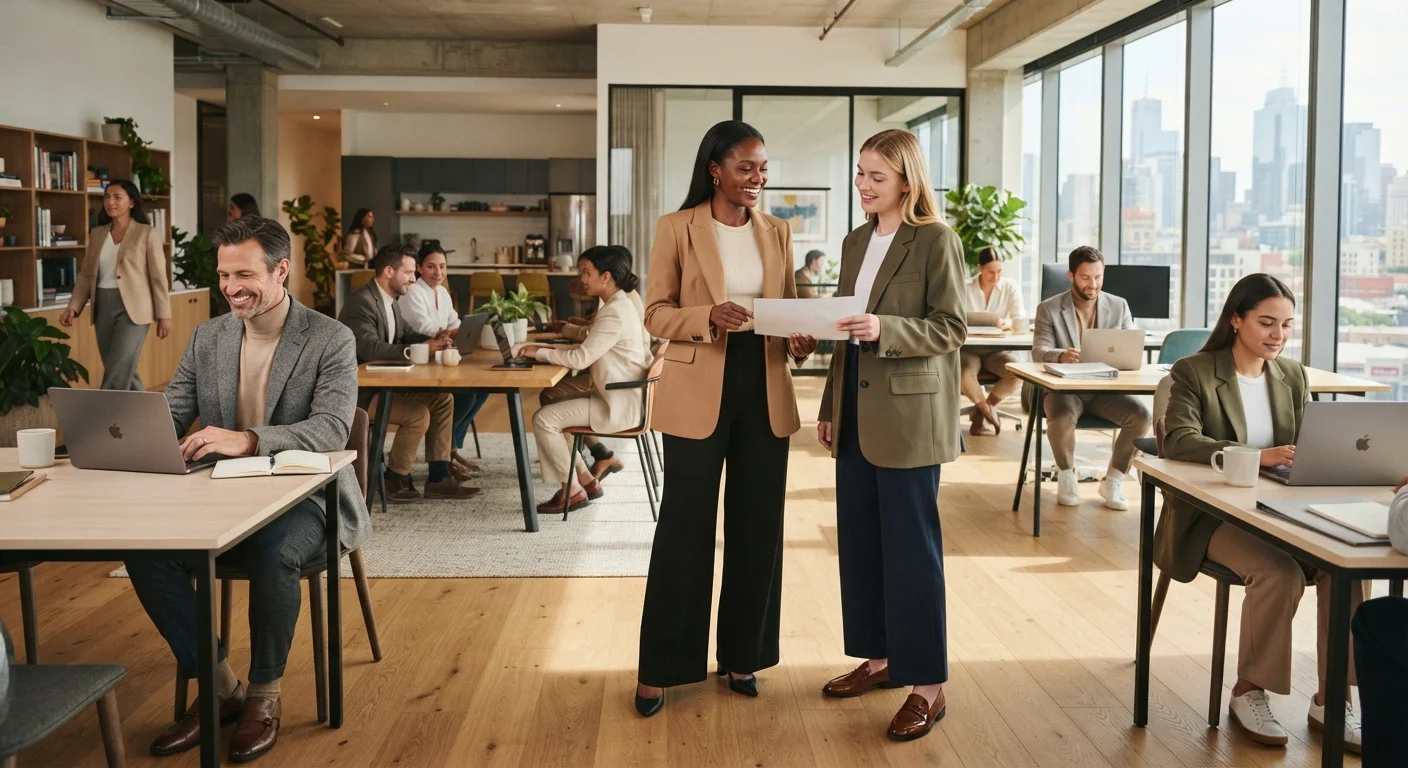
The visual identity of reinvented workwear sits somewhere between what a 2019 HR policy would recognize and what a fashion editor would call effortlessly composed. A few recurring elements define the look:
- Relaxed tailoring: Blazers remain central, but cuts are looser, fabrics are softer, and the overall silhouette has more room. Oversized blazers worn over simple knits or wide-leg trousers are a staple combination.
- Elevated basics: High-quality knit tops, structured turtlenecks, and clean-lined shirts replace the novelty blouses and power-shoulders of earlier eras.
- Wide-leg trousers: These have become the default work pant for many American women and increasingly for men, offering a polished look with significantly more comfort than slim or tapered cuts.
- Loafers and chunky flats: Footwear has tilted toward comfort-forward silhouettes that still read as deliberate and put-together.
- Monochromatic dressing: Head-to-toe tonal outfits — all camel, all charcoal, all ivory — signal style sophistication without requiring complex coordination.
Gender norms in professional dressing are also notably more fluid than a decade ago, a shift covered in depth in our look at the gender-neutral wardrobe. More workers across gender identities are choosing pieces from traditionally opposite categories, and many workplaces have moved toward appearance policies that accommodate this.
“The worker of today expects clothing to perform — to look sharp in a meeting and feel livable in for eight hours. That wasn't the design brief for most office fashion before 2020. It absolutely is now.”
— Fashion industry analyst, Retail and consumer trends commentator
Building a Work Wardrobe That Lasts Beyond the Trend
One of the more lasting lessons of the pandemic wardrobe reset is that fewer, better pieces serve most people better than a closet full of occasion-specific items. The reinvented workwear moment is as much about editing as it is about buying new things.
Investing in well-constructed basics — pieces that hold their shape, work in multiple contexts, and don't rely on a single trend for their relevance — remains the most practical approach for professionals who don't want to keep cycling through fashion moments. The principles behind building a wardrobe that survives trend cycles apply directly here: versatility, quality, and intentionality over novelty.
The home office transformation has also influenced how Americans think about dressing overall — the physical space of work changed, and clothing adapted alongside it. For a broader look at how remote work reshaped daily American life, the American home office five years on offers useful context.
What the post-pandemic wardrobe ultimately reflects is a recalibrated relationship between how Americans present themselves professionally and how they actually want to feel in their bodies throughout the workday. That negotiation — between appearance and comfort, structure and ease — is what makes reinvented workwear feel genuinely different from every prior cycle of office fashion.
This article is for informational and editorial purposes only and reflects general fashion and cultural trends rather than personalized style advice.
Frequently Asked Questions
Traditional business attire typically meant rigid rules — specific suiting, ties, and formal shoes. Reinvented workwear keeps the polish and intentionality of professional dress but prioritizes comfort-friendly fabrics, relaxed silhouettes, and personal expression. Structure is present, but it no longer demands discomfort.
It depends heavily on the workplace culture. Many industries that embraced athleisure during remote work are now signaling a return to more structured dressing for in-person days. However, comfort-driven details from athleisure — like stretch fabrics and relaxed fits — have been absorbed into mainstream office fashion.
Wide-leg trousers, tailored blazers in relaxed cuts, loafers, knit tops with structure, and monochromatic outfits are among the most visible elements. The goal is looking intentional and put-together without sacrificing ease of movement or all-day wearability.
Hybrid schedules mean professionals need clothing that reads as polished in meetings but remains comfortable throughout a full commute and workday. This has accelerated demand for pieces that look sharp without being stiff — versatile enough to work across multiple contexts.
Some industries — finance, law, client-facing roles — are reinforcing expectations around professional appearance. But a wholesale return to strict, top-down dress codes is not broadly observed across American office culture. Most workplaces are landing on 'polished casual' as the new baseline.
Focusing on versatile, high-quality basics — pieces that work together and span multiple occasions — is a practical approach. Secondhand shopping and clothing rentals are also increasingly popular options for extending a wardrobe without a large financial commitment.
The content on this site is for informational purposes only and is not a substitute for professional advice. Always consult a qualified professional for guidance specific to your situation.