

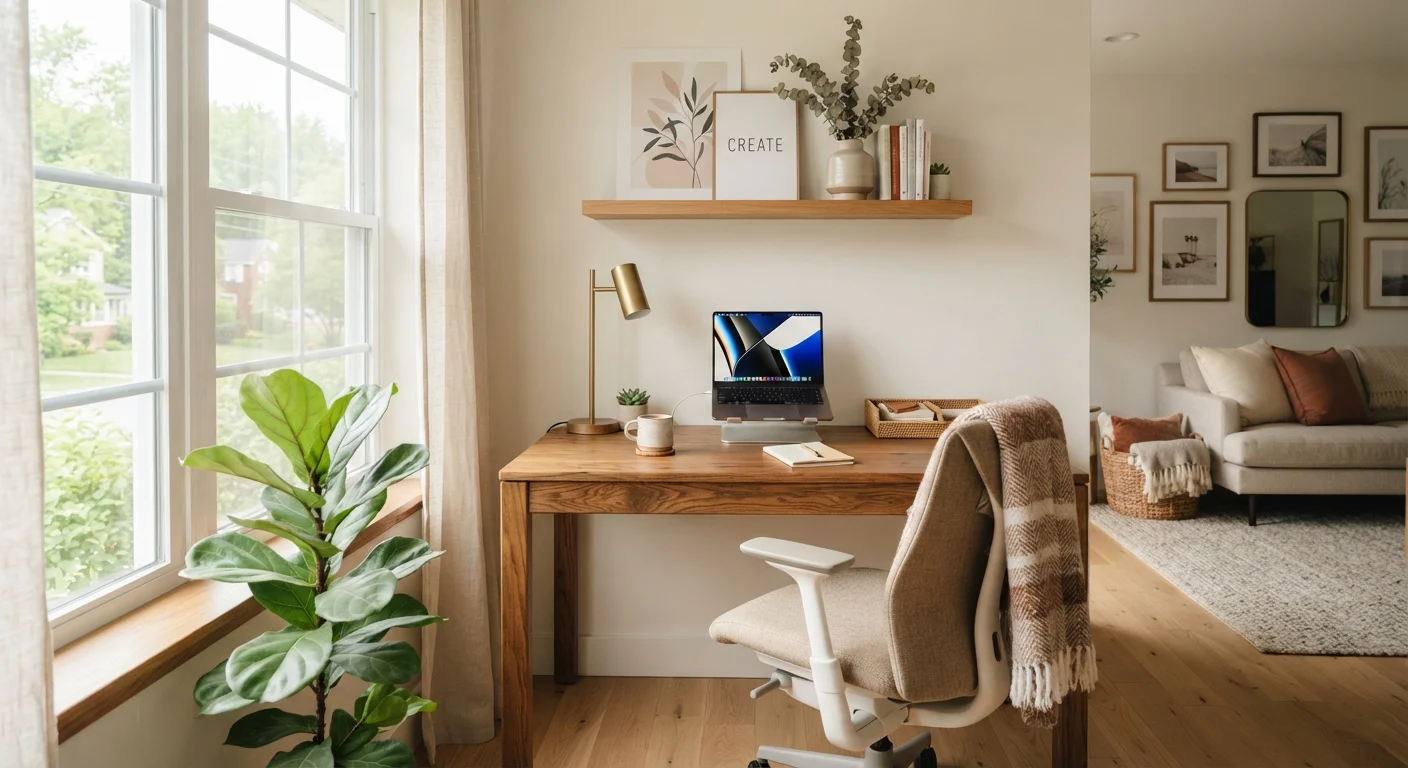
From Makeshift to Permanent: The Home Office Evolution
When millions of Americans were sent home to work in early 2020, the immediate response was improvisation — a laptop propped on a kitchen counter, a folding chair dragged in from the garage. Five years on, those stopgap solutions have been replaced by deliberate, often significant renovations. The home office is no longer an afterthought; it is a design category in its own right.
According to the U.S. Census Bureau's American Housing Survey and data from the Joint Center for Housing Studies at Harvard University, home improvement spending surged during the pandemic years and remained elevated afterward, with workspace upgrades among the most cited motivations for renovation. The shift is cultural as much as architectural: Americans have renegotiated their relationship with domestic space, and those negotiations have left lasting marks on floor plans, furniture markets, and neighborhood housing demand alike.
58%
Remote-capable workers with some WFH arrangement
A Gallup survey conducted in 2023 found that a majority of workers who can do their jobs remotely maintain at least a hybrid schedule.
$420B+
Annual U.S. home improvement spending (2022 peak)
The Joint Center for Housing Studies at Harvard University reported that U.S. home improvement spending reached historic highs in 2022, driven in part by workspace and livability upgrades.
#1
Home office: most-requested feature by homebuyers
The National Association of Realtors cited dedicated home office space as a top priority among buyers surveyed between 2021 and 2024.
Space Reallocation: What Rooms Became Offices
No single room bore the brunt of the home-office boom more than the guest bedroom. Interior designers and real estate agents across the country observed the same pattern: spare rooms that once hosted holiday visitors were cleared out, repainted, and furnished with desks and monitors. The National Association of Realtors has noted that dedicated home office space became a top-requested feature among homebuyers in surveys conducted between 2021 and 2024.
But bedrooms weren't the only casualties. Formal dining rooms — already declining in relevance for years — accelerated their transformation into dual-purpose or full-time work areas. Understairs storage, wide hallways, and even large closets were outfitted with built-in desks. Walk-in closets in particular gained a second life: fit out with a small monitor and proper lighting, they offer natural acoustic dampening ideal for video calls.
Treat acoustic control as your first renovation priority — not your last. A desk in a noisy, echo-prone room undermines every other upgrade you make to lighting or ergonomics.
Video call quality and concentration are both heavily affected by sound bleed and reverberation. Heavy curtains, bookshelves, and even a large area rug can dramatically reduce echo without major construction.
Position your primary monitor perpendicular to the nearest window rather than facing it or backing onto it. This eliminates glare and screen washout without sacrificing natural light.
Direct window light behind or in front of a screen creates contrast that strains vision over a full workday — a simple desk reorientation resolves most of these issues at zero cost.
Design Priorities That Stuck
Early pandemic home offices prioritized speed — whatever was available. The second wave, visible by 2021 and 2022, prioritized comfort and performance. Three design elements rose to the top of most wish lists: ergonomics, lighting, and acoustic management.
Ergonomic furniture — adjustable standing desks, lumbar-supporting chairs, monitor arms — moved from specialty office supply stores into mainstream home furnishing conversations. Natural light became a premium; workers who had spent years in fluorescent-lit cubicles suddenly had agency over their environment and chose windows, skylights, and daylight-balanced LED fixtures. Acoustic panels, cork walls, and heavy drapery addressed the echo and noise bleed that made video calls a daily frustration.
The broader lifestyle ripple is visible in fashion, too. As dress codes shifted alongside physical environments, Americans reconsidered what they owned and wore day to day — a trend explored further in our look at how Americans are rethinking what they own. Meanwhile, workwear itself is undergoing its own reinvention, as covered in the return of structured office dressing.
Wellness and the Work-From-Home Environment
The blurring of work and home life prompted a parallel conversation about wellness. Without a commute to serve as a transition ritual, many remote workers struggled to mentally separate professional and personal time. In response, home design began to incorporate deliberate decompression zones: reading nooks, yoga corners, and small meditation spaces began appearing in the same homes that had just gained a new office.
Research from institutions including Harvard T.H. Chan School of Public Health has highlighted the relationship between indoor environments — air quality, natural light, noise — and cognitive performance and mood. Houseplants surged in popularity not merely as decor but as perceived air-quality and well-being enhancers. Biophilic design (incorporating natural elements like wood, stone, and greenery into interiors) moved from architectural theory into mainstream renovation guides.
This article provides general lifestyle and design information. It is not professional health or medical advice. Consult a qualified healthcare provider for personal wellness concerns.
Don't Sacrifice Safety for Aesthetics
Home office electrical upgrades — adding outlets, running dedicated circuits for multiple monitors and standing-desk motors — should always be handled by a licensed electrician. Overloaded power strips and DIY wiring are among the leading causes of home electrical fires. When in doubt, consult a qualified professional before adding significant electrical load to any room.
The Hybrid Effect: Designing for Flexibility
As many employers shifted to hybrid schedules — some days in office, some at home — the design challenge evolved again. A room optimized purely for full-time work became a liability on days the owner wanted to host dinner or exercise. Multipurpose furniture responded: murphy beds with integrated desk systems, folding partitions, and modular shelving that converts between bookshelf and privacy screen became practical rather than novelty solutions.
This flexibility impulse is echoed in other lifestyle domains. Remote-capable workers have also changed how they travel, with the workation and remote year models offering ways to blend productivity with new environments. Closer to home, the growth of home-based education placed additional demands on domestic space, with families sometimes needing functional study areas for children alongside adult work zones.
What Comes Next for the American Home
Five years on, the dust hasn't fully settled. Office return mandates are reshaping some workers' routines, but surveys consistently show that a substantial portion of the American workforce retains at least partial remote arrangements. The home office, in many households, is here to stay — even if it gets used three days a week instead of five.
The lasting legacy may be attitudinal as much as architectural: Americans now expect their homes to work harder, serve more roles, and adapt to changing routines. That expectation is driving demand for flexible floor plans in new construction, renovation investment in existing homes, and a design vocabulary that treats productivity as a legitimate domestic need alongside rest, cooking, and play.
The parallels extend beyond the front door. Hybrid learning in higher education — explored in depth in our piece on higher education trends reshaping campus life — reflects the same desire for environments that flex rather than dictate. The American home office, in this sense, is one node in a broader cultural rewiring of where and how we show up for the responsibilities of daily life.
The content on this site is for informational purposes only and is not a substitute for professional advice. Always consult a qualified professional for guidance specific to your situation.