

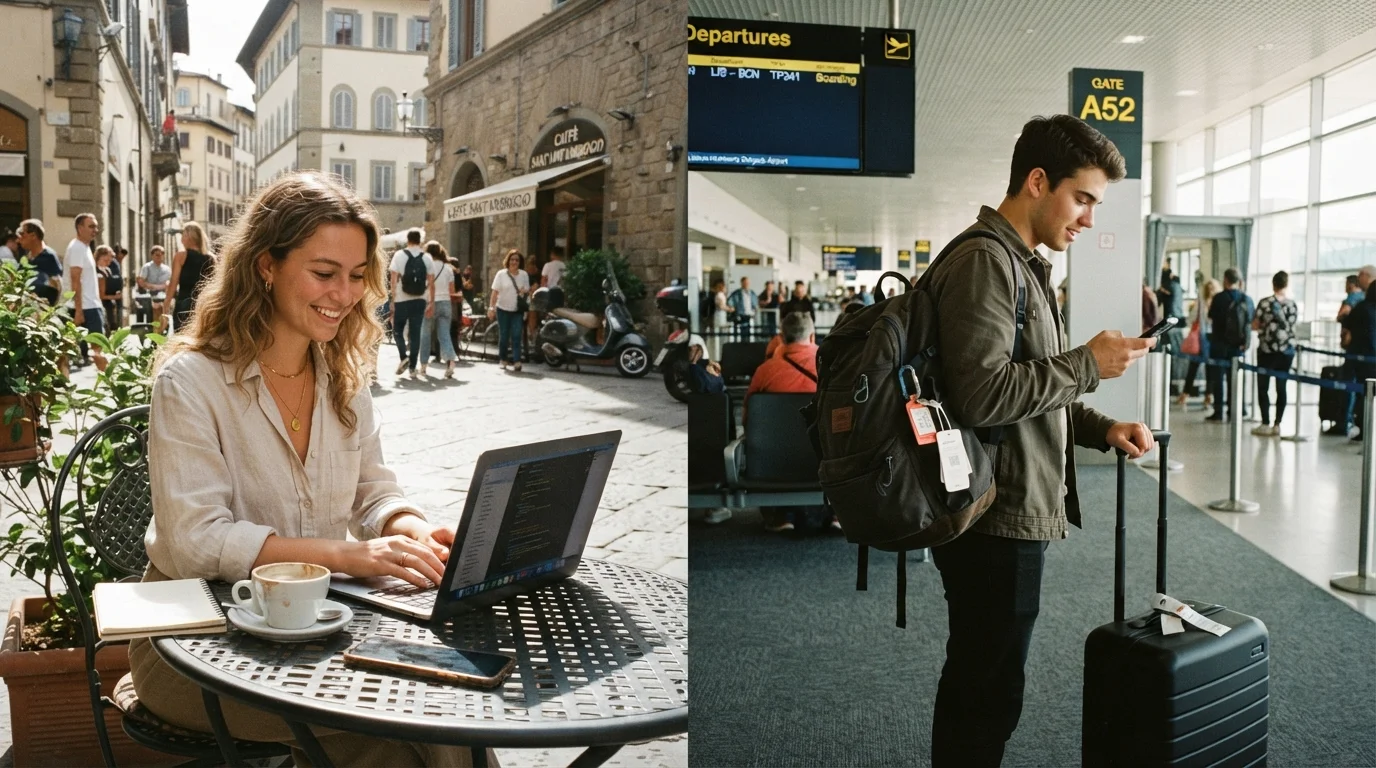
Option A
Workation
The short-term, low-commitment approach to working while traveling.
Best for: Remote workers who want a temporary change of scenery without upending their daily routines or long-term obligations.
Option B
Remote Year
The long-haul, immersive commitment to living and working across multiple countries.
Best for: Location-independent workers ready to embrace extended international living, frequent relocation, and deep cultural immersion.
Defining the Two Models
The rise of remote work has opened new possibilities for where and how people do their jobs. Two arrangements — the workation and the remote year — have gained significant traction, often discussed as if they are interchangeable. They are not.
A workation is a short-term trip, typically ranging from a few days to several weeks, during which a remote-capable employee works from a location other than their usual home or office. The concept is an extension of the broader bleisure travel trend, where professional and personal time overlap deliberately.
A remote year — a term popularized by companies that sell structured nomadic programs, though many people pursue the format independently — involves spending an extended stretch of time, often six months to a year or more, living and working across multiple international destinations. It represents a fundamental restructuring of where home is, at least temporarily.
Understanding which model fits a traveler's circumstances requires looking at duration, logistics, employer relationships, and personal readiness — not just wanderlust.
Duration, Commitment, and Lifestyle Impact
The most immediate distinction is scale. A workation can be as brief as a long weekend in a neighboring state or as long as a month abroad. It fits within most standard vacation or remote-work policies and rarely requires a worker to renegotiate their lease, tax residency, or employment contract.
A remote year, by contrast, demands sustained logistical commitment. Workers considering this path typically need to arrange storage or sublet their housing, understand how extended stays abroad affect their tax status, and confirm that their employer permits long-term international remote work — which is not a given. Digital nomad visa programs have expanded options in many countries, but each program carries its own residency, income, and renewal conditions that require careful verification through official government sources.
| Criterion | Workation | Remote Year |
|---|---|---|
| Typical duration | Days to a few weeks | Six months to one year or more |
| Number of destinations | Usually one | Multiple countries or cities |
| Visa considerations | Standard tourist entry often sufficient | Nomad visas or long-stay permits often needed |
| Housing arrangement | Short-term rental or hotel | Sequential short-term stays or program housing |
| Employer approval needed | Usually informal or standard PTO policy | Formal remote-work agreement often required |
| Tax complexity | Minimal for short stays | Potentially significant; varies by country |
| Community structure | Self-directed; solitary | Programs offer cohort-based communities |
| Cost to organize | Lower overall planning overhead | Higher; program fees or DIY logistics |
Readers evaluating either path should also weigh how frequently they're willing to move. A workation typically means one location. A remote year, especially through organized programs, may involve relocating every four to eight weeks — a pace that suits some personalities but exhausts others.
Practical Realities: Cost, Infrastructure, and Productivity
Workations are generally lower-cost to organize. A traveler books accommodation, verifies reliable internet access, and adjusts their schedule for any time-zone differences. The overhead is modest, and most workers return home with their routines largely intact — a consideration explored further in how remote work has reshaped home setups for Americans.
Remote years carry considerably higher planning overhead. Participants must account for varying internet reliability across destinations, health insurance that covers international care, time-zone management for team collaboration, and potential tax exposure in multiple jurisdictions. Organized remote year programs often bundle housing, coworking space, and community — which simplifies logistics but adds program fees.
35%
U.S. workers with full-time remote capability
According to Pew Research Center survey data from 2023, roughly 35% of U.S. workers with jobs that can be done remotely were working from home all the time.
60+
Countries with active digital nomad visa programs
As of 2024, more than 60 nations had introduced some form of digital nomad or remote worker visa, according to widely reported immigration policy tracking.
Productivity is a genuine concern for both formats. Research on remote work broadly suggests that environment and routine discipline matter more than location, but frequent movement can disrupt concentration. Travelers pursuing either arrangement benefit from establishing consistent work hours and a dedicated workspace at each stop — much like the considerations covered in our look at solo versus group travel dynamics. For remote years, choosing destinations thoughtfully — including off-season timing — can help balance cost and livability.
Neither model is inherently superior. The right choice depends on how much flexibility a worker's employer allows, how portable their financial and personal obligations are, and how deeply they want travel woven into their working life. See our travel tips hub for broader planning guidance suited to both arrangements.
The content on this site is for informational purposes only and is not a substitute for professional advice. Always consult a qualified professional for guidance specific to your situation.