

Our Verdict
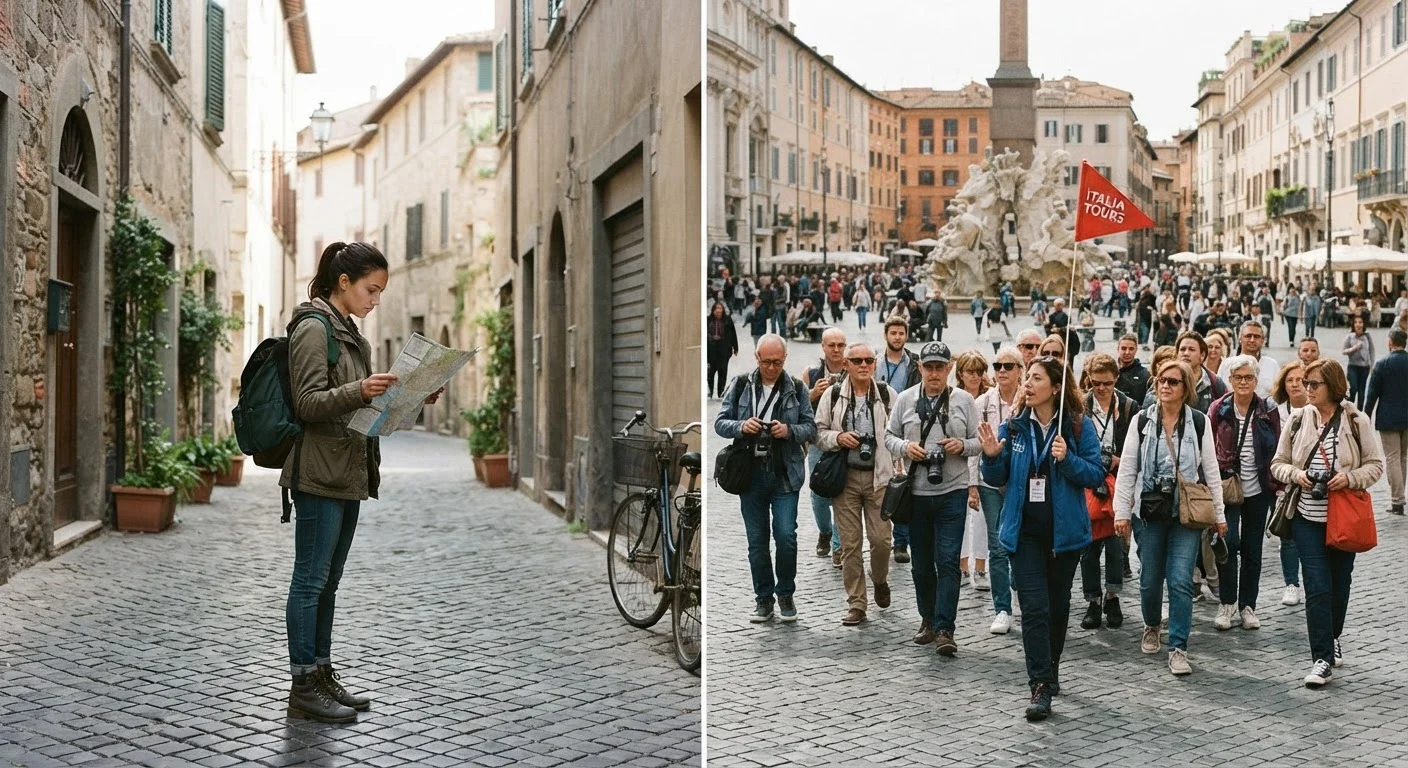
Neither solo travel nor group tours is objectively superior — the right choice depends on the traveler's priorities, destination, and comfort with uncertainty. Solo travel rewards those who value autonomy and organic discovery, while group tours serve travelers who prefer structured experiences, guaranteed logistics, and ready-made social connection. Many seasoned travelers find both styles useful at different points in a single trip.
| Best for | Recommended |
|---|---|
| Those who value schedule flexibility and self-directed discovery | Solo Travel |
| First-time visitors to complex or unfamiliar destinations | Group Tours |
| Travelers seeking built-in social connection without advance coordination | Group Tours |
| Experienced travelers comfortable managing logistics independently | Solo Travel |
How Each Style Actually Unfolds Day to Day
The practical texture of a solo trip looks nothing like that of a group tour, and understanding that difference is more useful than weighing abstract pros and cons.
On a solo trip, the traveler controls every decision: when to wake up, which neighborhood to wander into, whether to spend three hours at a single museum or skip it entirely. That freedom is real, but so is the workload. Booking accommodations, researching transport connections, navigating language barriers, and adapting when plans fall apart all rest with one person. For travelers who find that kind of problem-solving energizing, solo travel can feel like its own reward. For those who find it draining, it can overshadow the destination itself.
A group tour operates on a different logic. An operator has pre-negotiated entry to sites, booked transport between cities, and arranged accommodation — typically at properties accustomed to handling groups. The traveler shows up and follows a schedule. Mornings often begin early; free time is parceled out in blocks. The pace is set by the group's average, not by any individual's preferences. This predictability is the point: travelers who want to see a wide range of sites without managing each handoff themselves get exactly that.
For context on how these patterns fit into broader shifts in how people travel, see the Travel Trends hub.
Cost Realities: What You Pay and What You Get
Cost comparisons between solo travel and group tours are less straightforward than they first appear, because the two styles don't purchase the same things.
Solo travelers pay retail rates for accommodation, transport, and activities. A private hotel room costs more per night than a shared tour bunk, and individually booked museum entries or guided experiences often carry a premium over group rates. On the other hand, solo travelers spend only what they choose to spend — skipping a boat tour or eating at a street stall rather than a tour-designated restaurant are options that simply don't exist on a fixed itinerary.
Group tours bundle costs into a single upfront price, which can make high-access experiences — a private archaeological site visit, a cooking class with a local chef — more attainable than they would be for a solo traveler arranging the same thing independently. However, that price also covers components the traveler might not have chosen individually. Understanding what a tour package includes, and what it doesn't, is essential before comparing costs. Peak-season timing also affects both styles differently, with group tours often having fixed departure dates regardless of how crowded or expensive a destination becomes.
| Solo Travel | Group Tours | |
|---|---|---|
| Schedule flexibility | Full control over daily pace | Fixed itinerary set by operator |
| Logistical responsibility | Entirely on the traveler | Managed by tour operator |
| Cost structure | Pay retail; spend only what you choose | Bundled upfront price; less customizable |
| Social experience | Organic connections; more solitude | Built-in group; structured social time |
| Access to remote/restricted sites | Requires independent arrangement | Often pre-negotiated by operator |
| Best for destination type | Urban, well-documented destinations | Remote, complex, or permit-heavy regions |
Social Dynamics and Safety Considerations
One of the most consistent findings among experienced travelers is that the social experience of each style is fundamentally different — not better or worse, but structurally distinct.
Solo travelers frequently report that traveling alone makes them more approachable to locals and other travelers. Without a companion to default to, there's more incentive to strike up a conversation at a hostel common room or accept a local's invitation. That said, solo travel also means managing safety without a built-in support network. Destination choice matters: some regions and contexts present greater risks for travelers alone, and those considerations are worth researching seriously through official government travel advisories before booking.
Group tours provide immediate social infrastructure. Travelers arrive as strangers and spend days navigating shared experiences — a dynamic that some find energizing and others find constraining. The group's composition matters enormously; a tour filled with like-minded travelers can be a highlight of a trip, while a poor fit can make even a beautiful destination feel tedious. As explored in the growth of solo travel as a mainstream choice, a growing number of travelers are navigating exactly this question when deciding how to structure a trip.
Consider a Hybrid Approach
Many travelers find value in combining both styles within a single trip. Joining a structured tour for a logistically complex segment — a multi-day trek, a region with limited independent infrastructure — while traveling independently in cities or well-connected areas can give you the benefits of both approaches without committing entirely to one style. Research what each leg of your trip actually requires before deciding.
For travelers who want companionship without surrendering full autonomy, friend-group travel offers a middle path — though it carries its own coordination challenges, as covered in this guide to group travel among friends.
Matching the Style to the Destination and the Traveler
Neither style is universally appropriate, and destination type often tips the decision more than personal preference alone.
Remote trekking regions, destinations with complex permit systems, or areas where language and infrastructure barriers are significant can be genuinely easier to navigate through an organized operator with established local contacts. Conversely, well-documented urban destinations — where transport is straightforward, English is widely spoken, and independent accommodation is abundant — lend themselves naturally to solo exploration.
Experience level also factors in. A traveler taking their first international trip to an unfamiliar region may find that a group tour provides a useful orienting experience, offering context and access that would take considerably more effort to replicate independently. More seasoned travelers often find group pacing frustrating once they've developed their own logistical confidence.
Some travelers resolve the tension by combining approaches: joining a structured tour for a demanding leg of a trip, then traveling independently before or after. This hybrid model is increasingly common, particularly among travelers exploring destinations like those covered in New Zealand's two islands, where one island may suit independent travel while the other benefits from guided access.
Regardless of which style a traveler chooses, practical protections remain relevant to both. Understanding what travel insurance covers is worthwhile before departing on either a solo itinerary or a group departure.
The content on this site is for informational purposes only and is not a substitute for professional advice. Always consult a qualified professional for guidance specific to your situation.