

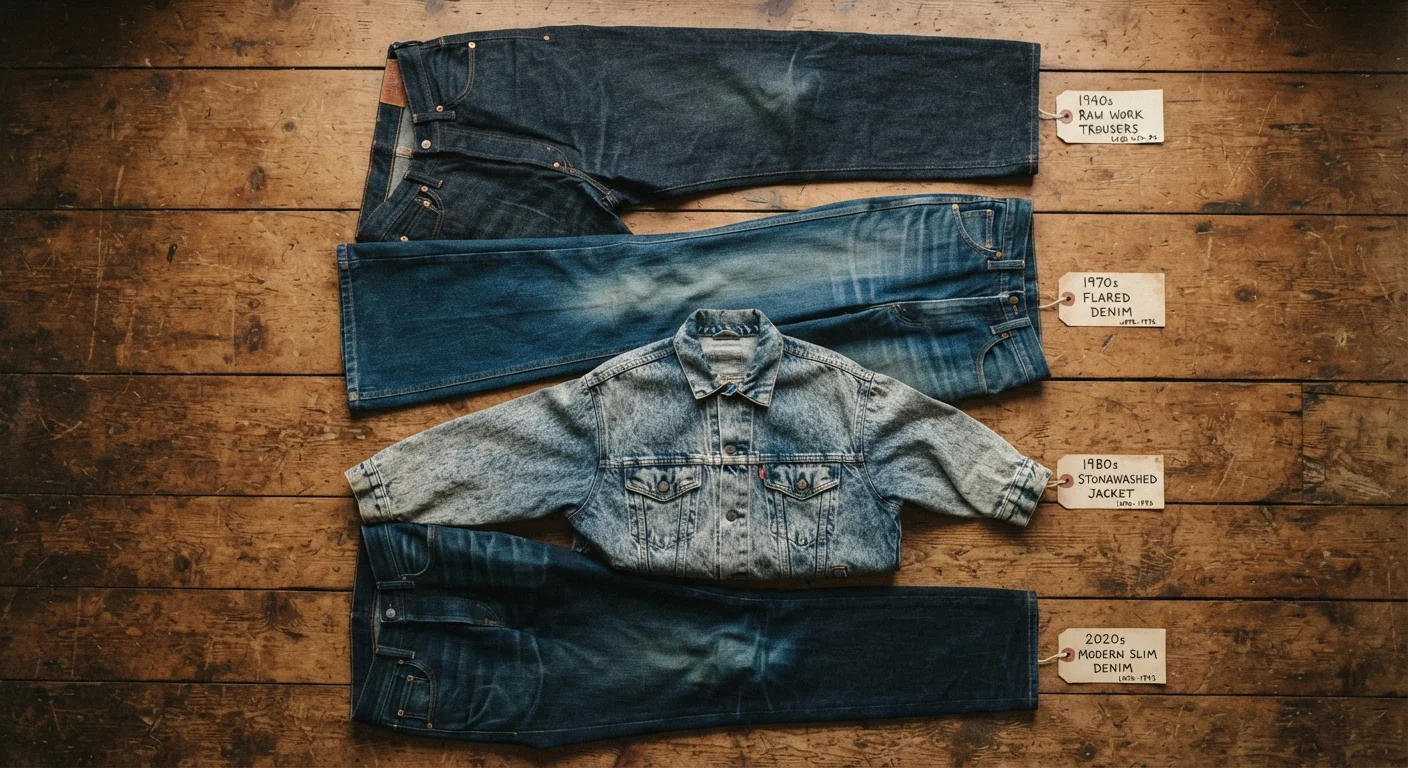
Born from Labor: Denim's Working-Class Origins
Long before denim landed on a runway, it clocked in at a job site. The fabric's American chapter began in earnest in the 1870s, when riveted denim trousers were patented as rugged workwear for miners and laborers. The key ingredient was a sturdy cotton twill woven in a distinctive diagonal pattern that made it exceptionally resistant to tearing — exactly what someone swinging a pickaxe needed.
For several decades, denim stayed squarely in the realm of utility. Ranch hands, factory workers, and farmers relied on it not for style but for endurance. The indigo dye that gave denim its signature blue was practical too: dark enough to hide grime, stable enough to survive repeated washing.
It wasn't until the mid-20th century that denim began its first cultural crossing. Postwar youth culture — influenced by cinema, motorcycle culture, and a restless spirit of rebellion — adopted denim as a uniform of defiance. Suddenly, what was worn in the fields became something charged with attitude. That pivot set the stage for everything that followed.
Decade by Decade: How Denim Shifted Shape and Meaning
Each generation has recut denim to fit its own cultural moment, and the silhouettes tell a remarkably clear story.
1950s–60s: Straight-leg jeans became the emblem of teenage independence. By the mid-1960s, counterculture movements had added embroidery, patches, and fringe — early signs that denim could carry personal expression as readily as it carried wear and tear. This DIY impulse is something that keeps resurfacing; see the enduring pull of DIY culture for deeper context.
1970s: The silhouette flared dramatically. Bell-bottoms and wide-leg styles reflected a decade of maximalism and disco influence. Designer names began appearing on back pockets, signaling denim's first serious upmarket move.
1980s: Acid wash, stonewashing, and high-waisted cuts dominated. Denim was now a canvas for industrial finishes and pop-culture excess. Jeans were ripped, bleached, and bedazzled — worn as statements rather than workwear.
1990s–2000s: Minimalism and then low-rise cuts shaped the era. Baggy silhouettes carried streetwear's influence deep into mainstream wardrobes. The relationship between denim and streetwear's rise in American fashion became especially visible during this period.
2010s–present: Skinny jeans gave way to a revival of wide-leg and straight-cut styles. Sustainability conversations pushed consumers toward raw denim, deadstock fabric, and the secondhand market. The growth of thrift and resale platforms has made vintage denim more accessible and culturally resonant than ever.
Selvedge denim
A tightly woven denim produced on traditional shuttle looms, creating a self-finished edge that prevents fraying. It is often associated with higher-quality, longer-lasting jeans.
Stonewashing
A finishing process where denim is tumbled with pumice stones to create a worn, faded appearance. It became a defining aesthetic of 1980s fashion.
Raw denim
Denim fabric that has not been washed or treated after dyeing. It fades and creases according to the wearer's body and habits over time, developing a personalized look.
Warp-faced twill
The weave structure that gives denim its diagonal texture. The warp (lengthwise) threads dominate the fabric's face, contributing to its characteristic durability.
Deadstock fabric
Unused textile inventory left over from previous production runs. Designers use deadstock to reduce waste by giving existing material a new purpose.
Denim Today: Where Fabric Meets Identity
Contemporary denim occupies a broader cultural space than at any previous point in its history. It moves easily between workwear revival aesthetics, high-fashion collections, and everyday casual dressing — sometimes within a single outfit. Wide-leg and barrel-leg silhouettes have surged in popularity, while denim-on-denim styling (once dismissed as a fashion misstep) is now widely embraced.
The fabric's relationship with material innovation is also evolving. Stretch blends, organic cotton selvedge, and recycled-fiber denim reflect consumer demand for both comfort and lower environmental impact. Denim production is one of the more water- and chemical-intensive textile processes, and brands across the industry have faced pressure to address that reality.
Perhaps what makes denim so persistently relevant is its neutrality of meaning — it belongs to no single group, era, or occasion. It has been worn as protest, as aspiration, as nostalgia, and as nothing more than a comfortable Tuesday. That flexibility, as much as its physical durability, is what keeps Americans reaching for it decade after decade. And as wardrobes shift toward intentional, longer-lasting choices, denim's longevity makes it a natural anchor piece.
The content on this site is for informational purposes only and is not a substitute for professional advice. Always consult a qualified professional for guidance specific to your situation.