

What DIY Culture Actually Means
"Do it yourself" sounds simple — fix your own shelf, hem your own jeans. But as a cultural force, DIY is something far richer. It is an ideology, a creative practice, and a recurring act of resistance against the idea that expertise, consumption, and manufactured products are prerequisites for a full life.
At its core, DIY asserts that ordinary people have the capacity — and the right — to make, repair, and customize the things that shape their daily existence. That conviction has surfaced in wildly different contexts across American history, from Depression-era resourcefulness to postwar hobbyist culture to the hypercreative online communities thriving today. The thread running through all of it is autonomy: the belief that making something yourself carries a meaning that buying it simply cannot replicate.
Punk, Zines, and the Original DIY Ethos
The phrase "do it yourself" gained its modern cultural charge in the mid-1970s, when punk musicians in the U.S. and U.K. rejected the gatekeeping of major record labels. If you couldn't get signed, you pressed your own records, booked your own shows, and sold cassette tapes out of a backpack. The point wasn't polish — it was participation.
Zines — self-published, photocopied magazines distributed by hand or through mail — became the punk era's parallel information network. They carried band news, political screeds, personal essays, and cut-and-paste artwork that no mainstream magazine would touch. The aesthetic was deliberately rough, a visual declaration that production value was beside the point.
“Punk was never really about the music alone. It was about proving that you didn't need permission — to perform, to publish, to exist on your own terms.”
— Greil Marcus, Cultural critic and author on American music and subculture
This ethos shaped entire subcultures. Hardcore, riot grrrl, and skateboarding communities all built infrastructure — labels, magazines, clothing lines — entirely outside commercial channels. The communities that formed around these scenes were early proof that shared values, not shared budgets, could sustain a culture.
The Craft Revival and Domesticity Reclaimed
By the early 2000s, a different kind of DIY was gaining momentum. Knitting circles, screen-printing studios, and home-fermentation groups started drawing young adults who hadn't grown up in punk scenes but shared a similar restlessness with passive consumption. Platforms like Etsy, launched in 2005, gave handmade goods a commercial home while reinforcing the cultural prestige of making.
This wave reclaimed domestic crafts — weaving, canning, embroidery, sourdough baking — that had been dismissed as unglamorous housework. Feminist scholars noted that the revival carried an implicit argument: labor that had been rendered invisible was now being valued and displayed. Making your own bread or hand-dyeing a shirt became a statement about slowing down, about knowing what goes into the things you use.
Craft Meets Closet: A Natural Overlap
If you're drawn to DIY through fashion, visible mending and garment customization are low-cost entry points that require minimal equipment. A needle, thread, and a thrifted piece of denim are enough to start. As your confidence builds, skills like basic pattern drafting or natural dyeing open up genuinely creative possibilities without requiring a full workshop setup.
The overlap with fashion was significant. Visible mending, upcycling thrifted garments, and customizing denim connected craft culture to sustainability — a thread explored in depth in discussions of the thrift and resale shift in American fashion.
Maker Spaces and the Digital Fabrication Era
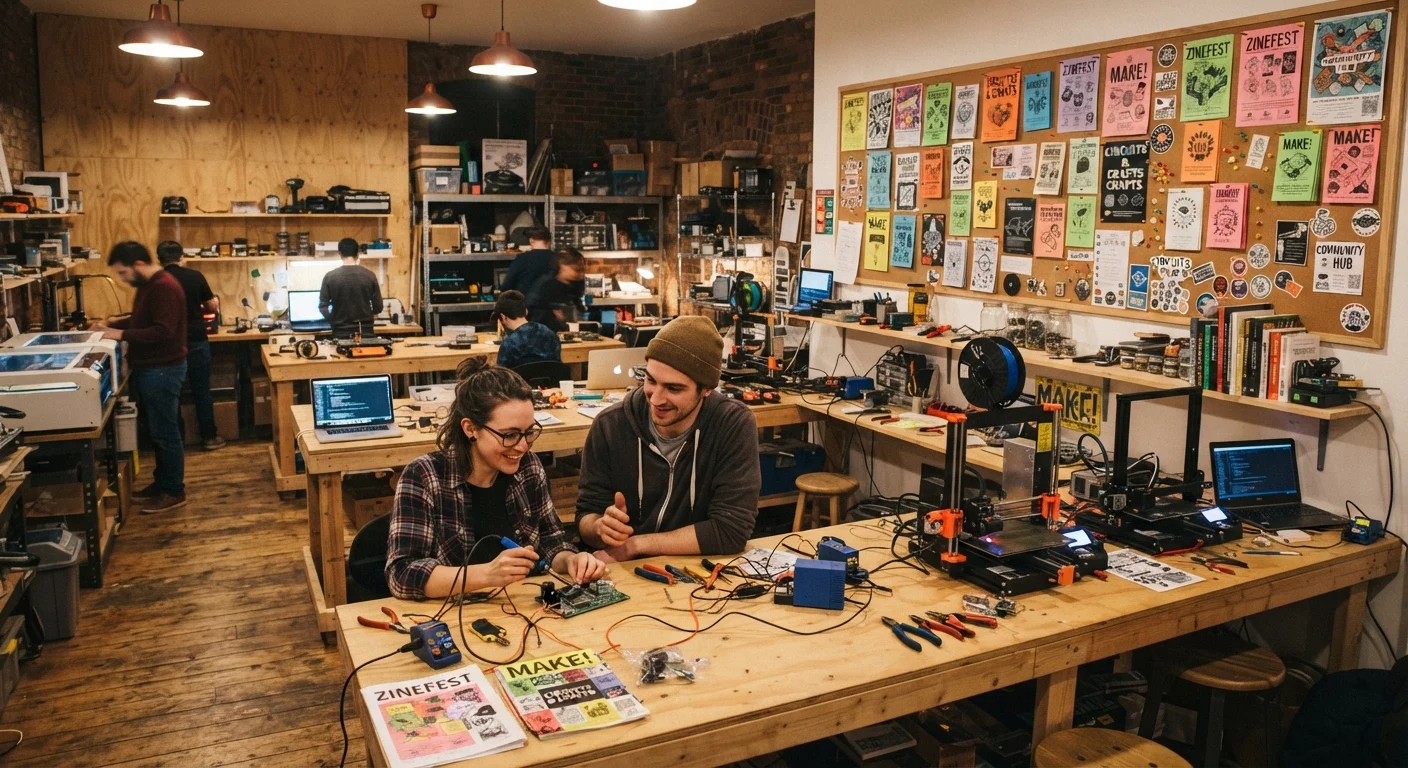
The term "maker movement" entered mainstream vocabulary around 2010, propelled by Make: magazine, Maker Faire events, and the falling cost of tools like 3D printers, laser cutters, and Arduino microcontrollers. Maker spaces — shared workshops equipped with both digital and analog fabrication tools — began appearing in libraries, universities, and community centers across the country.
What maker spaces did was democratize manufacturing-grade equipment. Someone with no engineering background could walk into a shared facility, learn to use a CNC router, and fabricate a custom part that would have required a factory contract a decade earlier. The barrier between idea and object collapsed in ways that felt genuinely revolutionary.
1,400+
Maker spaces operating in the U.S.
According to data compiled by Make: magazine and the Makerspace directory, the number of community maker facilities grew rapidly through the 2010s and continued expanding into the 2020s.
62%
Americans who engage in DIY home projects annually
Surveys by home improvement research groups have consistently found a majority of U.S. adults undertake at least one DIY project each year, spanning repair, craft, and building activities.
Critically, maker spaces preserved the communal dimension that had always distinguished DIY from mere hobbyism. Skill-sharing, peer teaching, and collaborative projects were baked into their design. The object mattered less than the network of knowledge that helped produce it.
Why DIY Keeps Resonating Across Generations
Each generation that embraces DIY brings its own urgency to the practice. For Depression-era Americans, it was economic necessity. For 1970s punks, it was political defiance. For millennials navigating economic uncertainty, it blended financial pragmatism with a search for meaning that traditional employment wasn't always providing.
Today, Gen Z creators on short-form video platforms are documenting furniture builds, clothing alterations, and electronics repairs with an audience reach that would have seemed impossible to a 1980s zine publisher. The aesthetic values have shifted — production quality is often high — but the underlying message remains: I made this, and that matters.
The impulse also responds to something specific about contemporary consumer culture. As deinfluencing pushes back against overconsumption, DIY offers an alternative framework: instead of buying a new version, understand what you already own well enough to repair or transform it. That's not nostalgia — it's a coherent response to real cultural pressures.
Start with repair before you start with making. Learning to fix something you already own builds foundational skills — and reveals how objects are constructed — faster than starting a new project from scratch.
Repair tasks expose material properties, joinery techniques, and mechanical logic that guide more ambitious projects. Repair cafés and community workshops often offer free guidance for beginners.
Treat your local library or community center maker space as your first stop before investing in expensive tools. Many offer free access to 3D printers, sewing machines, and woodworking equipment alongside trained staff.
Access to shared tools removes the financial barrier that stops many beginners. It also connects you to an existing community of practitioners who can accelerate your learning significantly.
DIY as Counter-Culture and Consumer Critique
Perhaps the most durable aspect of DIY is its capacity to function as critique. Every era of the movement has contained an implicit argument against passivity — against the idea that the correct response to a need or desire is always to purchase something. That argument has grown more pointed as concerns about supply chains, environmental impact, and corporate consolidation have entered everyday conversation.
This connects DIY to broader conversations about ownership and intentionality. The same values driving Americans to rethink what they own — quality over quantity, understanding provenance, resisting disposability — animate the person learning to repair their own appliance or weave their own bag.
DIY has never been a single movement with a unified manifesto. It is more accurately described as a recurring cultural response: whenever mass production, corporate gatekeeping, or passive consumption feels overwhelming, people pick up tools. They always have, and the evidence suggests they always will. The form changes — from mimeograph machines to laser cutters — but the animating spirit of self-determined making remains stubbornly, meaningfully constant.
The content on this site is for informational purposes only and is not a substitute for professional advice. Always consult a qualified professional for guidance specific to your situation.