

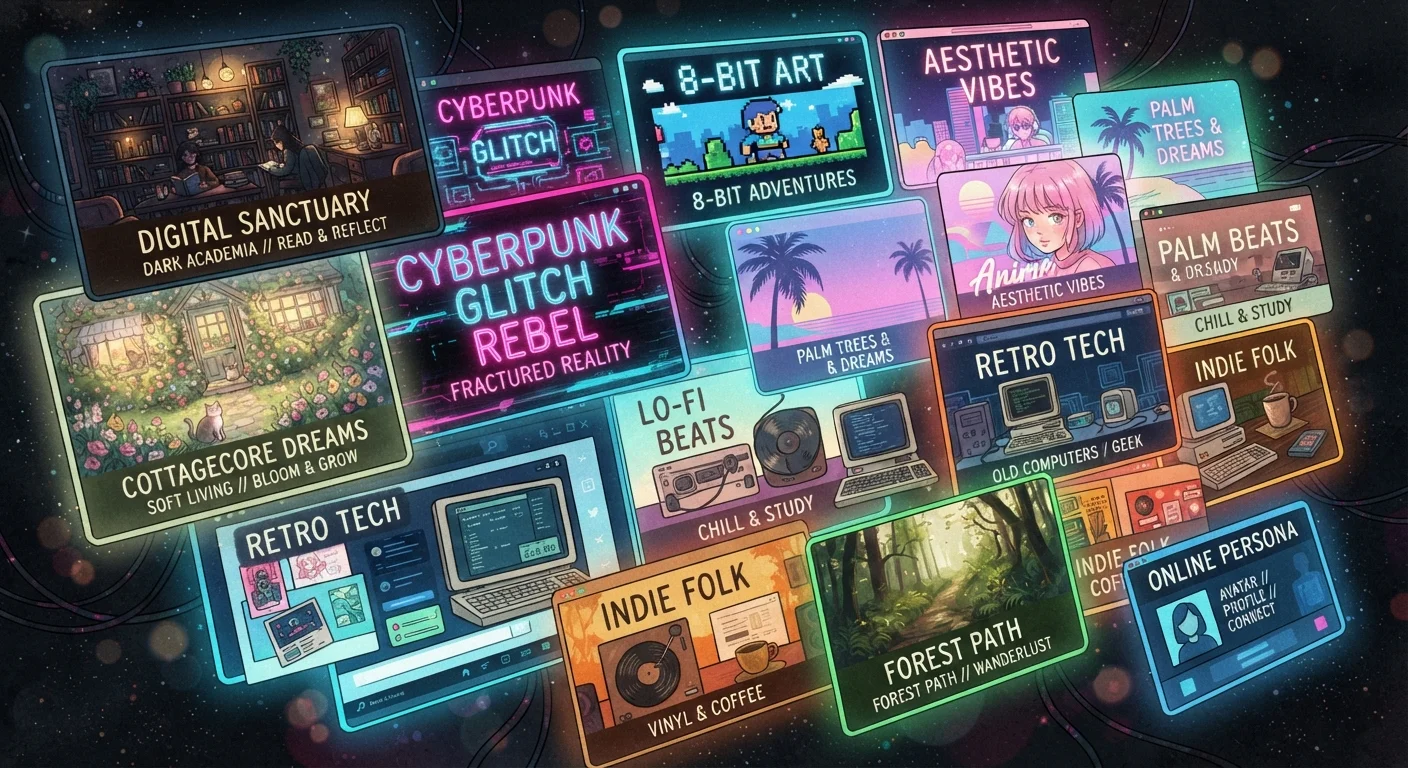
What Is an Internet Subculture, Exactly?
An internet subculture is a community — sometimes loosely, sometimes tightly organized — that coalesces around a shared aesthetic, value system, or way of moving through the world. These groups form on platforms like TikTok, Tumblr, Reddit, and Discord, often growing from niche inside jokes or style experiments into full-blown identity frameworks with their own vocabularies, rituals, and reference points.
What makes them distinct from a passing trend is staying power and internal depth. Members don't just consume content — they produce it, debate it, remix it, and shape it into something that signals who they are. As life online deepens, these subcultures increasingly function the way neighborhoods and social clubs once did: as places to belong.
Aesthetic
In internet subculture contexts, an aesthetic is a cohesive visual and philosophical style that signals identity. It typically encompasses fashion, décor, music taste, and values all at once.
Cottagecore
A subculture romanticizing rural, slow living — emphasizing handmade goods, natural environments, and a rejection of industrial-paced modern life. Primarily visual on Instagram, Pinterest, and TikTok.
Dark Academia
An internet subculture that blends gothic atmosphere with intellectual aspiration — celebrated through imagery of old libraries, classical literature, and scholarly rituals.
Goblincore
A subculture celebrating the overlooked, earthy, and unconventional in nature — mushrooms, mud, found objects — often as a lighthearted rejection of conventional beauty standards.
Lore
The accumulated mythology, backstory, and world-building detail of a fictional universe. In fan communities, engaging deeply with lore is a mark of serious membership.
Digital Identity
The version of oneself constructed and expressed through online platforms — including profile choices, community membership, aesthetic preferences, and content creation.
A Field Guide to Major Communities
The landscape shifts constantly, but several communities have demonstrated real cultural traction.
| Most active platform for subculture content | TikTok and Tumblr (Widely reported by digital culture researchers, 2022–2024) |
| Cottagecore peak search interest | 2020–2021 (Google Trends data) |
| Common subculture lifespan before mainstream adoption | 2–5 years (Observed pattern in digital culture journalism) |
| Primary age group driving subculture participation | Ages 16–30 (Pew Research Center internet use reports) |
| Key content formats | Mood boards, short video, long-form fan fiction, Discord servers |
Cottagecore
Rooted in a romanticized vision of rural, slow living — think linen aprons, sourdough starters, wildflower bouquets, and hand-stitched quilts — cottagecore surged in visibility during the early 2020s. Its appeal is largely aspirational: a retreat from digital overwhelm into tactile, nature-connected simplicity. Many participants never actually move to the countryside; the aesthetic functions as a values statement about intentionality and self-sufficiency. It shares philosophical DNA with DIY culture's emphasis on making things by hand.
Dark Academia
Dark academia aestheticizes intellectual pursuit through a gothic lens — candlelit libraries, classical literature, tweed and plaid, and a fascination with knowledge shadowed by melancholy. The community thrives on Tumblr and Pinterest, drawing in readers, students, and anyone who found something romantic in a well-worn hardback. It often intersects with self-directed learning communities, where participants create personal reading lists and share study aesthetics.
Goblincore
Where cottagecore reaches for sunlit meadows, goblincore leans into the mucky, the overlooked, and the weird — mushrooms, mossy rocks, bones, shiny found objects. It celebrates the unseemly corners of nature and rejects mainstream beauty standards with genuine humor and warmth.
Lore-Based Fan Communities
These are communities organized around the deep mythology of fictional universes — sprawling wikis, theory threads, and in-world debates that can span decades. From space operas to fantasy epics, the investment often rivals that of sports fandom: both involve rituals, tribal loyalty, and identity-level commitment.
Why People Join — and What They Get Out of It
Belonging is the core draw. Internet subcultures offer something that mainstream culture often doesn't: a highly specific mirror. When someone stumbles onto a community that matches not just their taste in music but their philosophical outlook, their humor, and their specific brand of anxiety about modernity, the recognition can feel profound.
Subcultures also provide structure for identity experimentation. Adolescents and young adults have long used style and group affiliation to test who they are — the internet simply multiplied the available options and made geographic isolation less of a barrier. Someone in rural Kansas can find their aesthetic tribe as readily as someone in Brooklyn.
There's a learning dimension too. Many subcultures are knowledge-intensive: members read broadly, study craft, and build real skills. Dark academia participants often develop genuine literary depth. Maker-adjacent communities build technical skills. As the range of learning formats expands, subcultures increasingly serve as informal curricula.
The flip side deserves acknowledgment: intense subculture participation can reinforce insular thinking or make it harder to engage with people outside the group. And the data trails left across platforms carry their own considerations — something worth understanding through a closer look at your digital footprint.
How These Communities Influence Mainstream Culture
Internet subcultures don't stay niche forever. They leak. Cottagecore aesthetics shaped fashion runways and home goods catalogs. Dark academia influenced fall capsule wardrobes. Meme formats born in obscure corners of Reddit eventually power mainstream advertising campaigns.
The pipeline typically runs from tight-knit community to platform virality to mainstream adoption — at which point original members often feel the community has been diluted. This cycle of discovery, adoption, and perceived co-optation is itself a defining feature of internet subculture life. It mirrors, in digital form, the human search for authentic community spaces that feel genuinely one's own.
Understanding these communities — their language, their values, their tensions — offers a real window into how identity is being constructed and negotiated in contemporary American life. They're not frivolous; they're where a significant share of cultural meaning-making is happening right now.
84%
U.S. teens who say they use YouTube
According to Pew Research Center's 2023 survey on teen social media and technology use, YouTube remains the dominant platform — a key distribution channel for subculture content.
35%
Teens who report being online 'almost constantly'
Pew Research Center's 2023 data shows that deep platform immersion is the norm for a significant share of young Americans — the primary audience for internet subcultures.
The content on this site is for informational purposes only and is not a substitute for professional advice. Always consult a qualified professional for guidance specific to your situation.