
The Space Between Home and Work
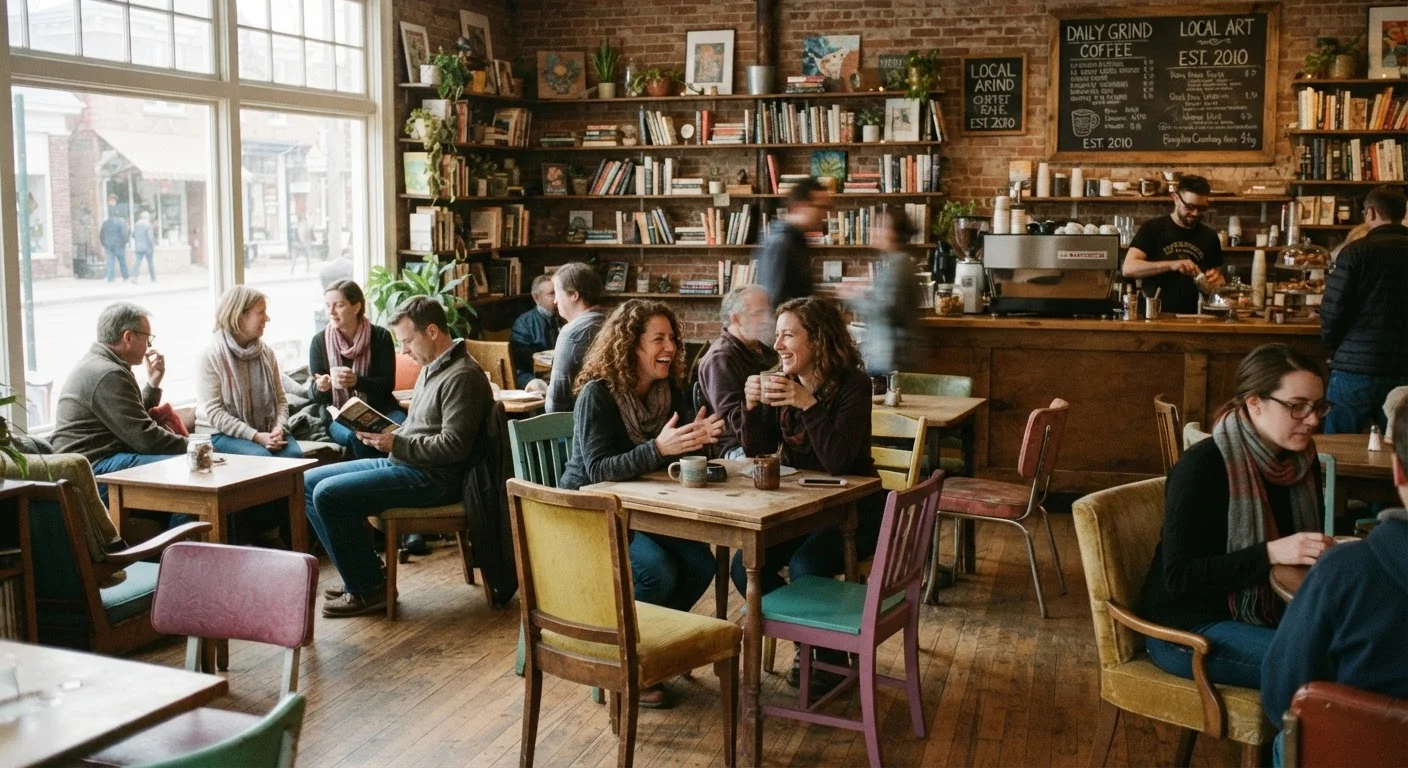
For much of the 20th century, American social life had a reliable rhythm: you'd grab a coffee at the same corner diner every morning, exchange weekend stories at the barbershop on Saturday, or drop into the neighborhood library on a rainy afternoon. Nobody scheduled these moments. They just happened — because the spaces existed, were walkable, and felt like yours.
These are third places, and for millions of Americans, they've quietly vanished. The diner became a chain pharmacy. The barbershop moved to a strip mall across a six-lane road. The park lost its benches to budget cuts. What's left, increasingly, is the couch and the screen.
The cultural conversation around third places has flared back to life in recent years, particularly on social media, where younger generations lament the absence of "somewhere to just be" without spending $18 on a cocktail or feeling pressure to consume. That collective frustration is telling — it points to a real structural shift in how American communities are built and who they serve.
58%
Americans who report feeling lonely
A 2023 survey by the Survey Center on American Life found majorities of Americans across age groups reported meaningful loneliness, a figure researchers connect in part to declining community infrastructure.
~30%
Decline in social club membership since 1970s
Political scientist Robert Putnam documented steep drops in civic participation and associational membership across the latter 20th century in his widely cited research on social capital.
17,000+
Public libraries still operating in the U.S.
According to the American Library Association, the U.S. public library system remains one of the most expansive free third-place networks in the country, serving millions of visitors weekly.
How Third Places Got Squeezed Out
The decline isn't accidental — it's the product of overlapping economic and design forces that played out over decades. Post-war suburban sprawl replaced walkable neighborhoods with cul-de-sacs and parking lots, physically separating people from the local businesses that once anchored daily life. When driving became the only way to get anywhere, spontaneous social stops became intentional errands.
Rising commercial rents hit especially hard in dense urban areas. A coffee shop or independent bookstore operates on thin margins; when a landlord triples the rent, the community hangout closes and a higher-revenue tenant moves in. Small towns faced their own version: as local economies hollowed out, the diner and the hardware store shuttered, leaving few natural gathering points.
Digital entertainment accelerated the retreat indoors. Streaming services, social media, and on-demand delivery made it more convenient — and, for many people, more comfortable — to stay home. The pandemic then compressed years of that transition into months, closing the physical doors that remained and pushing social life almost entirely online. Many venues that closed in 2020 never reopened.
This contrasts sharply with the parallel world of online subcultures, where identity and belonging get constructed in digital spaces. Those communities are real and meaningful — but they tend to be self-sorted by interest rather than forged across the random human mix that a physical neighborhood produces.
What We Lose When They Go
The stakes aren't purely nostalgic. Sociologists and public health researchers have pointed to third places as essential infrastructure for what's sometimes called "social capital" — the web of trust, reciprocity, and shared norms that makes communities function. When those spaces erode, so does the casual familiarity between neighbors that once smoothed over conflict and built collective identity.
“Third places are the heart of a community's social vitality. They are the gathering places where community is most alive and most collectively enjoyed.”
— Ray Oldenburg, Sociologist and author of 'The Great Good Place'
There's also the democracy argument. A well-functioning third place is one of the few remaining venues where people from different income brackets, backgrounds, and political views actually occupy the same room without a formal purpose. That kind of incidental mixing is increasingly rare in an era of algorithmically sorted digital feeds and economically segregated neighborhoods.
Loneliness, meanwhile, has become a recognized public health concern in the United States — something the U.S. Surgeon General's office has addressed in public communications. Third places won't solve loneliness on their own, but their absence removes one of the most accessible, low-stakes pathways to connection available to ordinary people.
Why People Are Searching Again — and What They're Finding
Something interesting is happening in response. Across American cities and towns, people are actively seeking out third places — and in some cases building them from scratch. Community-oriented spaces like maker labs, reading rooms attached to cafés, and free community fridges with surrounding gathering areas are emerging as modern iterations of the concept.
Urban planners are revisiting designs that prioritize walkability and human-scale retail — thinking that dovetails with broader conversations about urban mobility and the last-mile problem. If people can reach neighborhood spaces without a car, the case for third places becomes more viable. Public libraries have quietly reinvented themselves as some of the most democratic third places left, offering not just books but warming centers, social services, and neutral ground.
The slow travel movement offers an interesting parallel: travelers are increasingly drawn to destinations precisely because they have thriving local third places — the café culture of a European city, the public market square, the neighborhood tea house. Americans are noticing the contrast and asking what it would take to reclaim something similar at home.
The search itself is a cultural signal worth taking seriously. When people scroll through social media wishing for "a place to just exist," they're not being precious — they're naming a genuine gap in the built environment. Third places have always reflected the health of a community. Their return, wherever it happens, is worth paying attention to.
Frequently Asked Questions
A third place is any informal social spot that isn't your home or job — a coffee shop, park, library, or community center. It's where people gather regularly without a formal agenda, building a sense of neighborhood and belonging.
Rising real estate costs have priced out many small, low-revenue community businesses. Car-centric urban planning eliminated walkable neighborhood hubs. Longer work hours and digital entertainment have also reduced the time people spend in shared physical spaces.
Online spaces can replicate some functions — shared interests, conversation, identity — but research consistently suggests they don't fully replace face-to-face interaction. The spontaneity of meeting strangers and the sensory richness of physical spaces are hard to replicate digitally.
Modern third places include bookstores with seating, breweries, dog parks, community gardens, maker spaces, and even the sidelines of youth sports fields. The key qualities are accessibility, inclusivity, and regulars who foster a welcoming atmosphere.
Social scientists link the decline of third places to increased loneliness and weakened community resilience. While this article is general information and not medical advice, strong social connections are widely associated with better wellbeing — and third places have historically been a primary source of those connections.
Urban planners and advocates point to policies like mixed-use zoning, pedestrian-friendly streetscapes, publicly funded libraries and parks, and small-business support as levers for restoring third places. Individual residents can also support local venues by patronizing them consistently.
The content on this site is for informational purposes only and is not a substitute for professional advice. Always consult a qualified professional for guidance specific to your situation.