

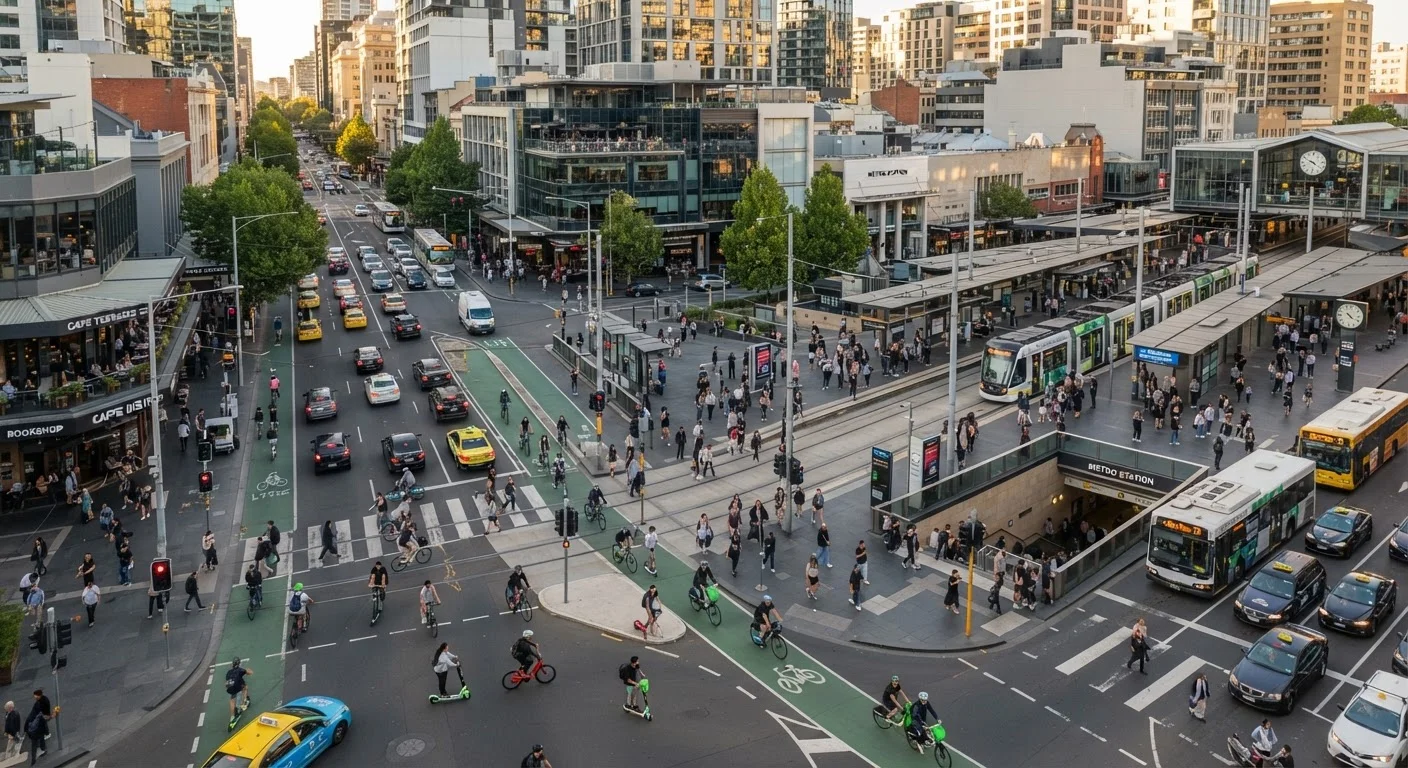
Why the Last Mile Remains Urban Transit's Hardest Problem
Public transit networks in most American cities are built around fixed corridors — subway lines, light rail, and bus routes that move large numbers of people efficiently along high-demand pathways. But transit systems are only as useful as their ability to get riders to and from those corridors. That final stretch — sometimes a quarter-mile, sometimes two miles — is where the system frequently breaks down.
When that gap is inconvenient, people drive instead. This dynamic is a key reason why even well-funded transit systems struggle to attract riders who have car access. The last-mile problem isn't a new concept, but the range of potential solutions has expanded considerably as cities experiment with new vehicle types, app-based routing, and redesigned street infrastructure. See how these developments fit into the broader future of mobility for additional context.
~49%
Americans who live in areas with low transit access
According to the American Public Transportation Association, nearly half of Americans have no access to public transit, underscoring the scale of connectivity gaps.
0.5–1 mile
Typical last-mile distance riders face
Urban planning research commonly identifies this range as the threshold where walking becomes impractical and alternative modes are most needed.
600+
U.S. cities with shared micro-mobility programs
Industry tracking by the National Association of City Transportation Officials (NACTO) has documented rapid expansion of dockless and docked bike and scooter programs across U.S. cities.
E-Scooters and Dockless Bikes: Promise Meets Reality
The rapid expansion of dockless e-scooters and shared electric bikes from around 2018 onward represented one of the most visible attempts to address last-mile connectivity. The appeal is intuitive: a rider steps off the subway, opens an app, unlocks a nearby scooter, and covers the remaining distance to their office or home without needing a car.
In practice, outcomes have been mixed. Studies have documented that e-scooters do serve genuine transportation needs — a portion of trips demonstrably replace car journeys — but a significant share also substitute for walking or existing transit trips, diluting the net emission and congestion benefits. Safety remains a pressing concern; emergency department data has consistently shown elevated injury rates, particularly among riders not wearing helmets.
Regulatory responses have varied widely. Some cities have embraced permit systems that cap operator numbers, require data-sharing with transportation agencies, and enforce geofenced slow zones near schools and crowded pedestrian areas. Others have suspended programs altogether after clutter and safety complaints. Street redesign efforts are increasingly viewed as a prerequisite for making micro-mobility genuinely safe and functional.
Check Your City's Micro-Mobility Rules Before Riding
E-scooter and dockless bike regulations vary significantly from city to city and can change with little notice. Speed limits, helmet requirements, designated parking zones, and permitted riding areas differ by operator and municipality. Check your local transportation department's website or the operator's app for current rules before your first ride.
Micro-Transit: Flexible Routing for Underserved Corridors
Where e-scooters address individual last-mile trips, micro-transit tackles a related but distinct challenge: providing transit service to areas or time windows where fixed-route buses are inefficient. Micro-transit services typically deploy small vehicles — vans or minibuses — that respond to on-demand requests routed through a central algorithm.
Several U.S. cities and transit agencies have piloted micro-transit programs, sometimes as a replacement for underperforming bus routes, sometimes as a complement to them. The results have been instructive. Micro-transit tends to perform well in low-density suburban areas or during off-peak hours where running a full-sized bus makes little economic sense. In dense urban cores, however, fixed-route transit usually remains more cost-efficient per rider.
The technology also intersects with broader concepts like Mobility as a Service (MaaS), which aims to bundle micro-transit, rail, ride-sharing, and bikes into a single digital platform where users plan and pay for multimodal trips seamlessly.
“The last-mile problem is really a first-and-last-mile problem. People need a way to get to transit, and they need a way to leave it. If either end fails, the trip fails — and they drive.”
— Transportation Policy Researcher, Urban mobility analyst cited in public transit planning literature
Equity, Access, and the Risk of Leaving Riders Behind
One of the most consequential critiques of emerging mobility solutions is that they frequently serve those who need them least. App-based services, cashless payment, and smartphone dependency can effectively exclude low-income residents, older adults, and people without reliable internet access — populations that often depend most heavily on transit.
This tension is not hypothetical. Research has documented geographic disparities in scooter deployment, with devices concentrated in higher-income or tourist-heavy neighborhoods rather than transit deserts in lower-income areas. Some cities have pushed back by requiring operators to deploy a meaningful share of their fleets in underserved zones and to offer subsidized membership programs.
The equity dimension also shapes how micro-transit should be evaluated. A service that efficiently connects affluent suburban commuters to rail stations while bypassing low-income neighborhoods isn't solving the last-mile problem — it's replicating existing inequities in a new vehicle. For a broader perspective on how personal mobility choices interact with these trends, see ride-sharing vs. car ownership.
This article is for informational purposes only. Transportation policies, service availability, and regulations vary by city and change frequently. Readers should consult local transit agencies and official city sources for current information.
Frequently Asked Questions
It refers to the difficulty of traveling the short distance between a transit stop and your final destination. Even a half-mile gap can deter people from using public transit when walking is impractical or unsafe. Solving this gap is central to increasing transit ridership in cities.
Research suggests e-scooters do fill genuine gaps for short urban trips, though their effectiveness varies by city layout and rider demographics. Studies have found that a meaningful share of scooter trips replace car rides, but others replace walking or transit trips, complicating the net benefit calculation.
Micro-transit services use smaller vehicles — often vans or minibuses — that operate on flexible, demand-responsive routes rather than fixed schedules. Riders typically book via an app, and the vehicle routes dynamically based on where passengers need to go, making it more adaptable than traditional fixed-route buses.
This is a recognized equity challenge. Many micro-transit and scooter programs are app-based and require digital payment, which excludes low-income riders, older adults, and those without bank accounts. Some cities have mandated cash payment options and low-income subsidy programs, but gaps remain widespread.
Regulation varies significantly by city. Common approaches include permit systems limiting the number of operators, geofenced speed and parking zones, mandatory helmet laws, and requirements that operators share data with city transportation agencies. Some cities have banned or paused programs over sidewalk clutter and safety concerns.
Protected bike and scooter lanes, designated parking corrals, and proximity to transit hubs all significantly improve micro-mobility usage and safety. Without dedicated infrastructure, users compete with cars and pedestrians, increasing risk and reducing the appeal of these options.
The content on this site is for informational purposes only and is not a substitute for professional advice. Always consult a qualified professional for guidance specific to your situation.