

Start here
What Is Mobility as a Service?
Next
How a MaaS Platform Actually Works
Then
Where MaaS Is Being Tested Today
Dig deeper
The Challenges Standing in the Way
Wrap up
What MaaS Means for Cities and Commuters
What Is Mobility as a Service?
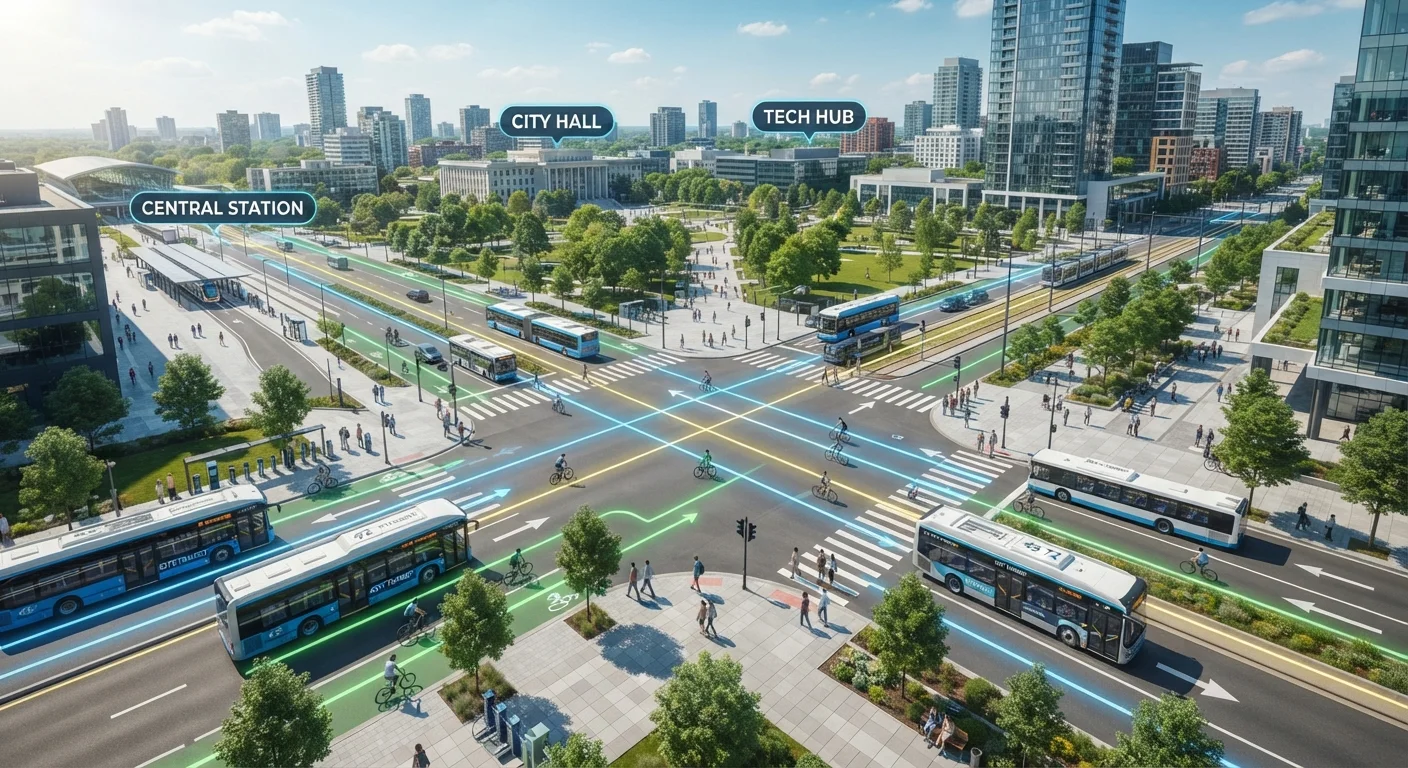
Mobility as a Service — commonly shortened to MaaS — is a transportation model that combines multiple ways of getting around into a single, integrated digital experience. Instead of buying a bus pass separately, booking a ride-hail through one app, and unlocking a rental bike through another, a MaaS platform lets users plan, book, and pay for an entire journey — across any mix of modes — from one place.
The concept treats transportation the way streaming services treat entertainment: rather than purchasing access to individual channels, you subscribe to a bundle. A commuter might take a bus to a transit hub, hop on a shared e-scooter for the last half-mile, and pay for both in a single transaction.
MaaS sits within a broader shift in how cities and transportation planners think about movement. For a plain-language overview of the vocabulary shaping this field, see Key Terms Every Mobility Watcher Should Know. For the wider context, The Future of Mobility maps all the forces reshaping how people and goods move.
How a MaaS Platform Actually Works
At the technical core of a MaaS platform are three interconnected functions: journey planning, booking, and payment. A user enters a destination, and the app calculates multi-modal route options — ranking them by cost, time, or carbon footprint depending on user preference. The user selects a route, and the app books each leg automatically with the relevant operators.
Payment is typically handled through a single wallet or subscription plan within the app. Some MaaS models offer pay-as-you-go pricing; others sell monthly mobility packages similar to a phone plan, where a flat fee covers a set number of transit rides, ride-hail credits, and bike-share minutes.
The backbone of all of this is real-time data. MaaS platforms depend on live feeds from transit agencies, shared-vehicle operators, and mapping services to show accurate arrivals, availability, and pricing. That data dependency is also one of the system's biggest vulnerabilities — covered in the challenges section below.
Look for MaaS features in existing apps
Many transit agency apps in major U.S. cities already incorporate early MaaS features — such as bike-share integration or ride-hail connections — without branding themselves as MaaS. If your city's transit app offers multimodal trip planning, it's worth exploring how far that integration actually goes before downloading separate apps for each mode.
Where MaaS Is Being Tested Today
Helsinki, Finland, is the city most frequently cited in MaaS research. Its Whim app — launched commercially in 2017 — integrates public transit, taxis, rental cars, and bike-share under subscription tiers. Academic studies of the Helsinki pilot found that heavy Whim users reported reduced car use, though researchers have cautioned that self-selection effects make causal claims difficult.
Singapore has embedded MaaS principles into its national smart-mobility framework, linking transit planning apps with ride-hailing and micromobility options. Several German cities, including Hamburg and Munich, have run pilots connecting regional rail with on-demand shuttle services.
In the United States, progress has been slower. Transit agencies in cities like Los Angeles and Columbus have developed multimodal trip-planning tools, but unified payment across public and private operators remains rare. The fragmented regulatory landscape — where transit is governed at the city or regional level — adds complexity that European unitary systems sometimes avoid.
The last-mile dimension of these efforts is explored in depth in Urban Mobility in Transition, which covers how cities are tackling short-distance travel gaps that MaaS platforms depend on solving.
The Challenges Standing in the Way
MaaS sounds straightforward on paper, but several structural obstacles have slowed adoption.
- Data-sharing tensions: Private ride-hail and scooter companies are reluctant to share real-time operational data with competitors or public agencies, citing competitive sensitivity. Without open data feeds, integrated journey planning breaks down.
- Revenue distribution: When a user pays a single MaaS subscription, how are funds split between the bus operator, the bike-share provider, and the ride-hail service? Negotiating those agreements is legally and commercially complex.
- Equity and access: MaaS platforms require smartphones and digital payment methods. Residents without reliable internet access, older adults less comfortable with apps, and unbanked populations risk being excluded if equity isn't designed in from the start.
- Regulatory fragmentation: In the U.S., transportation authority is distributed across hundreds of local and regional agencies. Coordinating a unified MaaS framework across jurisdictions demands political will that has so far been hard to sustain.
Urban planners are also adapting physical infrastructure in parallel — from dedicated drop-off zones to smart signals — as explored in How Cities Are Redesigning Streets.
Equity gaps need deliberate design solutions
MaaS platforms that rely solely on smartphone access and digital payment will inherently exclude some populations — including lower-income residents, older adults, and people without bank accounts. Transportation researchers and advocates have consistently flagged that equity must be built into MaaS policy from the outset, not treated as an afterthought once the technology is deployed.
What MaaS Means for Cities and Commuters
If MaaS reaches meaningful scale, urban transportation researchers suggest it could reduce the number of private vehicles on city streets — though that outcome depends heavily on whether MaaS complements strong public transit rather than substituting for it. A well-designed MaaS layer on top of a weak bus network is unlikely to move the needle; the underlying service has to be reliable first.
For individual commuters, the clearest near-term benefit is convenience: fewer apps, fewer accounts, and a single view of every available option for a given trip. The comparison with private car ownership is nuanced — Ride-Sharing vs. Car Ownership breaks down where the trade-offs actually land for different types of households.
For city planners, MaaS generates a new category of aggregate mobility data that could improve network planning, identify underserved corridors, and help model the impact of new housing or employment centers on transportation demand. Managing that data responsibly — with appropriate privacy protections — will be as important as the technology itself.
MaaS is not a finished product. It is better understood as a design direction: a set of principles about integration, user experience, and shared infrastructure that cities are testing in different ways. How far it travels depends on the regulatory frameworks, commercial agreements, and public investment decisions that governments make over the coming decade.
ITDP (Institute for Transportation and Development Policy)
A research and advocacy organization publishing in-depth analysis on sustainable urban transportation, including MaaS-adjacent topics like bus rapid transit and shared mobility policy.
Transit app (general category)
Multi-modal trip planning apps available in many cities offer a practical, real-world example of how MaaS principles are beginning to appear in consumer tools — useful for understanding the concept firsthand.
NACTO Urban Street Design Guide
Published by the National Association of City Transportation Officials, this resource covers how street infrastructure is being redesigned to accommodate shared mobility, drop-off zones, and new transit modes.
Frequently Asked Questions
MaaS is a system that brings multiple transportation options — buses, trains, bikes, ride-hailing, scooters — into one app. Users plan, book, and pay for any combination of modes through a single digital interface rather than dealing with each provider separately.
Helsinki, Finland, is widely cited as an early leader through its Whim app. Singapore has integrated MaaS concepts into its national smart mobility strategy. Several European and Asian cities have active pilots, while U.S. cities are largely in earlier planning phases.
Full MaaS integration is still limited in the U.S. Some transit agencies offer multi-modal trip planning apps, but unified payment across private and public operators remains uncommon. Several cities are exploring pilot programs, though none has yet matched Helsinki's scope.
No. MaaS is designed as an alternative for trips where other modes make more sense, not a mandate to sell your vehicle. Over time, researchers suggest strong MaaS adoption could reduce household car ownership rates, but individual choice remains central to the concept.
Ride-sharing apps connect passengers to drivers for a single mode. MaaS goes further by integrating public transit, shared bikes, scooters, and other options into a single journey, using whichever combination of modes is most efficient for a given trip.
Data-sharing between competing private operators, regulatory fragmentation, and the political complexity of public-private partnerships are the primary hurdles. Building consumer trust in a new payment model and ensuring equitable access for all income levels are also significant concerns.
The content on this site is for informational purposes only and is not a substitute for professional advice. Always consult a qualified professional for guidance specific to your situation.