

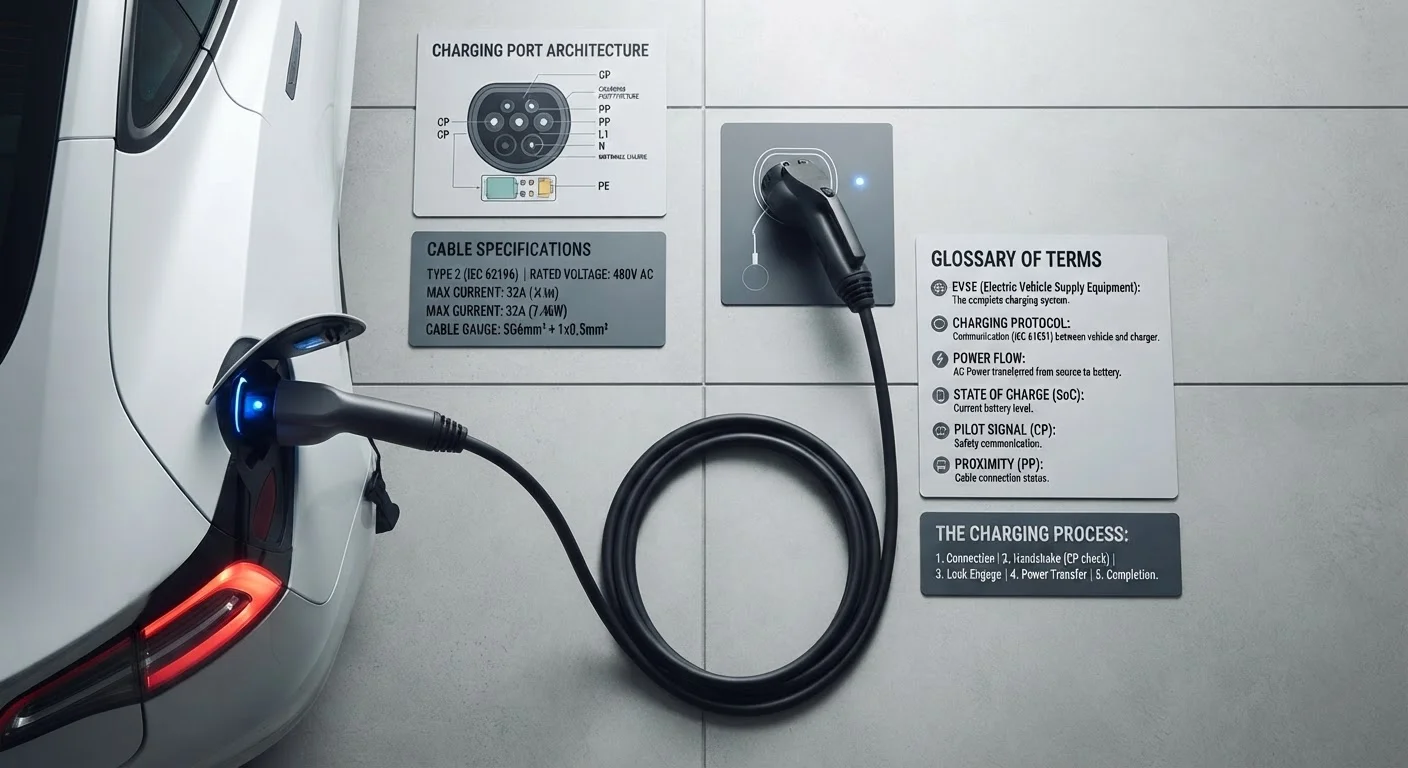
Why EV Language Matters
Electric vehicles come with a vocabulary that can feel impenetrable to newcomers. Spec sheets reference kilowatt-hours, range estimates cite competing testing standards, and charging discussions invoke acronyms that weren't part of any driver's ed curriculum. Getting fluent in this language isn't just an academic exercise — it helps you interpret real-world range, evaluate charging options, and understand what your vehicle's battery is actually doing.
This reference covers the terms you're most likely to encounter as an EV owner or prospective buyer. For a deeper look at the underlying technology, see how EVs work under the hood.
Energy, Range, and Efficiency Terms
Battery capacity, range estimates, and efficiency ratings are the numbers that dominate EV conversations — and each has specific meaning.
| Typical EV battery capacity range | 40–100+ kWh (Varies by vehicle segment and model year) |
| EPA vs. WLTP range gap | EPA typically reads 10–20% lower (General industry observation across multiple models) |
| Level 2 home charging speed | 10–30 miles of range per hour (Depends on charger output (kW) and vehicle OBC rating) |
| DC fast charge session time (typical) | 20–40 minutes for significant range (Varies widely by vehicle, battery size, and charger power) |
| Recommended daily SoC window | 20%–80% for routine charging (General guidance from multiple manufacturers; check your vehicle's manual) |
State of Charge (SoC) is the percentage of usable energy currently in the battery, analogous to a fuel gauge. Most manufacturers recommend keeping SoC between roughly 20% and 80% for everyday use to reduce long-term battery stress — though exact guidance varies by vehicle. Regenerative braking captures kinetic energy during deceleration and converts it back into stored electricity, partially replenishing the battery and extending range on every drive. For a side-by-side comparison of how these dynamics differ between battery EVs and plug-in hybrids, see BEVs vs. PHEVs explained.
Charging Standards and Levels
Charging infrastructure has its own layered terminology. Level 1 charging uses a standard household outlet (120V in the US) and adds roughly 3–5 miles of range per hour — adequate for low-mileage drivers but slow for most. Level 2 chargers operate at 240V and are the most common home and public option, typically delivering 10–30 miles of range per hour depending on the vehicle and charger output.
DC fast charging (also called Level 3 or DCFC) bypasses the vehicle's onboard charger to deliver direct current straight to the battery, enabling charge speeds that can add 100–200+ miles in 20–40 minutes on compatible vehicles. Not all EVs support DC fast charging, and sustained use at high speeds can accelerate battery wear over time.
Connector formats also vary. CCS (Combined Charging System) and CHAdeMO are the two legacy DC fast-charge standards in the US, while NACS (North American Charging Standard) — originally developed by one major automaker — has been adopted by a growing number of manufacturers and is becoming a dominant US standard. If you're thinking through your home and public charging setup, the EV decision checklist walks through what to evaluate.
Grid Integration and Advanced Features
Vehicle-to-Grid (V2G) is a bidirectional charging capability that allows an EV's battery to send stored electricity back to the power grid during periods of high demand. A related concept, Vehicle-to-Home (V2H), uses the car as a backup power source for a residence. Both capabilities depend on compatible hardware in both the vehicle and the charger, and availability varies widely across models and markets.
Over-the-Air (OTA) updates allow manufacturers to push software improvements, bug fixes, or feature additions to a vehicle's systems wirelessly — similar to how a smartphone updates. These updates can affect charging behavior, range estimates, and driver-assistance features. Understanding how software shapes an EV's long-term value is explored further in how EV resale value works.
For readers interested in where EV technology fits within broader transportation trends, the Future of Mobility hub covers autonomous vehicles, next-gen powertrains, and more.
Terminology Is Still Evolving
The EV industry is moving quickly, and some terms — particularly around charging standards — are in active flux. Connector formats, charging protocols, and testing standards that are current today may shift as infrastructure expands and regulations evolve. When making vehicle or infrastructure decisions, it's worth checking manufacturer documentation and regulatory sources for the latest specifications rather than relying solely on general references.
The content on this site is for informational purposes only and is not a substitute for professional advice. Always consult a qualified professional for guidance specific to your situation.