

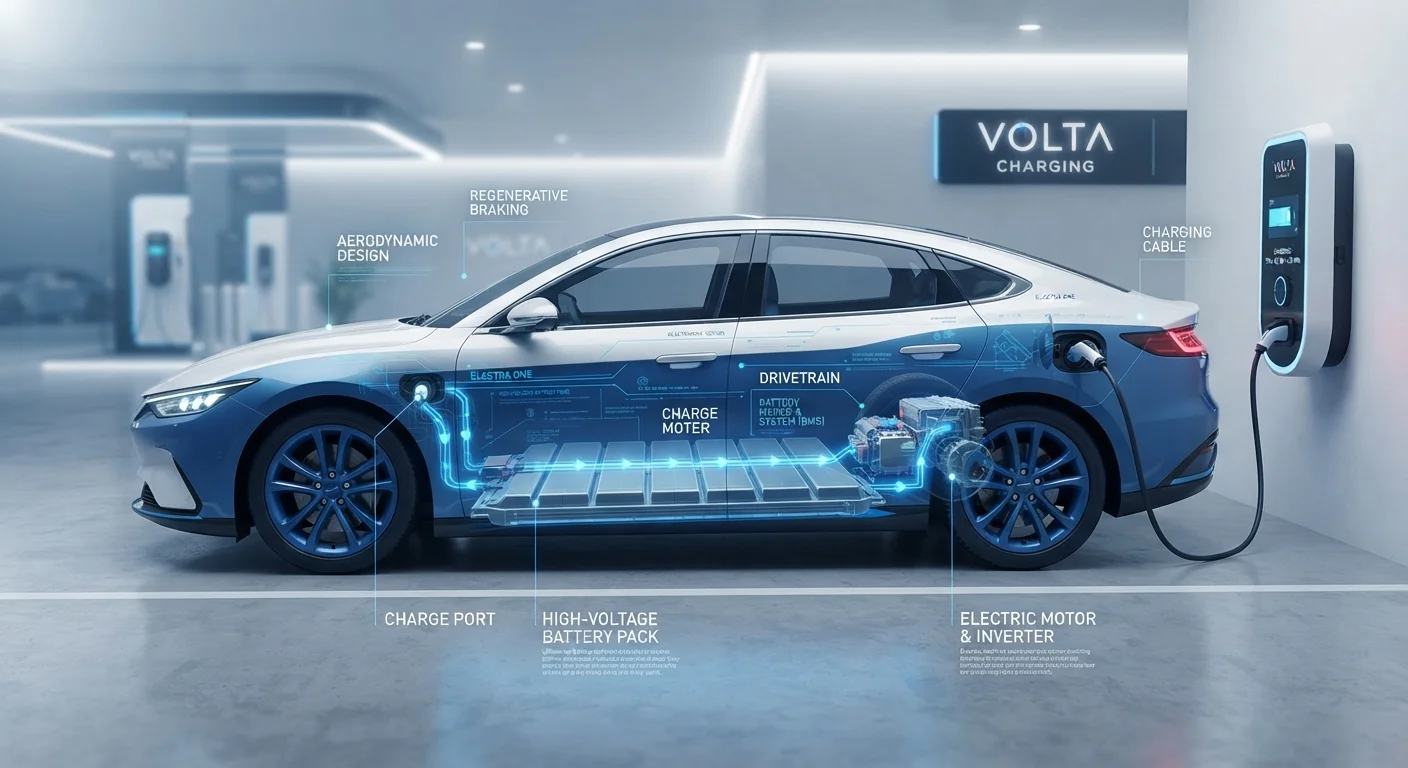
The Core Architecture: Motor, Battery, and Controller
Strip away the bodywork of a battery electric vehicle and three fundamental systems define everything about how it operates: the electric motor, the high-voltage battery pack, and the power electronics controller that manages them both.
The electric motor does the work that a combustion engine does in a conventional car — it converts energy into rotational force that turns the wheels. Most production EVs use permanent-magnet synchronous motors or AC induction motors, both of which generate torque almost instantaneously. That characteristic — delivering peak torque from zero rpm — is why EVs feel so responsive at low speeds.
The battery pack is the EV's fuel tank and engine rolled into one. Built from thousands of individual lithium-ion or LFP cells grouped into modules and then into a pack, it stores energy measured in kilowatt-hours (kWh). A larger pack generally delivers more driving range. The pack sits low in the vehicle floor in most designs, which lowers the center of gravity and improves handling.
The power electronics controller — sometimes called the inverter — acts as the brain between battery and motor. It converts the battery's direct current (DC) into the alternating current (AC) the motor needs, and it regulates power delivery based on driver input. For a deeper look at how this compares to combustion engineering, see the engineering overview of ICE vs. EV drivetrains.
85–90%
Energy efficiency of electric drivetrains
Electric motors convert roughly 85–90% of stored electrical energy into motion, compared to approximately 20–40% for typical internal combustion engines, according to the U.S. Department of Energy.
~40%
Share of new car sales that were EVs in Norway
Norway has consistently led global EV adoption rates; by the early 2020s, battery electric vehicles accounted for well over a third of new passenger car registrations annually.
300+ miles
Range achieved by some long-range EV models
Advances in battery energy density have enabled select production EVs to achieve EPA-estimated ranges exceeding 300 miles on a single charge, according to manufacturer and EPA disclosures.
Regenerative Braking: Turning Deceleration Into Energy
One of the most important efficiency features in any EV is regenerative braking — a system that recovers energy that would otherwise be lost as heat during deceleration.
When a driver lifts off the accelerator or applies the brakes, the electric motor reverses its role and operates as a generator. It applies resistance to the drivetrain, slowing the vehicle while simultaneously producing electricity that flows back into the battery. Friction brakes are still present and engage for harder stops, but regenerative braking handles a significant portion of everyday deceleration.
The practical benefit is measurable. In city driving, where vehicles accelerate and brake frequently, regenerative braking can meaningfully extend range compared to highway driving at steady speeds. Many EVs allow drivers to adjust the intensity of regenerative braking, and some offer a "one-pedal driving" mode where lifting off the accelerator alone is enough to bring the car to a complete stop.
Maximize Range With Regenerative Braking
If your EV offers adjustable regenerative braking intensity, experimenting with a higher setting in city or suburban driving can noticeably extend your range. One-pedal driving — where releasing the accelerator slows the car significantly — takes a short adjustment period but becomes intuitive quickly. Consistent use of regen, rather than frequent hard braking, is one of the simplest habits for getting the most from each charge.
Charging: How EVs Refuel
Recharging an EV differs fundamentally from filling a gas tank — it happens over a period of time rather than in minutes, and it can occur almost anywhere there is access to electricity.
Charging is typically categorized by level. Level 1 uses a standard 120-volt household outlet and is the slowest option, best suited for overnight charging for drivers with modest daily mileage. Level 2 chargers operate at 240 volts — the same as a household clothes dryer — and are the most common home and workplace solution. DC fast charging (sometimes called Level 3) bypasses the vehicle's onboard charger and delivers high-voltage direct current directly to the battery, enabling faster energy delivery.
The vehicle's onboard charger also plays a role: it governs how quickly AC power from Level 1 and Level 2 stations is converted and stored. A car with a 7.2 kW onboard charger will charge faster from a Level 2 station than one rated at 3.3 kW, even if both are plugged into the same outlet.
For a broader look at what new EV drivers should consider about charging habits and range, see what first-time EV buyers should know. Unfamiliar terms like kWh, WLTP, and V2G are explained in the EV terminology glossary.
How EVs Differ From Combustion Vehicles in Practice
The engineering differences between EVs and conventional vehicles translate directly into a different ownership and driving experience.
Without a multi-speed transmission, EVs typically accelerate with a smooth, linear surge rather than the stepped power delivery of a geared drivetrain. There is no engine vibration at idle, and cabin noise is significantly lower at most speeds. The absence of an exhaust system, oil changes, spark plugs, and timing belts also means EVs have fewer scheduled maintenance requirements.
Energy efficiency is another meaningful distinction. Electric drivetrains convert roughly 85–90% of stored energy into motion, while internal combustion engines typically convert only 20–40%, with the remainder lost as heat. This gap is why per-mile energy costs for EVs are often lower, though the total cost of ownership depends on many variables including electricity rates, insurance, and purchase price.
For those interested in how the technology is evolving and where it fits alongside hydrogen and hybrid options, understanding future powertrain options offers broader context on where the industry is heading.
Frequently Asked Questions
An EV's electric motor converts electrical energy from the battery into rotational mechanical energy that drives the wheels. Most EVs use AC induction or permanent-magnet synchronous motors. Because electric motors generate maximum torque from a standstill, EVs accelerate quickly without needing a traditional multi-speed transmission.
Regenerative braking is a system that captures kinetic energy when the vehicle decelerates and converts it back into electricity stored in the battery. Instead of wasting that energy as heat through friction brakes, the motor acts as a generator. This process meaningfully extends driving range, particularly in stop-and-go city traffic.
Charging time varies widely depending on battery size, the vehicle's onboard charger, and the power level of the charging equipment. A standard Level 1 household outlet may take overnight or longer; a Level 2 home charger typically adds 20–30 miles of range per hour; DC fast chargers can add significant range in 20–45 minutes.
Electric drivetrains convert a higher percentage of stored energy into motion — roughly 85–90% efficiency versus around 20–40% for typical combustion engines. This efficiency advantage is a key reason EVs tend to have lower per-mile energy costs, though the total cost picture also includes purchase price, electricity rates, and other factors.
A battery electric vehicle (BEV) runs entirely on electricity and has no combustion engine. A plug-in hybrid electric vehicle (PHEV) combines a smaller battery and electric motor with a conventional gasoline engine, allowing it to run on electricity for shorter trips and switch to gasoline for longer ones. See our <a href="/automotive/electric-vehicles/battery-electric-vehicles-vs-plug-in-hybrids-key-differences-worth-knowing">BEV vs. PHEV comparison</a> for a full breakdown.
The content on this site is for informational purposes only and is not a substitute for professional advice. Always consult a qualified professional for guidance specific to your situation.