

Option A
Internal Combustion Engine (ICE)
The century-old standard powering the majority of vehicles on the road today.
Best for: Drivers who need long range, rapid refueling, and access to widespread fuel infrastructure without range anxiety.
Option B
Electric Powertrain (EV)
The rapidly maturing technology reshaping how vehicles are engineered and powered.
Best for: Drivers with predictable daily routes, home or workplace charging access, and interest in lower per-mile energy costs.
How Each Powertrain Actually Works
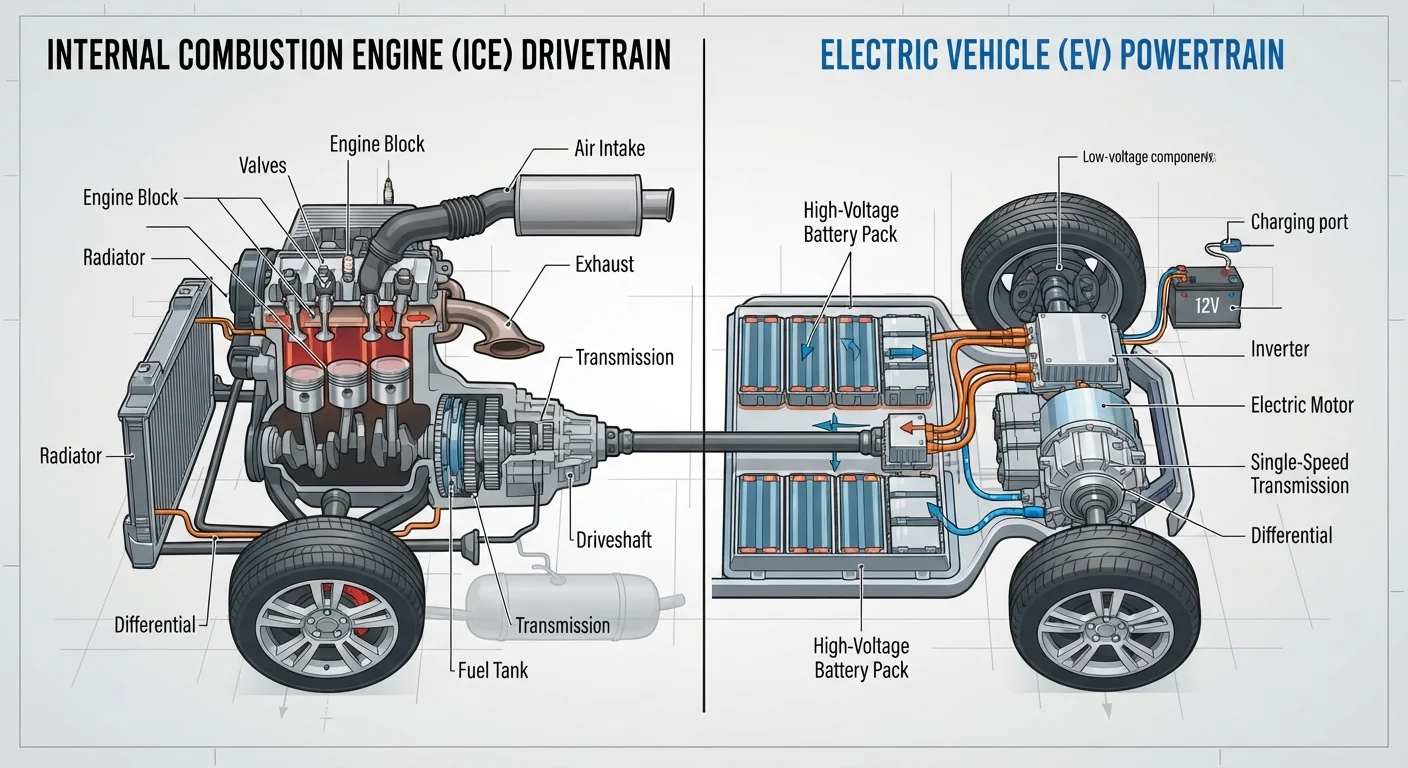
An internal combustion engine (ICE) produces motion by igniting a mixture of fuel and air inside cylinders. The resulting expanding gases push pistons, which turn a crankshaft, which ultimately spins the wheels through a transmission and driveline. This chain of mechanical conversion involves hundreds of precisely toleranced components — pistons, valves, camshafts, timing belts, and more — each adding complexity and potential failure points.
An electric powertrain works differently at every level. A battery pack stores energy in chemical form, then delivers it as electricity to one or more electric motors. Those motors convert electrical energy directly into rotational force with very few moving parts. There is no multi-gear transmission in most battery electric vehicles (BEVs); a single-speed reduction gear is typically sufficient because electric motors produce strong torque across a wide RPM range. For a deeper look at the core components, see how EVs work and why they're different.
| Criterion | ICE Powertrain | Electric Powertrain |
|---|---|---|
| Energy conversion efficiency | 20–40% (fuel to motion) | 85–90%+ (electricity to motion) |
| Torque delivery | Peaks at higher RPM | Maximum torque from standstill |
| Moving parts count | Hundreds of components | Far fewer; simpler drivetrain |
| Refueling / recharging time | Under 5 minutes | 20–60+ minutes (varies by charger) |
| Infrastructure availability (U.S.) | 145,000+ gas stations | Growing but less dense network |
| Routine maintenance needs | Oil changes, more fluid services | Fewer fluids; reduced brake wear |
| Energy storage form | Liquid fuel (high energy density) | Battery pack (lower energy density per kg) |
Efficiency, Performance, and Energy Losses
Energy efficiency is where the two architectures diverge most sharply. A conventional gasoline engine converts roughly 20–40% of the fuel's energy content into motion; the remainder exits as heat through the exhaust and cooling systems. Electric motors, by contrast, typically convert over 85–90% of electrical energy into mechanical work, with losses concentrated in battery discharge, power electronics, and motor windings.
That efficiency gap has real consequences for running costs and emissions. However, ICE vehicles benefit from the high energy density of liquid fuels — a full tank of gasoline stores enormous amounts of energy in a compact, lightweight package that currently no battery can match per kilogram.
On performance, electric motors deliver their full torque output almost instantaneously from a standstill, which explains why high-output EVs can accelerate very quickly despite having simpler drivetrains. ICE engines reach peak torque at higher RPM and rely on gear ratios to manage power delivery across different speeds.
~20–40%
Thermal efficiency of gasoline engines
The U.S. Department of Energy estimates conventional gasoline engines convert only 20–40% of fuel energy into usable motion, with the rest lost as heat.
85–90%+
Electric motor energy efficiency
The U.S. Department of Energy notes that electric motors convert over 85% of electrical energy into mechanical power under typical driving conditions.
145,000+
Public gasoline stations in the U.S.
The U.S. Energy Information Administration and industry sources estimate over 145,000 retail gasoline outlets operate across the country.
Maintenance, Infrastructure, and Real-World Trade-Offs
The mechanical simplicity of an electric drivetrain reduces routine maintenance. EVs eliminate oil and filter changes, have fewer fluids to monitor, and experience reduced brake wear because regenerative braking — which recovers kinetic energy back into the battery — handles much of the deceleration load. The EV terminology glossary explains regenerative braking and other key concepts in plain language.
ICE vehicles have a mature, global service network and decades of technician training behind them. Repairs are well understood and parts are widely available, which matters especially in regions where EV expertise is still developing.
Infrastructure is the most consequential practical divide. The U.S. has over 145,000 public gasoline stations; the public EV charging network, while growing rapidly, remains smaller and less evenly distributed. Charging speed also varies widely — a DC fast charger can add meaningful range in 20–30 minutes under optimal conditions, while a gasoline fillup takes under five minutes regardless of location.
Consumers weighing this decision should consider their specific driving patterns and local charging access. A structured approach to that decision is outlined in this practical decision checklist for prospective EV buyers.
Hybrid Powertrains Bridge the Gap
Plug-in hybrids (PHEVs) and conventional hybrids combine elements of both architectures, offering electric-only capability for shorter trips while retaining a combustion engine for longer range. They represent a transitional solution that many drivers and manufacturers are using while charging infrastructure matures. For a side-by-side breakdown of BEVs versus PHEVs, see BEVs vs. plug-in hybrids explained.
Where the Industry Is Heading
Automakers are not uniformly abandoning combustion — many are investing in both platforms simultaneously while developing hybrid bridges. Regulatory pressure in Europe, California, and other markets is accelerating electrification timelines, but engineering and consumer realities mean ICE vehicles will remain in production and on roads globally for decades. For a broader look at the different paths to cleaner mobility, including hydrogen fuel cells and plug-in hybrids, see how alternative powertrains compare. Understanding both architectures — their strengths, limitations, and cost structures — equips consumers to evaluate industry claims and make more informed decisions as the market continues to shift.
The content on this site is for informational purposes only and is not a substitute for professional advice. Always consult a qualified professional for guidance specific to your situation.