

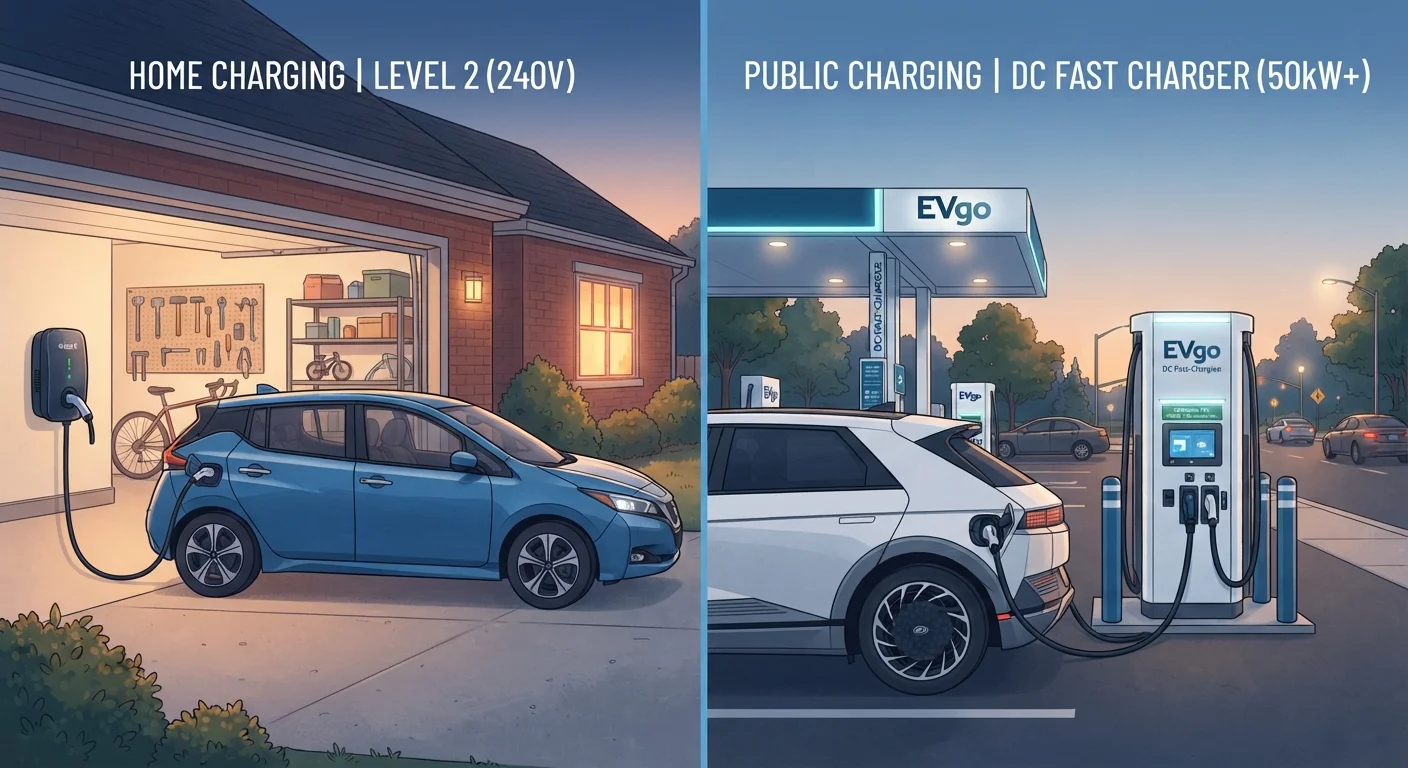
Option A
Home Charging
The convenient, low-cost overnight default.
Best for: EV owners with a dedicated parking space who charge regularly overnight and prioritize low per-mile energy costs.
Option B
Public Charging
The on-the-go solution for range and flexibility.
Best for: Drivers without home charging access, those on long road trips, or anyone who needs a quick top-up away from home.
Cost: The Gap Is Real, but Context Matters
For most EV owners, home charging is the clear cost leader. Residential electricity in the U.S. averages roughly 12–16 cents per kWh depending on state and utility, translating to an effective fueling cost that's often a fraction of gasoline for an equivalent distance. Enrolling in a time-of-use rate plan — where utilities charge less during off-peak hours like late night — can push that cost even lower.
Public charging is a different story. Level 2 public chargers (the slower AC type commonly found in parking lots and retail locations) typically charge by the hour or per kWh, and rates vary widely. DC fast chargers — the high-speed units capable of delivering 50 to 350 kilowatts — tend to carry premium pricing that can approach or occasionally exceed the per-mile cost of gasoline for some vehicles. Network membership programs from providers like Electrify America or ChargePoint can reduce session costs, but the baseline rate is almost always higher than charging at home.
80%
EV charging done at home or work
The U.S. Department of Energy has consistently found that the large majority of EV charging in the United States occurs at home or at the workplace rather than at public stations.
~$0.35
Average public DC fast charge per kWh
Per-kWh pricing at public DC fast chargers in the U.S. commonly ranges from $0.28 to over $0.48 depending on the network, state, and membership status.
37 miles
Average daily U.S. driving distance
Federal Highway Administration data shows the average American drives approximately 37 miles per day — well within the overnight recharge capacity of most Level 2 home chargers.
For riders who rely entirely on public charging, those costs accumulate meaningfully over time. The financial case for an EV is considerably stronger when home charging forms the foundation of a driver's routine.
Convenience and Speed: Different Definitions of Easy
Home charging redefines convenience by eliminating the trip entirely. Plug in when you arrive home, wake up to a topped-off battery. A standard Level 2 home charger (240V, typically 7.2–11.5 kW) adds roughly 20–30 miles of range per hour, which is more than sufficient for the average American's daily driving of around 37 miles. The home charger installation process involves an upfront electrical assessment and permitting, but once in place, the hardware largely disappears into the background of daily life.
Public charging demands more active planning. Finding an available, functioning charger — especially during peak hours near highways — can require detours and waiting. That said, DC fast chargers do something home units cannot: deliver speed. A 150–350 kW fast charger can bring many EVs from 20% to 80% state of charge in roughly 20–45 minutes depending on the vehicle's onboard charging capacity. That's a meaningful window for a driver who needs to continue a long journey.
What 'Charging Speed' Actually Depends On
A charger's kilowatt rating is only half the equation. Every EV has a maximum onboard AC and DC charging acceptance rate — the car itself is the limiting factor, not just the station. A vehicle rated for 50 kW DC charging won't benefit from plugging into a 150 kW station beyond its own ceiling. Understanding your vehicle's charging rate specifications helps set realistic expectations before pulling up to a fast charger.
The reliability gap is worth acknowledging. Industry research and surveys of EV drivers have repeatedly flagged out-of-order public chargers as a frustration point. The experience varies significantly by network, station age, and geography. For an overview of where infrastructure stands globally, see the state of EV charging infrastructure around the world.
| Criterion | Home Charging | Public Charging |
|---|---|---|
| Typical cost per kWh | ~$0.12–$0.16 (residential) | $0.25–$0.50+ (varies by network) |
| Charging speed | Level 2: ~20–30 mi/hr | DC fast: up to 80% in 20–45 min |
| Upfront cost | Equipment + installation required | No setup cost; pay per session |
| Convenience | Charge overnight, no detour needed | Requires trip planning and availability |
| Reliability | Highly consistent once installed | Variable; outages reported on some networks |
| Access requirement | Private parking/outlet needed | Open to all; no dedicated space needed |
| Best use case | Daily commuting and routine top-ups | Road trips and drivers without home access |
Who Each Approach Actually Works For
The honest answer for most EV owners is that neither approach stands entirely alone — they work in tandem. A homeowner with a Level 2 charger covers 90–95% of daily needs at home and reserves public fast charging for road trips or emergencies. That hybrid pattern is the norm rather than the exception.
The equation shifts meaningfully for apartment residents, renters, or anyone without reliable off-street parking. For these drivers, workplace charging, destination chargers (at hotels, shopping centers), and public networks become the core infrastructure. This group faces a genuine access challenge that is a central policy and industry discussion in the broader EV adoption debate. If you're evaluating whether an EV fits your situation, the EV switch decision checklist is a useful structured starting point.
Battery management also enters the picture. Frequent DC fast charging — while convenient — generates more heat than slower AC charging and is generally thought by engineers to contribute more wear over time, though modern battery management systems are designed to mitigate this. Occasional fast charging is considered routine and unproblematic by most manufacturers; it's a question of balance rather than avoidance. For newcomers still building their understanding, what first-time EV buyers should know covers these ownership fundamentals in detail.
The content on this site is for informational purposes only and is not a substitute for professional advice. Always consult a qualified professional for guidance specific to your situation.