

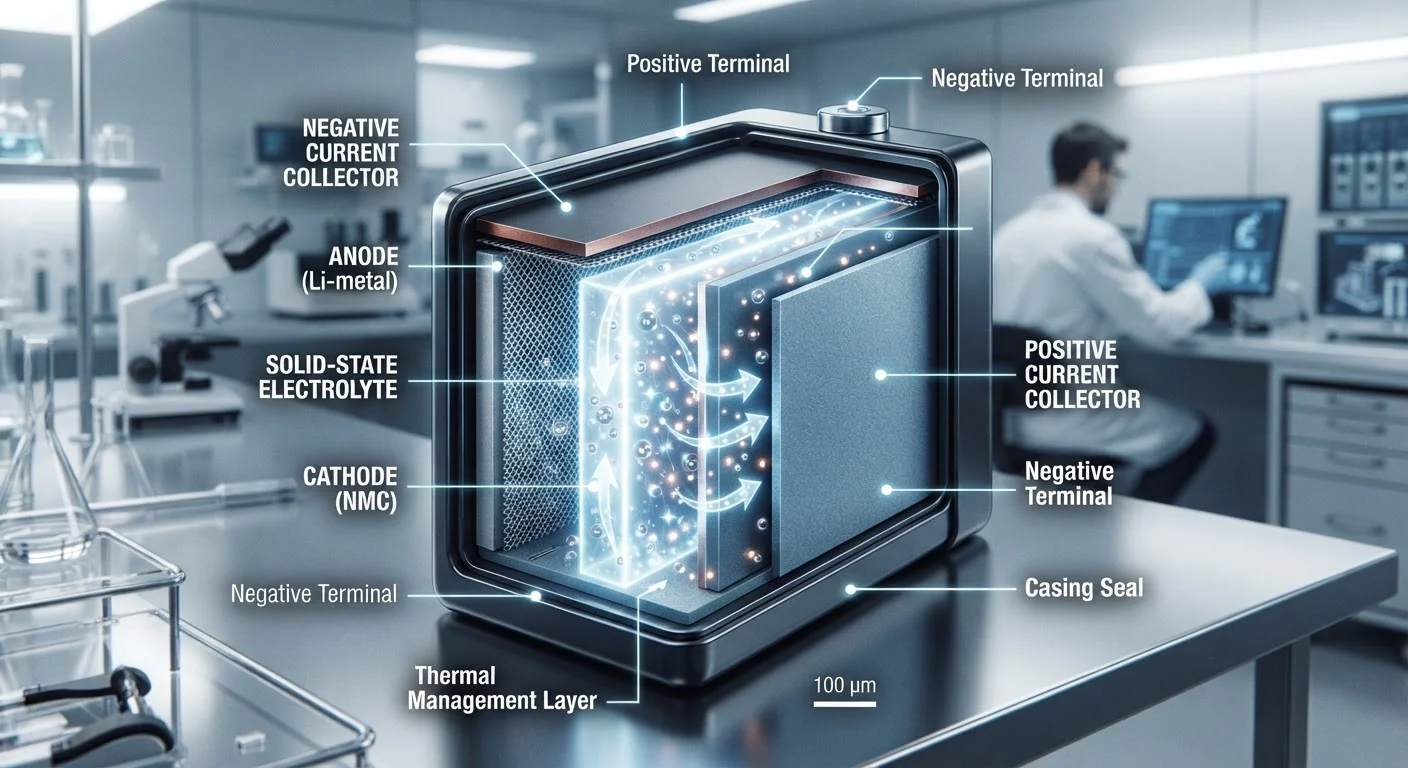
Why the Electrolyte Matters So Much
Inside every battery — from a smartphone to an electric vehicle — ions shuttle back and forth between two electrodes to store and release energy. The electrolyte is the medium that allows this movement. In the lithium-ion packs that power virtually every EV on the road today, that medium is a liquid or gel saturated with lithium salts.
That liquid works well, but it comes with constraints. It can degrade over charge cycles, it sets an upper limit on how much energy can be packed into a given volume, and it is chemically flammable — a factor engineers must carefully manage through thermal controls and safety systems. To understand the broader picture of how today's EVs use these battery systems, see how EV motors and batteries work together.
Swapping the liquid for a solid material is not a minor tweak. It changes the fundamental chemistry of the cell, which is why solid-state development has attracted billions of dollars in research investment from automakers, battery manufacturers, and governments worldwide.
Potential Advantages — and Why They Are Not Guaranteed
Proponents of solid-state technology point to three headline benefits: higher energy density, faster charging, and improved safety. Each deserves a measured look.
Energy density: Solid electrolytes can be compatible with lithium metal anodes, which hold significantly more energy per unit of weight than the graphite anodes used in conventional cells. This is where projections of 40–100% range improvements originate, though translating laboratory results into full vehicle packs involves real engineering trade-offs.
Charging speed: Some solid electrolyte chemistries tolerate higher current flows without the same degradation risks seen in liquid-electrolyte cells, which could support faster charging. The extent of that advantage depends heavily on which solid electrolyte material is used.
Safety: Eliminating flammable liquid solvents removes one trigger for thermal runaway — the dangerous chain reaction that can cause battery fires. Solid-state cells are not immune to failure, but the risk profile is different and, in some respects, more manageable.
~$6B+
Global solid-state battery R&D investment
Industry analysts and research groups estimate cumulative global investment in solid-state battery development across automotive, government, and startup sectors has surpassed several billion dollars as of the mid-2020s.
40–100%
Potential energy density improvement over lithium-ion
Researchers have projected this range of improvement using lithium metal anodes with solid electrolytes, based on laboratory-scale cell testing reported in peer-reviewed literature.
Late 2020s
Targeted first production timeline
Multiple automakers and battery developers have publicly stated target dates in the late 2020s for initial solid-state EV models or pilot production runs, though industry observers note timelines have shifted previously.
It is worth noting that many of these advantages have been demonstrated in small, controlled laboratory cells. Scaling them up while keeping costs competitive is where the difficulty lies.
The Manufacturing Challenge Keeping Solid-State EVs Off the Road
Building a solid-state cell that works in a lab is one thing. Building millions of them reliably and affordably is another challenge entirely.
The solid electrolyte layer must be extraordinarily thin — often just a few microns — to allow efficient ion movement. Producing that layer without cracks, pinholes, or contamination, at the speed automotive manufacturing demands, has proven exceptionally difficult. Volume and interface stability are two of the most persistent engineering problems the industry is working through.
For EV Shoppers: What This Means Now
If you are considering an electric vehicle today, solid-state batteries are not yet a factor in any mass-market purchase. Current lithium-ion packs are proven, improving, and covered by manufacturer warranties. Decisions about waiting for solid-state technology depend on how long a timeline you are comfortable with — the technology is real, but production readiness at scale remains years away.
Several major players — including Toyota, QuantumScape, Solid Power, and Samsung SDI, among others — have announced timelines for initial production or pilot programs targeting the late 2020s. Industry analysts broadly acknowledge that these timelines have slipped before and that the path from prototype to mass-market vehicle involves more variables than battery chemistry alone.
For context on how charging infrastructure — another essential piece of the EV puzzle — is developing in parallel, see the global state of EV charging networks.
Where Solid-State Technology Fits the Broader EV Picture
Solid-state batteries are one of several competing approaches to extending EV capability and reducing cost. Lithium iron phosphate (LFP) chemistry, silicon anodes, and next-generation thermal management systems are all improving conventional lithium-ion packs in the nearer term. Solid-state technology is not the only path forward — it is the most ambitious one currently being pursued at scale.
The broader competition among powertrain technologies — battery EVs, hydrogen fuel cells, plug-in hybrids — also shapes how urgently the industry pursues solid-state breakthroughs. That competitive landscape is explored in more depth in a comparison of EV, hydrogen, and hybrid powertrains.
For consumers, the practical implication is straightforward: today's EVs use lithium-ion technology that is mature, well-understood, and continuing to improve. Solid-state packs, if manufacturing challenges are solved, could deliver a meaningful generational leap in performance and safety — but that leap is still in progress, not yet on dealer lots.
Frequently Asked Questions
Solid-state batteries can potentially store more energy in the same physical space, charge faster, and operate more safely by removing flammable liquid electrolytes. However, these advantages are still largely demonstrated at the laboratory or prototype stage and have not yet been proven at mass-market scale.
Several automakers and battery developers have publicly targeted the late 2020s for initial production vehicles using solid-state technology. Industry analysts note that timelines have shifted before, and mass-market availability at competitive prices may take longer to achieve.
Removing flammable liquid electrolytes addresses one known risk factor in conventional lithium-ion cells — thermal runaway driven by electrolyte ignition. That said, solid-state cells are not without failure modes, and real-world safety depends heavily on full pack engineering, not the electrolyte material alone.
Manufacturing is the primary hurdle. Producing thin, defect-free solid electrolyte layers consistently at high volume and low cost is technically demanding. The industry has not yet solved this problem at automotive scale.
Early projections from researchers and developers suggest energy density improvements on the order of 40–100% compared to current lithium-ion cells, which could translate to meaningfully longer range. These figures come from laboratory conditions, and real-world gains will depend on full system integration.
The content on this site is for informational purposes only and is not a substitute for professional advice. Always consult a qualified professional for guidance specific to your situation.