

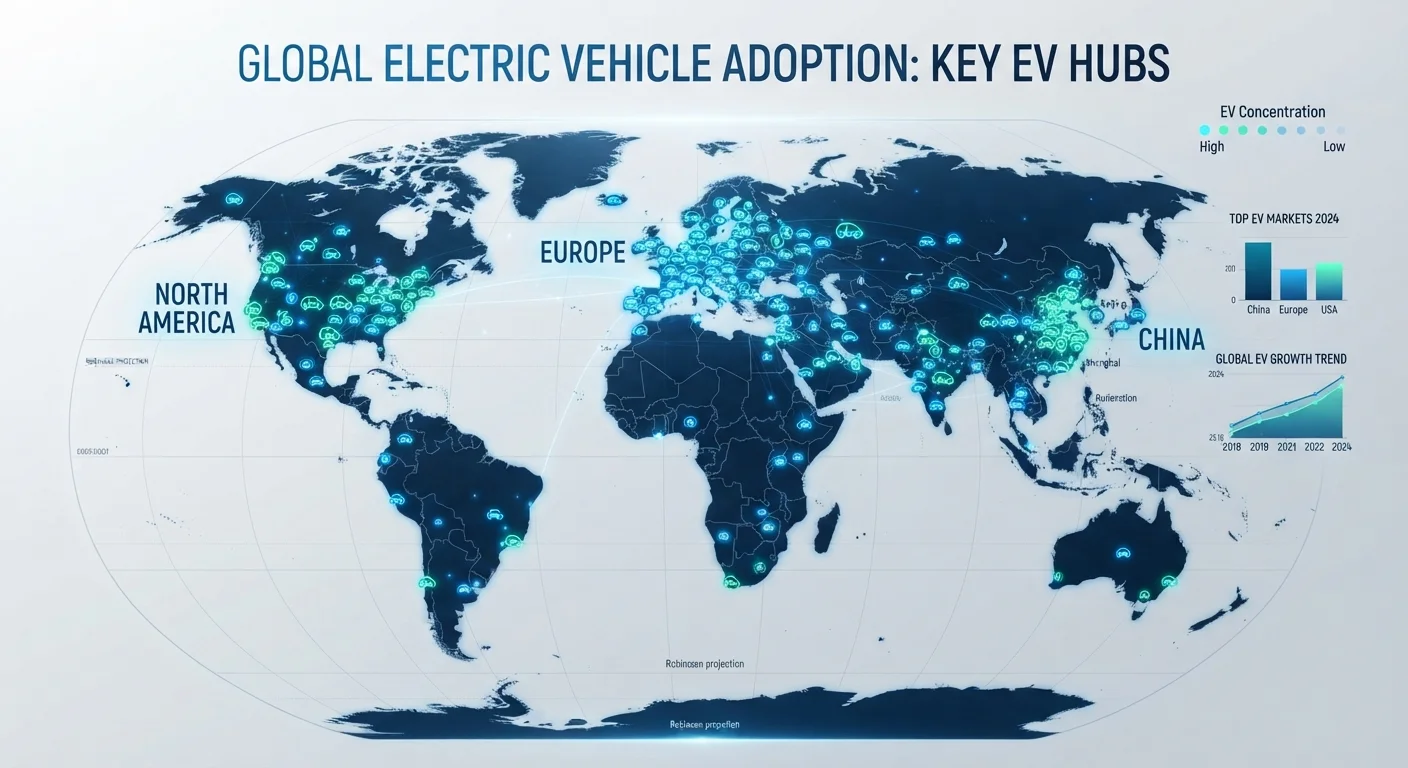
How Countries Are Measured on EV Adoption
When analysts compare EV adoption across countries, the most widely used metric is EV market share — the percentage of new passenger vehicle sales that are fully electric (BEV) or plug-in hybrid (PHEV). Raw sales numbers alone are misleading; a country selling 500,000 EVs into a 20-million-vehicle market looks very different from one where EVs account for 80% of all new registrations.
Infrastructure density, government subsidy structures, and grid energy mix are secondary indicators that help explain why adoption rates differ — not just where they stand. Several interconnected forces drive or suppress these numbers, from consumer income levels to utility costs.
Country-by-Country Snapshot
Norway
Norway consistently posts the world's highest EV market share — surpassing 80% of new car sales in recent years. The country's policy toolkit is unusually comprehensive: full VAT exemption on EV purchases, no road tolls, reduced ferry fares, and access to bus lanes. Norway's largely hydropower-based electricity grid also means EVs charge on some of the cleanest energy available anywhere. Its small population of roughly 5 million makes nationwide incentive programs financially manageable for the government.
China
China is the world's largest EV market by volume, with several million units sold annually. Government-mandated New Energy Vehicle (NEV) credits require automakers to hit sales quotas or purchase credits from competitors. Domestic manufacturers have scaled rapidly, producing a wide range of affordable models that have driven broad consumer adoption — particularly in urban centers. China also leads globally in public charging infrastructure deployment.
United States
The US reached an EV share of roughly 7–8% of new vehicle sales in 2023. Federal tax credits under the Inflation Reduction Act (IRA) — up to $7,500 for qualifying purchases — have supported demand, though income caps and vehicle sourcing requirements limit eligibility. Adoption rates vary sharply by state: California, where EVs accounted for over 25% of new car sales, functions almost as a separate market. Rural areas lag due to charging gaps. For a broader look at ownership economics, see how total cost of ownership compares over a vehicle's lifetime.
Europe (Germany, UK, France)
Western Europe as a bloc is a strong EV performer, though individual country rates diverge. Germany, the EU's largest auto market, saw EV share dip after subsidy cuts in late 2023 — demonstrating how sensitive consumer behavior is to incentive removal. The UK and France maintain stronger purchase incentives and have signaled firm combustion-engine phase-out dates. The EU's 2035 ban on new ICE vehicle sales continues to shape automaker planning across the continent. Emissions regulations differ significantly even among neighboring countries.
Emerging Markets
India, Brazil, and Southeast Asian nations represent a different adoption curve. Lower average incomes, limited charging infrastructure, and electricity grid reliability concerns slow uptake. India has prioritized two- and three-wheeler electrification as a more accessible entry point. These markets are increasingly important to long-term global EV projections.
What the Data Tells Us
Three consistent patterns emerge from the global data. First, upfront cost reduction through policy is the single most powerful lever — countries with strong purchase incentives or low sticker prices (due to domestic manufacturing) outperform peers. Second, charging infrastructure availability shapes consumer confidence even more than range anxiety about the vehicles themselves. See how charging networks are expanding globally for a regional breakdown. Third, grid cleanliness matters for long-term credibility: EVs on coal-heavy grids reduce tailpipe emissions but carry a larger lifecycle carbon footprint than those charged on renewable power.
Readers considering a transition should weigh their local context carefully. A practical decision checklist can help assess charging access, driving patterns, and financial fit before committing.
The content on this site is for informational purposes only and is not a substitute for professional advice. Always consult a qualified professional for guidance specific to your situation.