

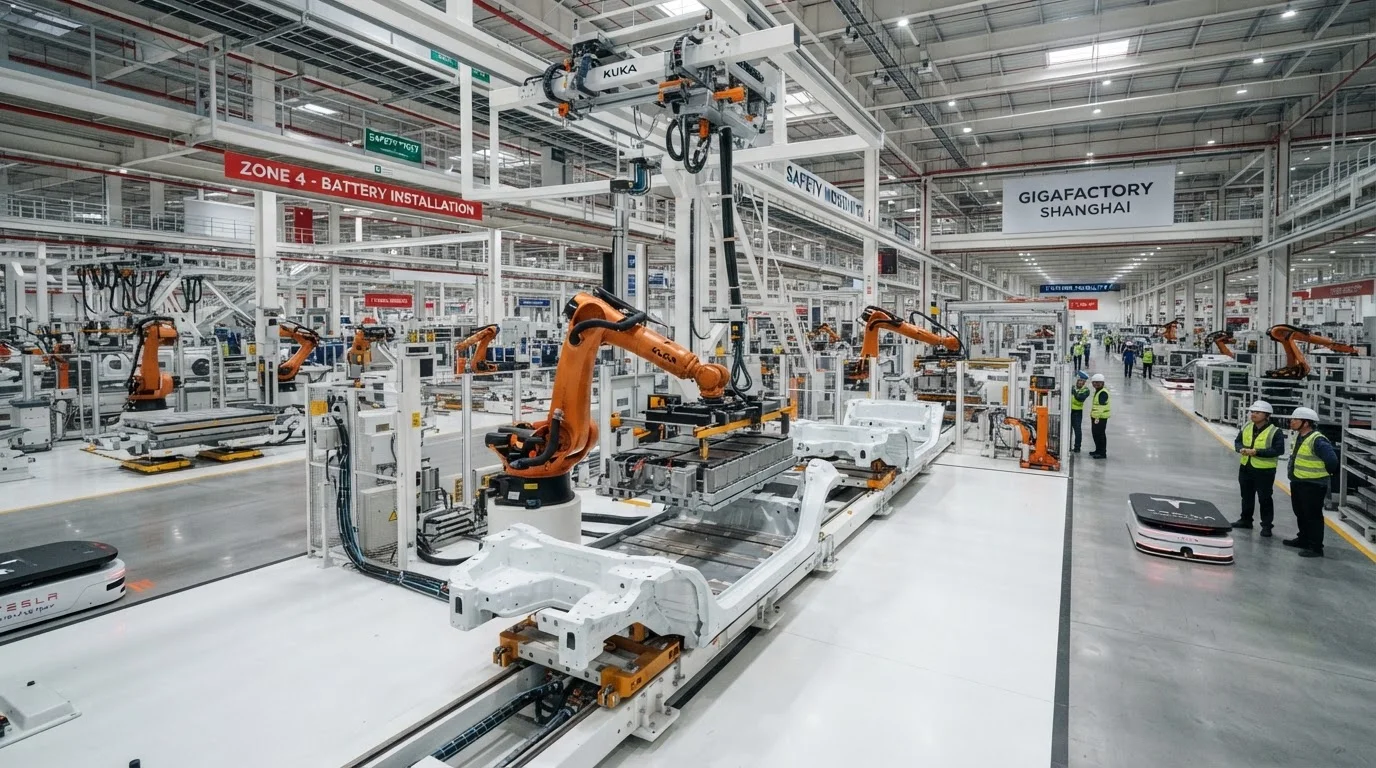
What Makes EV Manufacturing So Different
Building an electric vehicle is not simply a matter of removing a gasoline engine and inserting a battery. The architecture of an EV is structurally distinct from a combustion vehicle — it has no multi-speed transmission, no exhaust system, no fuel injection components, and no conventional engine block. What it does have is a large, heavy battery pack typically integrated into the vehicle's floor, one or more electric motors, and sophisticated power electronics managing energy flow.
That difference cascades through every stage of manufacturing. Stamping presses need new dies. Welding robots require reprogramming or replacement. Assembly sequences change because battery packs are installed early in the build process — before body panels are fitted — rather than late, as engines traditionally are. Supply chains shift: instead of pistons and camshafts, plants need battery cells, busbars, and thermal management components. To understand why these vehicles demand such a different production approach, it helps to first understand how EVs work at a technical level.
$526B+
Global EV manufacturing investment pledged through 2030
Various industry analyses tracking automaker and supplier capital commitments have estimated cumulative global EV-related manufacturing investment pledges in this range, though figures vary by methodology and timeframe.
~30%
Fewer moving parts in EVs vs. combustion vehicles
Industry estimates widely cited by engineering and manufacturing analysts suggest EV drivetrains have roughly 20–30% fewer mechanical components than comparable combustion powertrains, directly affecting assembly complexity.
40%+
Share of new vehicle battery cell cost in total EV cost
Battery packs have historically represented 40% or more of a battery EV's total manufacturing cost, according to multiple industry cost analyses, making battery supply and assembly the central economic variable in EV production.
The Business Case Behind Conversion
Automakers don't retool factories out of sentiment — they do it in response to hard commercial and regulatory pressure. Emissions regulations in key markets are tightening, with mandates in the European Union and multiple U.S. states establishing future targets that restrict or phase out new combustion-engine vehicle sales. Automakers that cannot demonstrate credible EV production capacity risk losing market access in those regions. The regulatory environment reshaping the auto sector is, for many manufacturers, the most immediate forcing function behind capital investment decisions.
Consumer demand, while still uneven, is also shifting. Fleet buyers, commercial operators, and government procurement programs are increasingly specifying electric powertrains. For automakers with large fleet-dependent revenue streams, this creates a separate, near-term business rationale for conversion independent of retail consumer trends.
Many manufacturers are choosing to retrofit existing plants rather than build greenfield facilities from scratch. Retrofitting preserves sunk infrastructure investment and keeps production closer to established supplier and labor networks, even when it means more disruptive temporary shutdowns during conversion.
What 'Flexible Manufacturing' Means in Practice
Some automakers are investing in flexible assembly lines capable of producing both combustion and electric models simultaneously. This hedges against demand uncertainty — if EV uptake accelerates, the line can shift toward more EV output; if it slows, combustion production can continue generating revenue. It costs more upfront but reduces the risk of stranded capacity.
Battery Integration: The Defining Challenge
Among all the changes retooling requires, battery pack integration is the most capital-intensive and technically demanding. Battery cells — typically sourced from specialized suppliers or in-house gigafactories — must be assembled into modules, then into full packs, then precisely installed into vehicle platforms. Each step demands environmental controls (temperature, humidity), high-voltage safety protocols, and quality checks that have no direct equivalent in combustion assembly.
Because battery packs are expensive and represent a large share of the vehicle's total cost, defects or handling damage at the assembly stage carry significant financial consequences. Plants must invest in new overhead cranes, AGVs (automated guided vehicles), and inspection technology specifically for this purpose. The broader forces that shape how quickly this transition unfolds — from supply chain constraints to energy infrastructure — are explored in the context of global EV market growth drivers and obstacles.
Workforce Implications and Retraining
The human side of retooling is substantial. Traditional automotive assembly plants employ skilled trades workers whose expertise centers on combustion drivetrain components — many of those specific skills have reduced demand in an EV plant. At the same time, EV production creates demand for workers trained in high-voltage electrical systems, battery module assembly, and software-connected quality diagnostics.
Automakers and labor unions have been negotiating how this transition is managed — whether through retraining programs, early retirement incentives, or new-hire pipelines with different skill profiles. The picture is complex and varies significantly by company and region. For a fuller account of how this labor shift is playing out across the industry, see the detailed look at how EV manufacturing is changing autoworker jobs.
What's clear is that factory retooling is not a one-time event — it is an ongoing industrial transformation that will continue reshaping automotive employment, supply chains, and regional economies for years to come. Understanding the full spectrum of powertrain options automakers are pursuing, including hybrids and hydrogen, provides useful context for why the road ahead involves multiple competing technologies.
Frequently Asked Questions
Existing factories are engineered around combustion engines, exhaust systems, transmissions, and fuel tanks — none of which exist in a battery electric vehicle. The tooling, conveyor sequencing, and supplier parts flows must be rebuilt for EV-specific components like battery modules and electric motors. Some plants can be adapted; others require near-total reconstruction.
Costs vary widely depending on plant age and scale, but major automakers have publicly announced individual plant conversion investments ranging from several hundred million to several billion dollars. Battery gigafactory construction — often built separately — adds billions more. These figures reflect equipment, facility upgrades, and workforce retraining combined.
EV assembly generally requires fewer labor hours per vehicle because EVs have significantly fewer moving parts than combustion-engine cars. Some traditional roles — such as engine and transmission assembly — are reduced or eliminated, while new roles in battery systems, software integration, and high-voltage electrical work are created. The net effect on total employment varies by region and company.
No. The pace varies considerably based on each company's financial position, home-market regulations, existing model lineup, and strategic commitments. Some have announced aggressive all-EV timelines; others are pursuing parallel investment in hybrids and combustion models while gradually converting select plants.
Government emissions mandates, EV sales quotas, and industrial policy incentives are significant drivers. Regulations in markets like the European Union and several U.S. states set future targets that effectively require automakers to have EV production capacity in place by specific dates, creating a deadline-driven urgency for factory investment.
The content on this site is for informational purposes only and is not a substitute for professional advice. Always consult a qualified professional for guidance specific to your situation.