

Our Verdict
The EV transition is simultaneously shrinking some parts of the auto workforce and creating new ones — but the gains and losses are not evenly distributed geographically or demographically. Workers in traditional powertrain manufacturing face the steepest adjustment, while regions that attract battery and EV assembly investment stand to gain. The net employment effect remains genuinely uncertain and will depend heavily on policy, investment decisions, and retraining outcomes.
Readers looking to understand the structural workforce forces behind the EV shift, particularly those with ties to manufacturing communities or an interest in industrial policy.
Why EVs Change the Labour Equation
A conventional internal combustion engine (ICE) vehicle contains roughly 2,000 moving parts. A battery electric vehicle (BEV) contains closer to 20. That difference is not just an engineering footnote — it directly shapes how many workers it takes to build a car and what skills those workers need.
Transmissions, exhaust systems, fuel injection components, and engine blocks all require dedicated machining, assembly, and quality-control labour. EVs eliminate most of those steps. According to estimates cited by the International Labour Organization, producing electric drivetrains requires significantly fewer person-hours than producing comparable combustion powertrains, with some analyses suggesting a reduction of 30–40% in direct assembly labour for those specific components.
For a deeper look at how powertrain architecture is diverging, see how EVs, hydrogen, and hybrids compare.
New battery manufacturing jobs in multiple regions
Gigafactory investments have created tens of thousands of positions in cell manufacturing, module assembly, and related supply chain roles, particularly in states that have actively courted EV investment.
Higher-skill roles with stronger long-term demand
EV and battery production increasingly requires workers trained in electrical systems, software, and precision chemistry — skills that may offer more durable employment as electrification deepens.
Union bargaining has secured some transition protections
Major labour agreements at U.S. automakers have included provisions such as job security commitments, retraining funds, and seniority protections for workers affected by plant conversions.
Reduced physical strain in some EV assembly processes
Battery pack assembly and EV body construction can involve different ergonomic profiles than heavy engine or transmission work, potentially reducing injury risk in certain roles.
Where Jobs Are Being Created
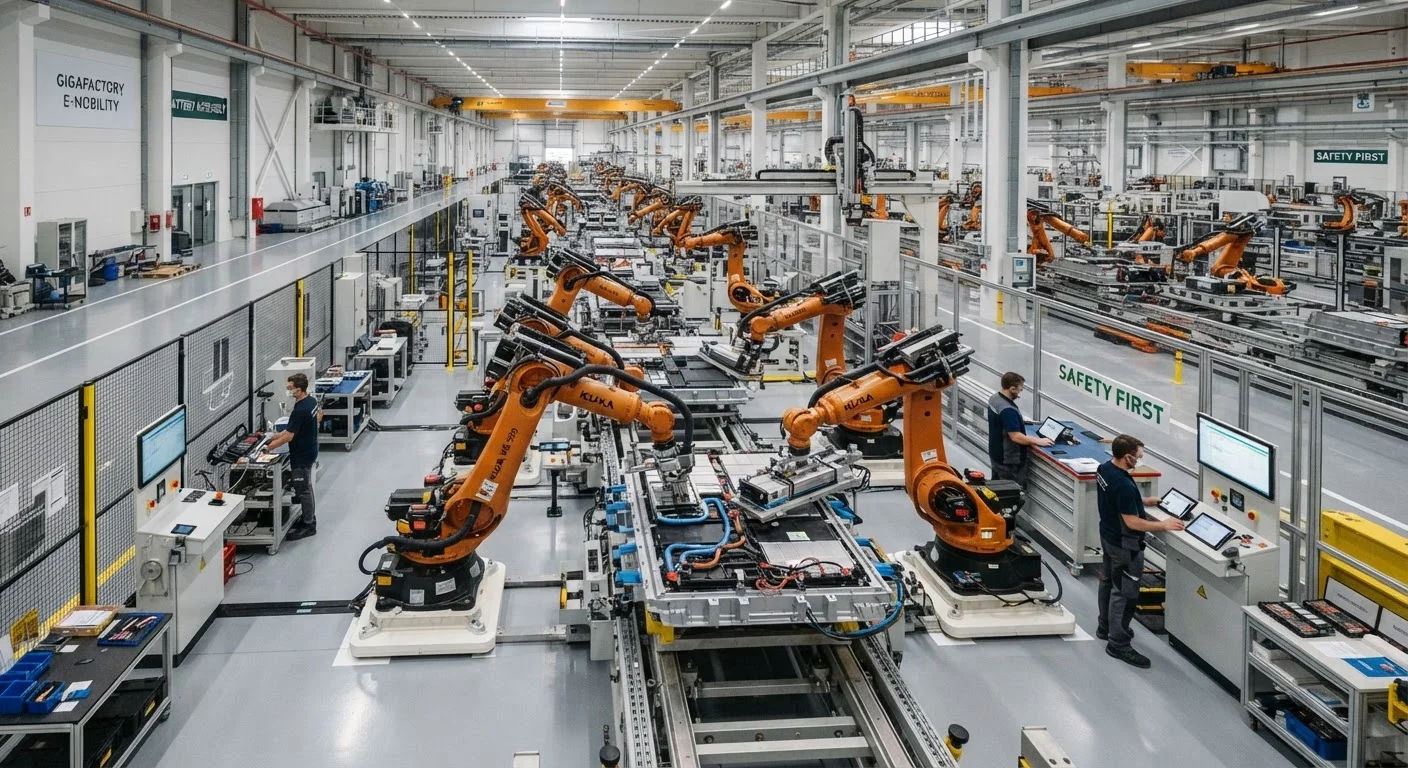
The EV shift is not purely subtractive. Battery cell manufacturing, power electronics, thermal management systems, and software integration represent genuinely new or expanded job categories. Gigafactories — large-scale battery production facilities — have been announced or opened across the U.S. South, Midwest, and internationally, bringing thousands of positions with them.
Governments have used industrial policy to steer this investment. In the United States, the Inflation Reduction Act included domestic content requirements tied to EV tax credits, explicitly designed to anchor battery supply chains in American communities. Similar incentive frameworks exist in the EU and South Korea.
That said, battery plant jobs are often located far from existing auto manufacturing clusters. A worker displaced from an engine plant in Michigan does not automatically benefit from a new battery facility in Georgia or Tennessee without significant relocation or retraining. The forces shaping EV market growth — including supply chain constraints — also affect where and how quickly these new facilities come online.
30–40%
Estimated reduction in powertrain assembly labour
Multiple industry and academic analyses have estimated that producing battery electric drivetrains requires roughly 30–40% fewer direct labour hours than comparable ICE powertrain production.
~2,000
Moving parts in a typical ICE vehicle
Industry engineers commonly cite this figure to contrast with the dramatically simpler mechanical architecture of battery electric vehicles, which have far fewer moving components.
Thousands
Tier-2 and Tier-3 suppliers at risk of disruption
The Center for Automotive Research and similar bodies have flagged the supplier base — particularly ICE-specific component makers — as facing the steepest near-term displacement risk from electrification.
The Retraining Challenge
Bridging the skills gap between ICE and EV manufacturing is widely acknowledged as one of the most pressing workforce challenges in the sector. High-voltage electrical systems, battery chemistry, and software diagnostics require training pipelines that many community colleges and apprenticeship programs are still developing.
Automakers and governments have committed funds to retraining, but implementation has been uneven. Critics note that some programs are insufficiently funded relative to the scale of displacement, and that older workers — who have the most to lose from job elimination — are least likely to complete retraining successfully. Union contracts at major automakers have increasingly included provisions for paid transition time and skill development, though the details vary widely.
What 'Retraining' Actually Involves
Transitioning from ICE to EV manufacturing is not simply a matter of learning a new assembly sequence. High-voltage battery systems require workers to understand electrical safety protocols, cell chemistry risks, and diagnostic software that have no direct equivalent in combustion-engine production. Community colleges and technical institutes are expanding curricula, but a meaningful skills transition typically takes months of structured training — a timeline that does not always align with the pace of plant conversions.
Pros and Cons for the Auto Workforce
Viewed in full, the labour implications of electrification cut in both directions. The transition creates real opportunities alongside genuine disruption — and the outcome for any individual worker depends heavily on location, age, skillset, and employer.
Fewer total assembly hours per vehicle
Independent analyses suggest EV powertrain assembly requires substantially fewer labour hours than equivalent ICE production, pointing to a structural reduction in direct manufacturing headcount over time.
Geographic mismatch between lost and new jobs
Many new battery and EV facilities are being built in regions with lower labour costs and weaker union density, often far from the Midwest communities where ICE job losses are concentrated.
Retraining programs lack scale and reach
Available workforce transition programs are insufficient in funding and capacity to match the volume of workers facing displacement, and uptake among older workers has been particularly low.
Supplier ecosystem faces acute disruption
Thousands of small and mid-size suppliers that produce ICE-specific components — gaskets, fuel injectors, exhaust parts — have limited ability to pivot to EV production, threatening job losses well beyond the OEM (original equipment manufacturer) level.
Wage and benefit uncertainty at new facilities
Some new battery plants have opened as non-union facilities or joint ventures with different wage structures than legacy auto plants, raising concerns about whether new jobs match the compensation of those lost.
Regulatory pressure is accelerating these timelines. Emissions mandates and EV sales quotas are compressing the window manufacturers have to manage workforce transitions, raising the stakes for both companies and workers.
The content on this site is for informational purposes only and is not a substitute for professional advice. Always consult a qualified professional for guidance specific to your situation.