

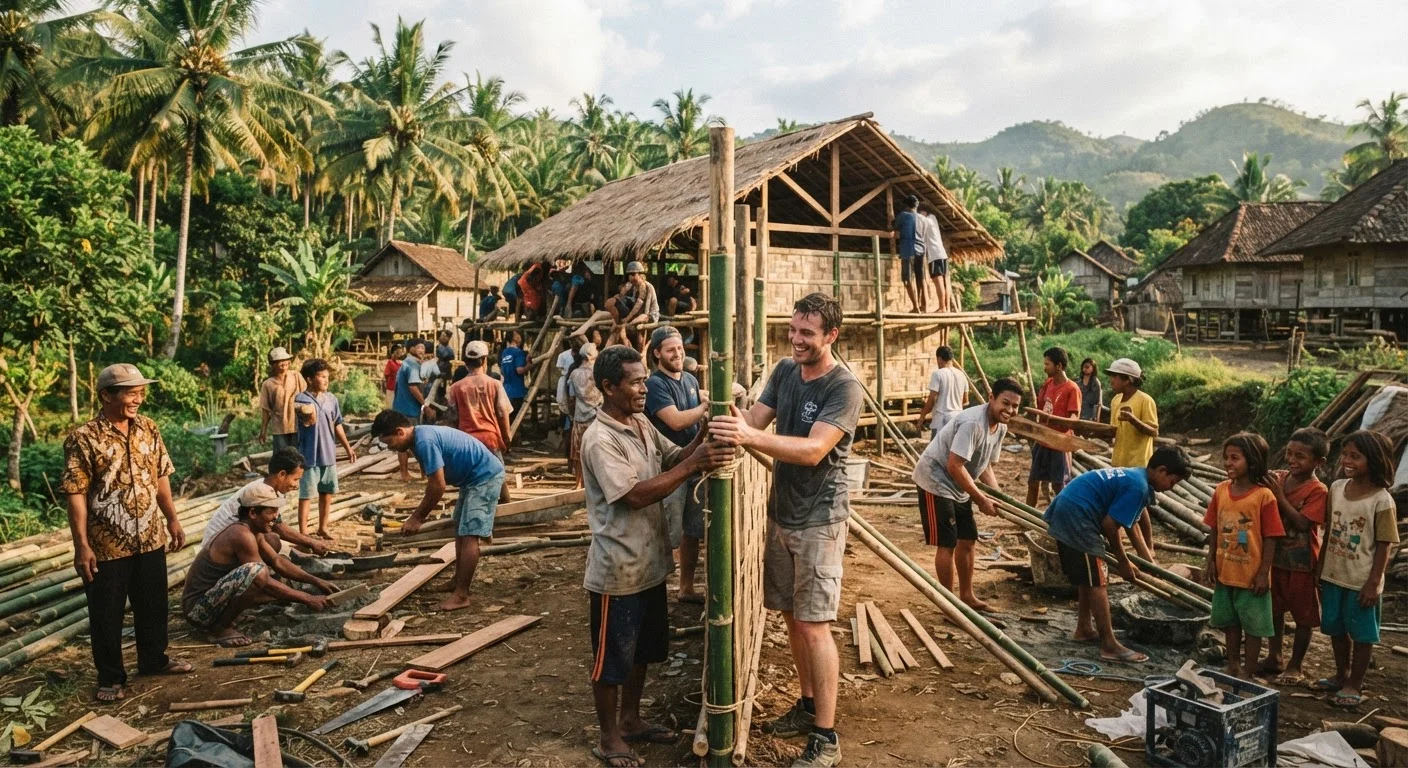
What Voluntourism Actually Means
Voluntourism — a blend of volunteering and tourism — refers to travel that incorporates organised community service or conservation work as a core part of the experience. It has existed in various forms for decades, from church-led humanitarian missions to gap-year programmes in sub-Saharan Africa. By the 2010s, it had grown into a multi-billion-dollar global industry.
The appeal is intuitive: travellers get to see the world while contributing something meaningful. Host communities, in theory, receive labour and resources they need. In practice, the arrangement is more complicated, and the sector has undergone substantial reexamination as a result.
Impact travel is a broader term that has emerged alongside voluntourism. It refers to any travel deliberately designed to generate positive social, economic, or environmental outcomes — whether through volunteering, choosing locally owned accommodation, supporting conservation-linked tourism, or participating in cultural exchange programmes structured around community benefit. Unlike voluntourism, impact travel does not necessarily require the traveller to perform hands-on work.
How the Industry Has Shifted
The voluntourism sector grew rapidly through the 2000s before facing a wave of critical reporting in the 2010s. Researchers, journalists, and development organisations raised pointed questions about programme effectiveness: Were short-term volunteers — many of them unskilled — actually helping? Were local communities shaping these programmes, or were they designed around traveller preferences?
One of the most widely discussed concerns centred on orphanage tourism, particularly in Southeast Asia and southern Africa. Investigations found that some facilities were actively recruiting children from non-orphaned families to meet demand from well-meaning Western travellers. Several governments and international child welfare organisations subsequently called for the practice to be discontinued entirely.
$173B+
Estimated global voluntourism market value
Industry analysts have estimated the global voluntourism sector at well over $100 billion annually, though precise figures vary by source and methodology.
1–2 weeks
Typical volunteer placement duration
Research from development organisations suggests most voluntourism placements last under two weeks — a duration many practitioners consider insufficient for meaningful community impact.
80%+
Programme fees retained by sending organisations
Studies examining fee distribution in some voluntourism programmes found that the majority of participant fees remained with the operator rather than reaching host communities.
These critiques prompted meaningful change among more established operators. Responsible travel organisations began adopting accountability frameworks, requiring longer minimum stays, prioritising skills-matched placements, and insisting that programmes be designed in consultation with host communities rather than for them. This shift mirrors broader changes in the development sector, where top-down aid models have faced similar challenges. For travellers interested in how purpose-driven approaches connect to wider travel ethics, regenerative tourism offers a useful parallel framework.
The Rise of Community-Led Impact Travel
The most significant structural change in impact travel over the past decade is the growing emphasis on community agency. Rather than external organisations designing programmes and recruiting foreign volunteers to deliver them, an increasing number of initiatives now originate with local organisations that identify their own needs and invite skilled outside support where genuine gaps exist.
This model appears across conservation, education, public health, and heritage preservation. Wildlife sanctuaries in southern Africa, for example, have shifted toward ranger-led research partnerships rather than open volunteer programmes where participants pay to handle animals. Archaeological projects in Central America and the Mediterranean work with trained professionals and student researchers under direct local institutional oversight.
Before committing to any programme, ask the operator to connect you with a community representative — not a staff member — who can describe the initiative's value independently.
Third-party community voices provide a more reliable signal of programme legitimacy than operator testimonials or curated alumni reviews, which are subject to selection bias.
If you have two weeks or less, consider spending that time supporting local economies as a traveller — staying at family-run guesthouses, hiring local guides — rather than attempting a volunteer placement.
Development researchers have consistently found that very short volunteer placements rarely produce measurable community benefit and can sometimes create dependency or disrupt existing workflows.
Community-led tourism enterprises — locally owned lodges, indigenous-guided experiences, cooperative craft markets — have also gained recognition as a form of impact travel that doesn't require volunteering at all. Travellers who spend money within genuinely local economies contribute to community livelihoods in ways that are arguably more durable than short-term labour. This principle aligns closely with the ethos behind slow travel, which encourages deeper engagement with fewer destinations over longer periods.
Red Flags and Ethical Pitfalls to Recognise
Not all programmes marketed as impact travel operate ethically. Travellers should approach programme selection with the same scrutiny they would apply to any major financial or personal commitment.
- Programmes that prioritise the traveller's emotional experience over measurable community outcomes are a common warning sign. Marketing that centres on how transformative or emotional the experience will be for the volunteer — rather than what the host community will gain — is worth questioning.
- No minimum stay or skills requirement may indicate a programme designed around volume rather than impact. Conservation and construction work, in particular, generally requires consistency that week-long visitors cannot provide.
- Lack of transparent reporting on outcomes, community partnerships, or how programme fees are distributed is a significant concern. Reputable organisations publish this information or provide it on request.
- Working with children warrants particular caution. International child welfare guidance generally advises against volunteering in orphanages or childcare settings unless the traveller has verified professional qualifications and the programme has robust child-protection policies.
The development research community has documented cases where paid volunteers displaced local workers who would otherwise have been employed — a dynamic that can undermine rather than support local economies.
What Responsible Impact Travel Looks Like Today
Responsible impact travel in its current form tends to share several characteristics that distinguish it from earlier, less scrutinised models. Programmes are typically designed by and accountable to the communities they serve. Volunteers are matched to placements based on specific skills — medical professionals in health settings, engineers in infrastructure projects, educators with verified teaching experience. Fees paid by participants are transparently allocated, with a documented portion going directly to host organisations or community funds.
Duration matters. Most credible organisations now recommend a minimum of several weeks for any placement involving direct community work, and many prefer commitments of three months or longer. This reflects research suggesting that short stays often produce more disruption than benefit, particularly in social services settings.
Certification Programmes Vary by Region
There is no single global standard for ethical voluntourism or impact travel. Standards bodies, accreditation schemes, and regulatory oversight differ significantly by country and region. Travellers should research the specific framework relevant to their destination and treat any certification as one data point among several rather than a definitive endorsement.
The sector's evolution also reflects changing traveller demographics. Younger travellers, including millennials and Gen Z, have shown greater appetite for accountability and are more likely to research programme credentials before booking. This demand signal has encouraged more operators to pursue independent certification from bodies such as the Fair Trade Tourism standard in southern Africa or similar regional frameworks.
Planning Your Own Purpose-Driven Trip
Travellers interested in impact travel should begin their research well before booking. A useful starting point is to identify the type of contribution that aligns with existing skills — rather than selecting a destination first and finding a programme second. Development practitioners consistently note that skill-matched volunteering produces better outcomes for host communities and more substantive experiences for participants.
Questions worth asking any prospective organisation include: Who designed this programme and how? How are programme fees distributed? What happens to the work when volunteers leave? Is there a local staff member or community liaison who could describe the programme's value independently?
Travellers should also verify entry requirements, vaccination recommendations, and any travel advisories from official government sources well in advance, as these can change. Do not rely on operator materials alone for safety or health information.
For those who prefer a less structured approach, choosing locally owned accommodation, eating at community-run restaurants, and buying directly from artisans and cooperatives can channel meaningful economic benefit without requiring a formal programme. This approach integrates naturally with broader travel styles — including the solo and group travel considerations that shape how most itineraries are planned. More foundational travel planning guidance can help frame how purpose-driven elements fit within a broader trip structure.
The content on this site is for informational purposes only and is not a substitute for professional advice. Always consult a qualified professional for guidance specific to your situation.