

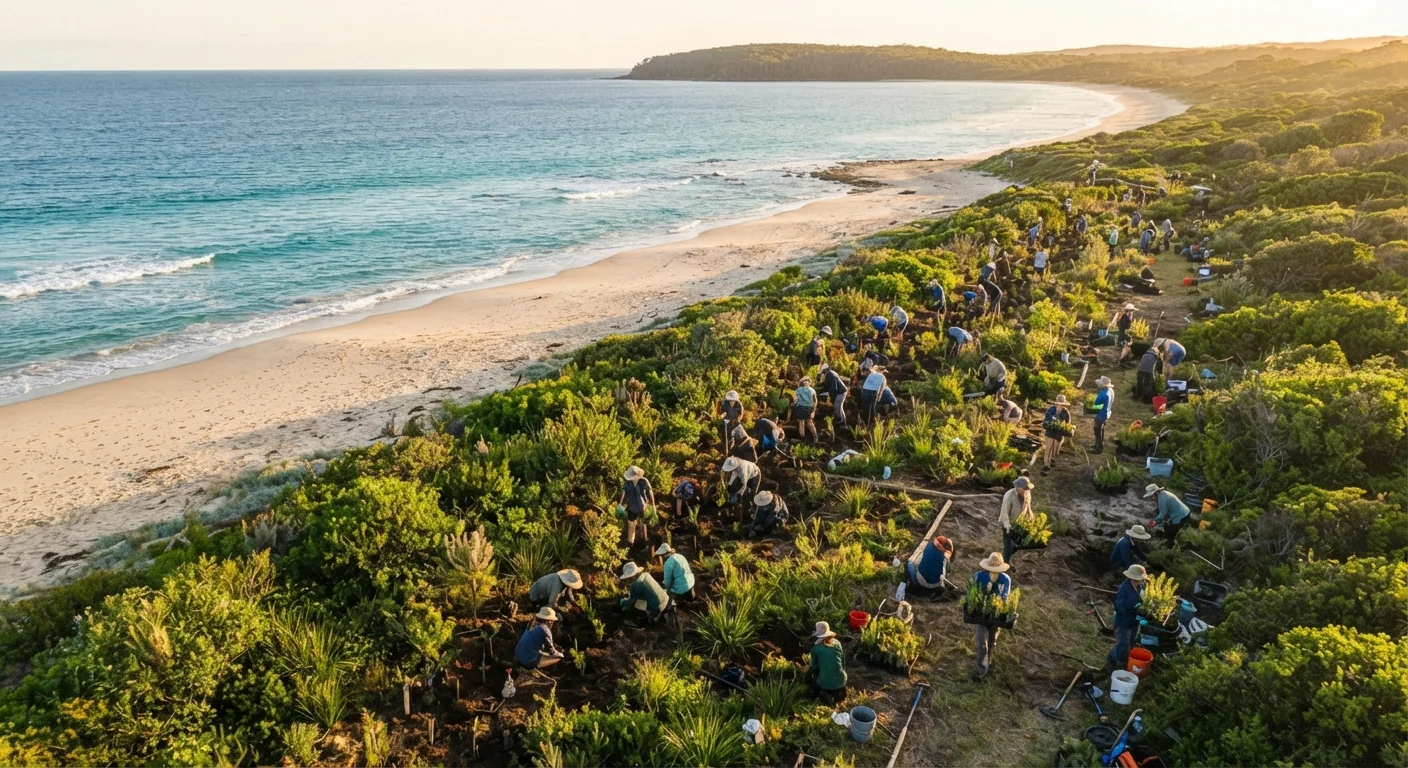
From 'Do No Harm' to Active Restoration
For decades, the dominant message in responsible travel has been rooted in restraint: take only photographs, leave only footprints. That ethic, captured in the "Leave No Trace" principle, was a meaningful corrective to extractive tourism practices. But a growing body of researchers, destination managers, and travelers now argue it doesn't go far enough.
Regenerative tourism reframes the question entirely. Instead of asking "how little damage can we do?" it asks "what positive difference can travel make?" The shift is more than semantic. It requires tourism to function as a restorative force — one that channels visitor spending, energy, and attention toward the active repair of natural environments, local economies, and cultural traditions that may already be under stress.
This isn't an abstract ideal. Destinations that have absorbed decades of high-volume tourism — from coral reef systems in Southeast Asia to historic centers in Europe — face real ecological and social deficits. Regenerative thinking holds that travel, if designed deliberately, can help address those deficits rather than deepen them. Common misconceptions about overtourism often obscure just how structural the damage can be, which makes the case for active restoration more urgent.
What Regenerative Travel Looks Like in Practice
Regenerative tourism isn't a single program or certification — it's a framework that plays out differently depending on the destination. At its core, it involves three interconnected pillars: ecological restoration, cultural vitality, and equitable economic benefit.
1.4B+
International tourist arrivals annually (pre-pandemic peak)
According to the United Nations World Tourism Organization, global arrivals surpassed 1.4 billion in 2018, intensifying pressure on ecosystems and host communities worldwide.
~8%
Share of global CO₂ emissions from tourism
A 2018 study published in Nature Climate Change estimated tourism accounts for approximately 8% of global greenhouse gas emissions when supply chains are included.
70%+
Tourism revenue that often leaves local economies
The UN Environment Programme has noted that in many developing destinations, a large share of tourism revenue flows out to foreign-owned companies rather than remaining in host communities.
Ecological restoration might mean a lodge that funds native reforestation on degraded land adjacent to its property, or a tour operator that allocates a portion of every booking to marine conservation. Cultural vitality looks like itineraries designed in partnership with Indigenous communities, where visitors learn traditional practices directly from knowledge holders rather than through curated performances. Economic equity means ensuring that tourism revenue reaches local households, not just international hotel chains or outside-owned platforms.
The slow travel movement intersects naturally with regenerative principles. Longer stays in fewer places reduce the carbon intensity of a trip, allow travelers to build genuine relationships with communities, and concentrate spending in ways that support local businesses more meaningfully than a rapid multi-city itinerary.
How It Differs From Voluntourism and Ecotourism
Regenerative tourism is sometimes confused with voluntourism — travel that incorporates volunteer service — or ecotourism, which emphasizes nature-based experiences with low environmental impact. There is genuine overlap, but the distinctions matter.
Voluntourism has faced sustained criticism for prioritizing the emotional needs of visitors over the actual needs of host communities. Short-term projects — building schools, planting trees — can displace local labor or produce work that isn't maintained after volunteers leave. Regenerative travel, by contrast, centers community agency: locals define what restoration looks like, and traveler participation supports rather than directs those efforts. For a closer look at how purpose-driven travel has evolved, see how voluntourism and impact travel have changed.
Ecotourism, meanwhile, often focuses on minimizing harm within the travel experience itself — choosing lower-impact transport, staying in eco-lodges, avoiding wildlife disturbance. These are worthwhile practices, but regenerative tourism demands a higher bar: measurable improvement, not merely reduced damage.
“Regenerative tourism is not about feeling good while you travel — it's about leaving a place with more life, more culture, and more economic opportunity than it had before you arrived. That requires design, not just intention.”
— Jeremy Smith, Travel writer and co-founder of Travindy, a responsible travel publishing platform
What Travelers Should Consider
One practical challenge with regenerative tourism is that the term lacks regulatory definition. Any operator can use the label without meeting a verified standard, which means travelers need to ask specific questions rather than accept marketing claims at face value.
Meaningful indicators include: whether an operator can name specific restoration projects and partners; whether local community members hold decision-making roles; whether environmental outcomes are tracked and reported publicly; and whether pricing reflects fair compensation for local workers.
Beyond operator selection, individual travelers can apply regenerative thinking through their own itinerary decisions. Prioritizing destinations that actively manage visitor impact, extending stays to deepen local economic contribution, and consulting practical travel guidance before booking can all shift a trip's net effect. Spending time in natural landscapes — an instinct many travelers already have — also connects to documented wellbeing benefits, as research on nature therapy and green space continues to show.
The concept is still evolving, and no trip is perfectly regenerative. But the framework offers a useful lens: rather than measuring only what travel takes from a place, it invites travelers to ask what their visit might give back.
Frequently Asked Questions
Sustainable tourism aims to maintain the current state of a destination by minimizing damage. Regenerative tourism goes further, seeking to actively restore and improve ecosystems, communities, and cultures. Think of sustainability as stopping the bleeding; regenerative travel is about healing the wound.
They overlap but are distinct. Ecotourism typically focuses on nature-based travel with low environmental impact. Regenerative tourism is broader, encompassing cultural and economic restoration alongside environmental goals. It also emphasizes that traveler participation should create measurable, lasting improvements.
Concrete steps include staying at locally owned accommodations, eating at community-run restaurants, joining certified conservation activities, and extending trip length to reduce the per-day carbon impact of flights. Avoiding overtouristed areas and spending in underserved communities also redistributes benefits more equitably.
Yes. Palau introduced the Palau Pledge in 2017, requiring visitors to sign a commitment to protect the environment — an early step toward regenerative thinking. New Zealand's Tourism Strategy and several rural regions in Costa Rica and Scotland have also adopted frameworks emphasizing restoration over volume.
Look for operators that disclose specific projects, measurable outcomes, and community partnerships — not just marketing language. Third-party certifications (such as those from the Global Sustainable Tourism Council) can offer some verification, though no single universal regenerative standard exists yet. Asking operators direct questions about where revenue goes is a reasonable starting point.
Not necessarily, but some regenerative experiences — such as small-group conservation programs or stays at community-owned lodges — may carry higher prices that reflect fair wages and environmental contributions. The added cost, where it exists, is generally directed toward the destination itself rather than third-party margins.
The content on this site is for informational purposes only and is not a substitute for professional advice. Always consult a qualified professional for guidance specific to your situation.