

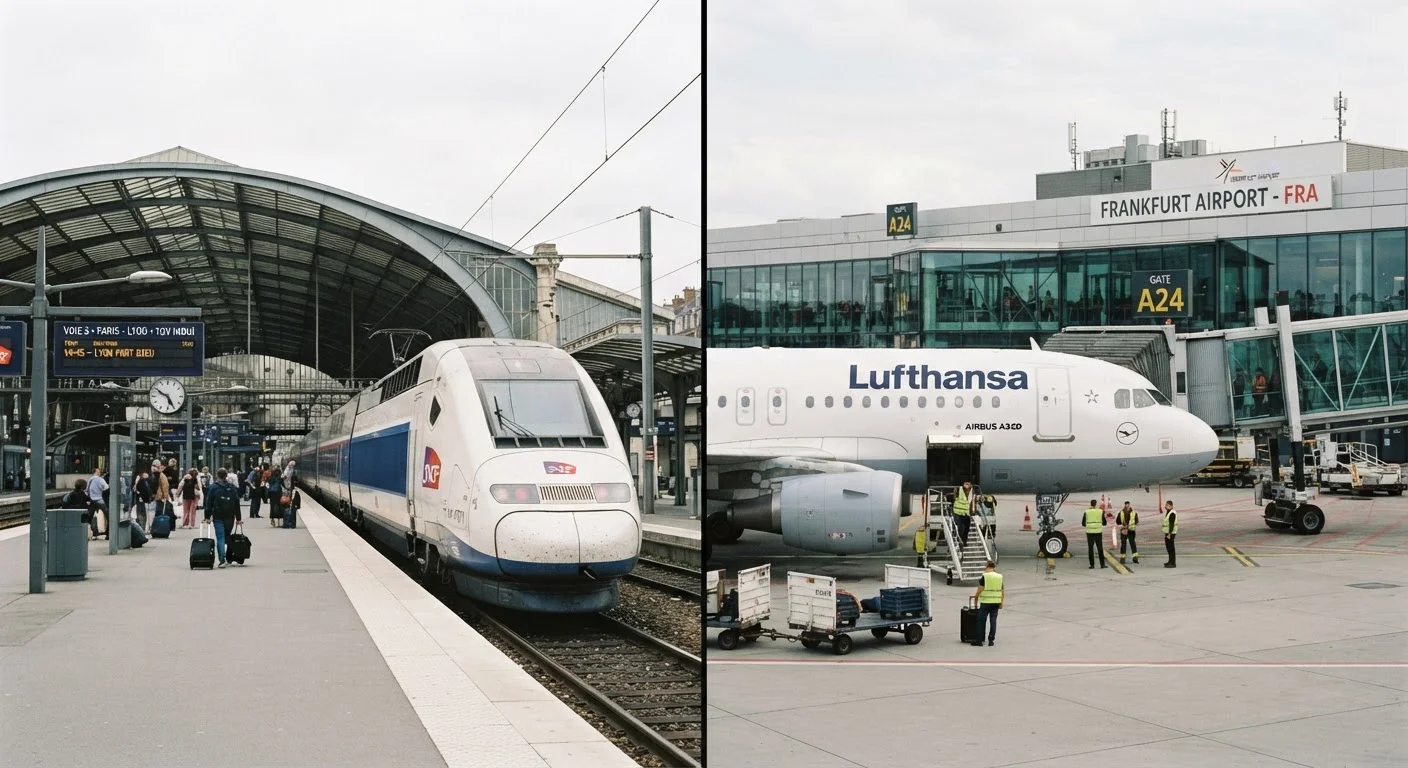
Our Verdict
Neither trains nor planes dominate European travel outright — the best choice depends on route length, origin and destination city locations, and individual priorities around time, comfort, and environmental impact. Rail offers a compelling case for medium-distance trips between well-connected cities, while aviation remains the practical choice for longer journeys and underserved regions.
| Best for | Recommended |
|---|---|
| City-centre to city-centre trips under roughly 500 miles | Train |
| Long-haul connections, island routes, or poorly served rail corridors | Flight |
| Travellers prioritising luggage flexibility and door-to-door convenience | Train |
| Those with tight schedules on very long distances | Flight |
How Europe's Transport Picture Has Shifted
Europe's rail and aviation sectors have both evolved considerably over the past decade, driven by infrastructure investment, policy pressure, and changing traveller expectations. The old assumption — that flying is always faster and trains are always more pleasant — has grown more complicated.
High-speed rail networks have expanded significantly across the continent. France's TGV, Spain's AVE, and Germany's ICE services now link dozens of major cities at speeds that were once the exclusive domain of aviation. Meanwhile, the European Union has signalled intent to double high-speed rail traffic by 2030 as part of broader climate commitments, though that target remains aspirational rather than guaranteed.
At the same time, budget airlines have not retreated. Low-cost carriers continue to offer fares on short-haul European routes that undercut rail tickets on price alone — though the full picture is rarely that simple. For travellers rethinking how they move around the continent, understanding what has actually changed matters more than picking a side. This shift also connects to broader trends in how people approach their trips; the rise of slow travel has made journey experience — not just arrival time — a factor in transport choices.
Time: The Calculation Travellers Often Miss
Flight schedules list block times that rarely reflect the full door-to-door journey. Arriving at the airport typically requires being there 90 minutes to two hours before departure for European flights. Many European airports sit well outside city centres — Charles de Gaulle north of Paris, Frankfurt Airport linked by train but still requiring transfer time, Gatwick and Stansted well south and north of central London, respectively.
Trains, by contrast, depart from central stations and arrive at central stations. London St Pancras to Paris Gare du Nord via Eurostar takes around two hours and fifteen minutes. When airport transfers, check-in time, and baggage claim are factored in, a Paris flight from a central London terminus rarely saves meaningful time and may take longer overall.
This equation shifts on longer routes. A flight from London to Athens or Lisbon to Warsaw will still be faster than any current rail option when total time is calculated realistically. The crossover point — where trains become competitive in total time — is generally considered to fall somewhere between three and four hours of pure rail journey time, depending on route specifics.
| Train | Flight | |
|---|---|---|
| City-centre access | Departs and arrives centrally | Often requires airport transfer |
| Total journey time (medium routes) | Competitive within ~3–4 hrs rail time | Faster only beyond that threshold |
| Luggage rules | Generally more flexible | Stricter on budget carriers |
| Border/security process | Minimal within Schengen Area | Full security screening required |
| Carbon emissions (typical) | Lower per passenger-km | Higher per passenger-km |
| Island and remote routes | Not available | Only practical option |
| Booking complexity | Improving but fragmented internationally | Well-aggregated booking ecosystems |
| Night travel option | Night trains available on key routes | Overnight flights available widely |
Environmental Considerations and Policy Pressure
Short-haul aviation is under increasing scrutiny for its carbon footprint. Flights produce significantly more greenhouse gas emissions per passenger per kilometre than rail on most European routes, particularly when electricity powering trains comes from lower-carbon sources. France has moved to restrict domestic flights on routes where train journeys under two and a half hours are available, a policy that has drawn both support and legal challenge.
Rail's environmental advantage is not universal — it depends on the energy mix of the country operating the trains. Electrically powered rail on grids with high renewable penetration performs very differently from diesel-hauled services in regions with older infrastructure.
Travellers who factor environmental impact into their planning are increasingly choosing rail for medium-distance European travel. Whether that preference will scale into lasting behavioural change is something researchers and transport planners continue to study, but booking data from Eurostar and Rail Europe have indicated growth in demand on key international routes.
Verify Rail Passes Before Committing
Interrail and Eurail passes offer broad access but are not always the most economical choice for travellers making only a few journeys. Point-to-point advance tickets frequently undercut pass prices on popular routes, and some high-speed services require a separate reservation fee on top of the pass. Compare both options for your specific itinerary before purchasing.
Practicalities: Luggage, Booking, and Border Crossings
Rail travel within the Schengen Area requires no passport check at borders for qualifying travellers, unlike flying, which involves security screening and — for non-EU travellers — immigration procedures. Trains also impose no liquid restrictions, no requirement to remove shoes or laptops, and generally allow more generous luggage than budget airline cabin allowances.
Booking, however, can be more complex by rail. International train tickets in Europe are not as uniformly aggregated as flight search, and multi-leg rail journeys across different national operators can require separate bookings. This is improving — Eurostar and Deutsche Bahn have expanded international ticketing — but it remains a friction point that aviation, with its mature booking ecosystems, does not share.
Night trains represent a growing niche. Austrian Federal Railways' Nightjet network and other operators have reinvested in overnight sleeper services across Central and Western Europe, allowing travellers to cover long distances while sleeping, effectively turning transit time into accommodation. These services are not uniformly reliable or affordable, and availability varies by route, so verifying schedules and booking windows directly with operators is advisable.
For more on how journey type intersects with travel style, see our comparison of solo travel versus group tours. Travellers planning around budget should also consider timing strategies covered in our look at off-season travel trade-offs.
Where Flying Still Holds the Advantage
For all the rail revival's momentum, aviation retains undisputed advantages in certain scenarios. No rail connection currently exists between mainland Europe and the United Kingdom outside the Channel Tunnel — and Eurostar serves only a limited set of city pairs. Travel to the Canary Islands, the Greek archipelago, the Azores, or Sardinia requires a flight regardless of environmental preference.
The Balkans, parts of Eastern Europe, and many smaller regional cities also have limited or slow rail infrastructure, making flying the only practical option within reasonable journey times. Budget carriers have long served these markets, providing affordable mobility in regions where rail investment has lagged.
Comfort-focused long-distance flying — particularly on carriers offering business or premium economy cabins — remains a distinct experience that rail cannot replicate on very long journeys. For those covering substantial distances, the habits that improve long-haul flight comfort are worth knowing regardless of the Europe-versus-flight debate.
Ultimately, neither mode has rendered the other obsolete. The emerging norm for informed European travellers appears to be a mode-by-mode assessment for each specific journey, rather than blanket loyalty to either rail or aviation. Checking official timetables, government entry requirements, and current carrier policies directly before booking remains essential, as conditions change and no third-party overview can substitute for up-to-date source verification.
The content on this site is for informational purposes only and is not a substitute for professional advice. Always consult a qualified professional for guidance specific to your situation.