

Why In-Flight Habits Matter More Than Class of Service
For most travelers, cabin class is fixed long before boarding. But the choices made during a long-haul flight — how often to move, what to drink, when to sleep, how to manage light — shape arrival condition more than seat pitch alone. A twelve-hour flight in economy, managed well, can leave a passenger more rested than a premium-class seat handled passively.
Long-haul flying creates a specific set of physiological stresses: low humidity, reduced cabin pressure (typically equivalent to an altitude of 6,000–8,000 feet), prolonged immobility, and circadian disruption. Understanding these conditions is the starting point for countering them. The habits below are drawn from widely available travel health guidance and reflect what frequent long-distance travelers consistently apply.
A Note on In-Flight Health Advice
The habits described in this article are general informational guidance drawn from widely available travel health resources. They are not a substitute for personal medical advice. Passengers with cardiovascular conditions, clotting disorders, pregnancy, or other health concerns should consult a qualified healthcare provider before a long-haul flight to discuss what precautions are appropriate for their specific situation.
Six In-Cabin Habits That Consistently Make a Difference
Choose your seat strategically before you board
Seat selection is one of the few variables entirely within a traveler's control before stepping onto the plane. Window seats offer a surface to lean against and give passengers control over the window shade — both useful for sleep. Bulkhead rows provide extra legroom but often lack under-seat storage, which forces carry-on bags into overhead bins.
For those prone to deep-vein thrombosis (DVT) — a condition where blood clots form in leg veins during prolonged sitting — aisle seats make it easier to stand and walk without disturbing fellow passengers. Many airline seat-map tools allow filtering by legroom and proximity to lavatories, which can meaningfully shape a twelve-hour experience.
Window seats give passengers control over light and a surface to lean against — both critical for sleep.
Treat hydration as a structured routine, not an afterthought
Aircraft cabins typically maintain humidity levels between 10% and 20%, far lower than most indoor environments. This dryness accelerates dehydration, contributing to headaches, dry skin, and fatigue that travelers often attribute to the flight itself. Drinking water consistently — rather than waiting until thirsty — helps offset this effect.
Alcohol and caffeine both act as diuretics and can amplify dehydration. Many frequent long-haul travelers limit or skip both during flight, choosing water and electrolyte drinks instead. Bringing an empty reusable bottle through security and filling it post-screening is a practical way to ensure access throughout the journey.
Cabin humidity can drop below 20% — consistent water intake counters the fatigue this causes.
Move deliberately and often throughout the flight
Prolonged immobility is one of the more concrete health risks of long-haul flying. Beyond discomfort, extended sitting reduces circulation in the lower limbs. Aviation health guidelines generally recommend standing or walking every one to two hours on flights longer than four hours.
Simple in-seat exercises — ankle rotations, calf raises, and seated leg stretches — maintain blood flow during periods when the seatbelt sign is illuminated. Compression socks, which apply gentle graduated pressure to the lower legs, are widely recommended by travel health practitioners for passengers on extended flights, particularly those with existing circulatory concerns. Consult a healthcare provider about whether compression garments are appropriate for your situation.
Standing or walking once every one to two hours meaningfully reduces circulatory risk during long flights.
Build a sleep environment with the tools you carry on
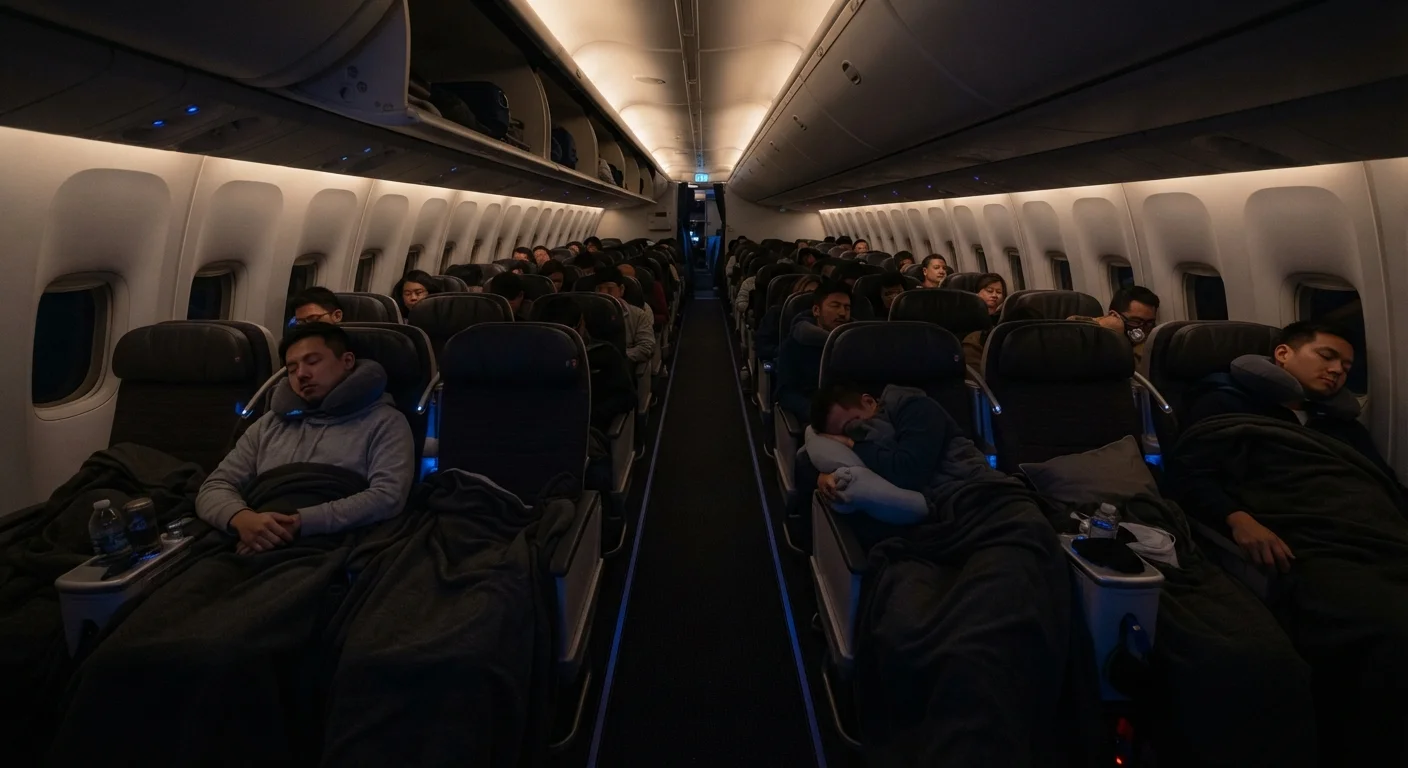
Economy-class seats are not designed for sleep, but passengers can meaningfully improve conditions. Noise-canceling headphones or foam earplugs block the persistent 85-decibel ambient roar of jet engines — a level that, over many hours, contributes to fatigue. Sleep masks block galley lighting and fellow passengers' screens, both of which disrupt the body's melatonin production.
A quality inflatable neck pillow that supports the cervical spine — rather than simply padding it — can prevent the muscle soreness that often follows an attempted cabin nap. Dressing in layers allows passengers to regulate temperature as cabin conditions shift, which they frequently do over a ten-hour flight. For more on how sleep conditions interact with travel fatigue, see the science behind beating time zone fatigue.
Noise isolation and light blocking are among the most effective — and most underused — sleep tools in a carry-on.
Align your meals and sleep windows with your destination
Circadian rhythm — the body's internal clock — is strongly influenced by light, meal timing, and sleep. Shifting these inputs toward the destination's schedule during the flight is a strategy supported by general chronobiology research, though individual responses vary.
Practically, this means resisting the urge to eat when the airline serves a meal timed to departure-city hours if that timing conflicts with the destination's daytime. Setting a watch to the destination's time zone at takeoff and making behavioral choices accordingly — when to sleep, when to eat, when to use light-blocking gear — gives the body an earlier signal to adjust. This habit pairs directly with pre- and post-arrival strategies covered in our reporting on reducing jet lag.
Adjusting meal and sleep timing to your destination's clock during the flight gives your body an earlier signal to adapt.
Manage screen use and light exposure with intention
In-flight entertainment systems are a fixture of long-haul travel, but extended screen exposure — particularly in the hours before a planned sleep window — emits blue-spectrum light that suppresses melatonin. Passengers who want to sleep during a flight benefit from switching to audio content, podcasts, or simply using their light-blocking mask during the rest window rather than watching films.
Conversely, if it's daytime at your destination, deliberate light exposure — keeping the window shade open, avoiding the sleep mask — supports alertness and helps anchor the new time zone. Treating light as a tool rather than an incidental part of cabin life is a habit that experienced long-distance travelers frequently cite as impactful.
Treating cabin light as a circadian tool — not background noise — is a habit seasoned travelers actively manage.
Pack Smart for the Cabin
The items you keep accessible during flight matter as much as the habits themselves. Keep hydration, sleep aids, and a change of socks within reach in your personal item — not in an overhead bin. See how frequent flyers organize their carry-on for practical packing strategies built around in-flight access.
Arriving Better: Connecting These Habits to the Broader Journey
In-flight habits don't exist in isolation. How you pack your carry-on determines what tools are accessible mid-flight — see practical strategies for packing lighter to avoid the common mistake of burying sleep essentials in an overhead bin. If your itinerary involves a connection, the energy you conserve on the long-haul leg directly affects how you handle that transition — navigating layovers without the stress covers that ground in detail.
The goal of these habits isn't to make long-haul flying comfortable in an absolute sense — that's a high bar for any economy passenger. The more realistic aim is to land with enough physical reserve to engage with your destination from day one rather than spending the first 48 hours in recovery. Small, consistent adjustments compound across a long flight in ways that matter when the wheels touch down.
The content on this site is for informational purposes only and is not a substitute for professional advice. Always consult a qualified professional for guidance specific to your situation.