

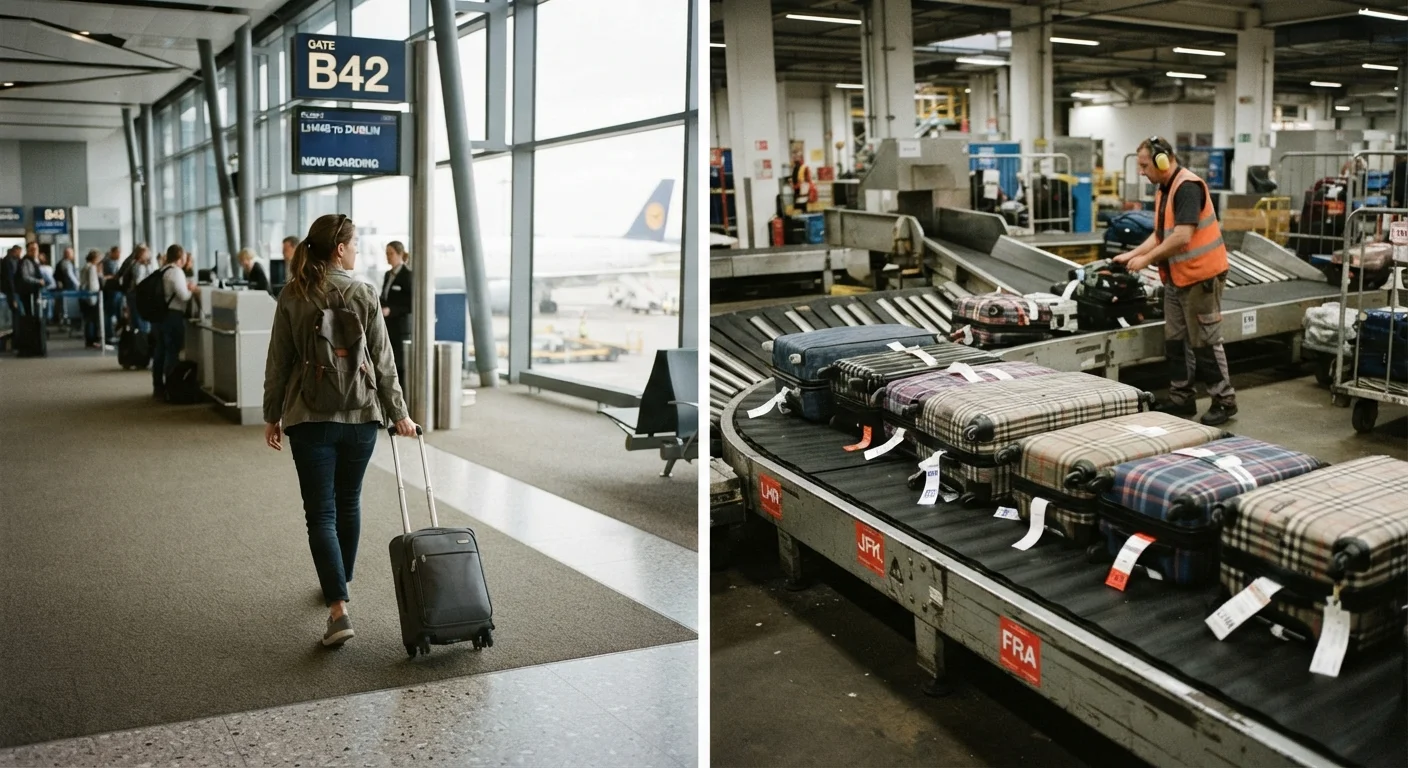
Option A
Checked Luggage
The spacious, flexible option for longer or more complex trips.
Best for: Travelers on extended trips, those needing specialty gear, or anyone visiting multiple climates.
Option B
Carry-On Only
The streamlined approach for speed, simplicity, and lower fees.
Best for: Short trips, frequent flyers, and travelers who want to bypass baggage claim entirely.
The Core Trade-Off: Convenience vs. Capacity
At its most basic level, the carry-on vs. checked bag decision is a negotiation between two competing priorities: speed and simplicity on one side, packing capacity on the other. Neither approach is universally better — the right choice depends on the specific demands of your trip.
Checked luggage gives travelers room to pack for virtually any scenario. A standard checked bag typically allows between 50 and 62 linear inches in combined dimensions (length + width + height) and up to 50 lbs on most U.S. carriers, though limits vary. That space comes at a cost: checked bag fees on major U.S. airlines generally range from around $30 to $40 per bag for the first checked piece on domestic routes, with international fees varying widely by carrier and route. Beyond fees, checked bags add time — both at check-in and at baggage claim, where waits of 20 to 40 minutes are common.
Carry-on travel eliminates those fees and delays, but demands planning. Most airlines allow one carry-on bag in the overhead bin (typically up to 22 x 14 x 9 inches on U.S. carriers) plus one personal item. Budget carriers, however, often impose stricter or paid carry-on policies — a detail worth verifying before booking. For guidance on traveling lighter overall, see why overpacking happens and what helps.
| Criterion | Checked Luggage | Carry-On Only |
|---|---|---|
| Packing capacity | High (up to 50 lbs typically) | Limited (overhead bin dimensions) |
| Typical added fee (domestic U.S.) | $30–$40+ per bag | Usually free (fare class dependent) |
| Airport time added | 20–40 min at baggage claim | Minimal — exit immediately after landing |
| Risk of loss or delay | Present — bags can be misdirected | None — bag stays with you |
| Suitability for long trips | Strong — ample room for extended stays | Requires laundry access or discipline |
| Ease on multi-stop itineraries | Cumbersome between transit points | Significantly easier to move |
| Budget airline compatibility | Fee applies but policy is clear | Strict size limits; some charge for carry-ons |
When Trip Type Should Guide Your Decision
Trip length is the single most reliable predictor of which strategy makes sense. For trips of four days or fewer, experienced travelers routinely pack carry-on only without sacrificing essentials. As trip length extends past seven to ten days, the calculus shifts — re-wearing and laundry access become factors, and many destinations do offer laundry services that extend the carry-on strategy's viability.
Destination also matters significantly. A beach week in a warm climate involves lightweight, compressible clothing. A winter trip to a cold-weather city requires bulkier layers that eat through carry-on space quickly. Similarly, trips spanning multiple climates — a cruise that includes port excursions with varying weather — may genuinely require more than a carry-on can hold.
Multi-destination itineraries tend to favor lighter packing. Moving between cities by train, bus, or short-haul flight becomes significantly more manageable without a checked bag in tow. As covered in planning a multi-destination trip, logistics complexity compounds with every additional stop — a heavy bag amplifies that friction.
$30–$40
Typical first checked bag fee, domestic U.S.
Fee structures vary by airline and fare class; some international fares include a checked bag at no additional charge.
~6 per 1,000
Checked bags mishandled per thousand enplaned
U.S. Department of Transportation Air Travel Consumer Reports track mishandled baggage rates across major carriers annually.
20–40 min
Average baggage claim wait at major U.S. airports
Wait times vary by airport, time of day, and flight load; international arrivals with customs processing tend toward the longer end.
For long-haul international travel, the decision is less clear-cut. Many international fares include a checked bag, effectively reducing the fee argument for carry-on. On those routes, the primary carry-on advantage shifts to speed — skipping baggage claim after a 12-hour flight is a genuine quality-of-life benefit, especially when connecting onward. See our guide on long-haul flight comfort habits for related planning considerations.
Practical Factors Often Overlooked
Baggage policies differ not just between airlines but between fare classes on the same airline. Basic economy fares on several major U.S. carriers restrict overhead bin access, effectively forcing travelers into a personal-item-only allowance unless they pay to upgrade. Checking the specific fare rules — not just the airline's general policy — before packing is essential.
Lost and delayed luggage remains a real consideration. U.S. Department of Transportation data consistently shows that checked bags are mishandled at a rate of several bags per thousand — a small but non-negligible risk, particularly on itineraries with tight connections. Irreplaceable items, medications, and valuables should always travel in the cabin regardless of which overall strategy you choose.
Always Keep Medications in the Cabin
Regardless of your overall luggage strategy, medications, medical devices, and essential documents should always be packed in a carry-on or personal item — never in checked luggage. If a checked bag is delayed or misdirected, access to these items could be delayed by hours or days. The TSA and most airlines explicitly permit medications through security screening; check current rules on the TSA website or your airline's policy page before travel.
For travelers connecting through busy airports, the carry-on strategy also reduces stress during layovers. Without a checked bag, missed connections become less catastrophic — you rebook a flight rather than also chasing luggage across a hub airport. For a detailed look at handling connections, see navigating airport layovers.
Ultimately, neither strategy is a permanent commitment. Many experienced travelers use checked luggage for extended family trips and carry-on only for business travel or short getaways — matching the tool to the trip rather than defaulting to habit.
The content on this site is for informational purposes only and is not a substitute for professional advice. Always consult a qualified professional for guidance specific to your situation.