

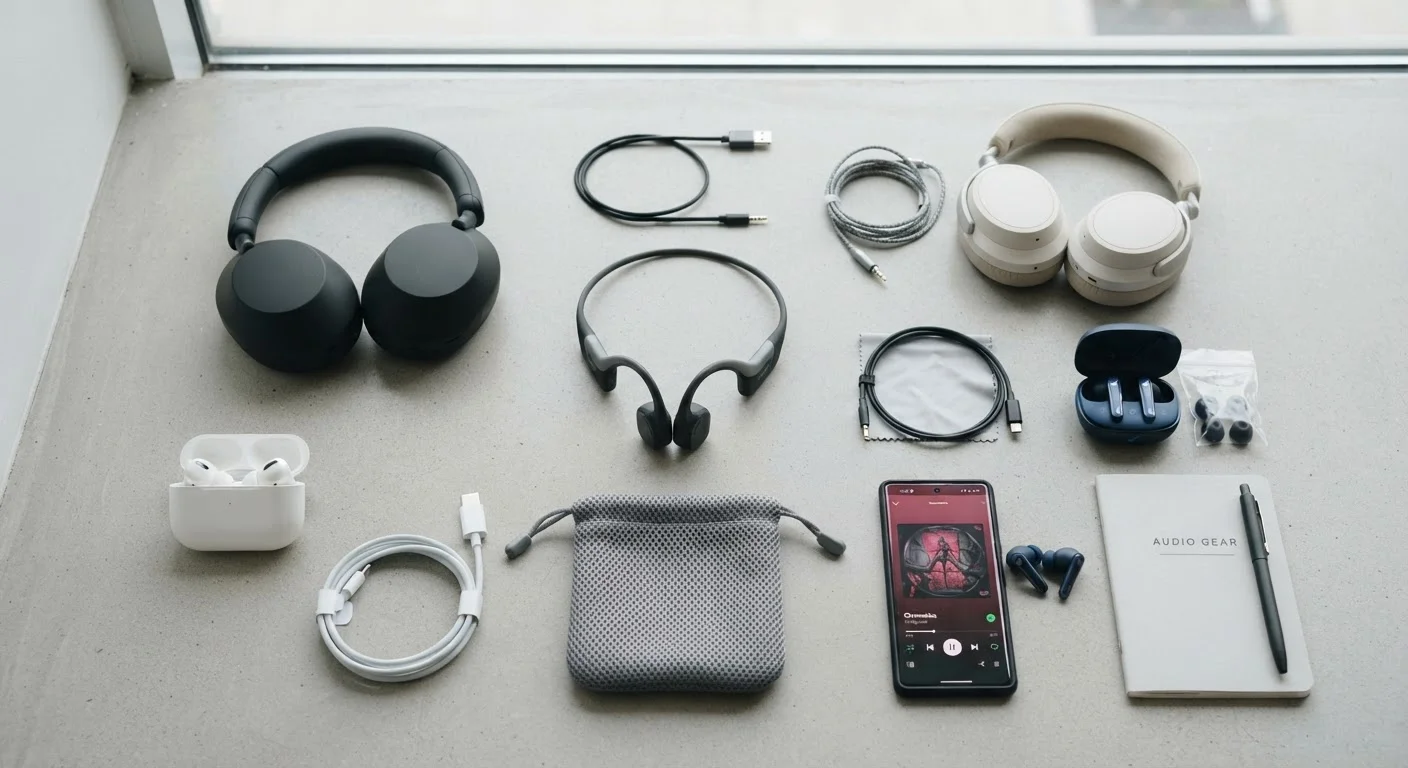
Why Form Factor Matters More Than Specs
Audio hardware marketing leans heavily on specifications: driver size, frequency response, impedance, codec support. These numbers have real meaning, but they rarely determine whether a pair of headphones works for your life. A set with outstanding specs that sits uncomfortable on your ears after 20 minutes is a poor purchase regardless of its measured performance.
Form factor — the physical shape and wearing style of a device — dictates comfort across time, how much outside sound it blocks or admits, how portable it is, and what trade-offs you accept. Understanding each major category helps you spend money on something that fits your actual habits, not just a spec sheet. For a plain-language guide to the technical terminology that appears across all consumer electronics, see the Consumer Electronics Glossary.
True Wireless Earbuds: Freedom With Trade-Offs
True wireless stereo (TWS) earbuds have no wire connecting the two earpieces or linking them to a device. Each bud communicates independently with your phone via Bluetooth, and they recharge inside a compact carrying case. That combination of portability and convenience made them the fastest-growing audio category of the past decade.
The trade-offs are real. Smaller drivers — the components that produce sound — mean TWS earbuds generally cannot match the bass depth or soundstage width of larger headphones at equivalent price points. Battery life per charge typically runs four to eight hours for the buds themselves, supplemented by additional charges from the case. Connection stability can vary depending on Bluetooth version, radio interference, and how far your phone travels from your body.
Fit matters enormously. Most earbuds ship with multiple silicone or foam tip sizes. A poor seal not only lets ambient noise in but also degrades bass response — the eartip creates the acoustic chamber the driver depends on.
Always try foam ear tips on TWS earbuds if your device shipped with silicone. Foam conforms to the ear canal more precisely, improving both passive isolation and bass response without any change to the electronics.
Foam tips create a tighter acoustic seal than silicone for most ear canal shapes, which directly affects how the driver's low-frequency output is perceived — a meaningful difference that costs almost nothing to test.
For open-back headphones, position matters: use them in a quiet room and expect people nearby to hear what you're listening to. They're not a compromise — they're a specialized tool for a specific context.
Open-back designs are engineered for a natural, speaker-like presentation at the expense of isolation and privacy; treating them as a general-purpose solution leads to disappointment, while using them correctly reveals their genuine strengths.
Over-Ear and On-Ear Headphones: Power and Immersion
Over-ear headphones (sometimes called circumaural) surround the entire ear with a cushioned cup, while on-ear (supra-aural) designs rest the cup directly against the outer ear. Both use significantly larger drivers than earbuds — typically 40mm or larger — which allows fuller reproduction of low and mid frequencies and a wider perceived soundstage.
Closed-back over-ear designs seal the rear of the driver housing, providing strong passive noise isolation without any active electronics. Open-back designs leave the rear vented, which produces a more natural, airy sound but leaks audio in both directions — unsuitable for public spaces, ideal for quiet home listening sessions.
The main downsides are bulk and heat. Over-ear headphones don't fold into a pocket. Wearing them for hours in warm environments causes ear fatigue from heat buildup. On-ear designs are lighter but can create pressure discomfort across extended sessions. If you're pairing these with a power source, consider reading about wired vs. wireless charging differences — many premium wireless headphones benefit from fast-charge support.
40mm+
Typical driver diameter in over-ear headphones
Larger drivers have more physical surface area to move air, which supports deeper bass reproduction compared to the 6–12mm drivers common in earbuds.
IPX4
Minimum water resistance for exercise earbuds
IPX4 indicates protection against splashing water from any direction — the baseline standard most manufacturers recommend for sweat-prone activities.
Bone Conduction and Open-Ear Designs
Bone conduction headphones bypass the eardrum entirely. Small transducers rest against the cheekbones and vibrate, transmitting sound through bone directly to the cochlea (inner ear). Because your ear canal remains completely unblocked, you hear both the audio and your full environment simultaneously.
This design has a devoted following among runners, cyclists, and commuters who need situational awareness — the ability to hear traffic, other people, or environmental cues while still listening to audio. The listening experience is markedly different from traditional headphones: the sound lacks bass depth and can feel diffuse or thin at higher volumes, and audio leakage to bystanders is noticeable.
A newer category, open-ear earbuds (sometimes marketed as "open-fit" or "clip-on" designs), achieves a similar result through a different mechanism: a driver positioned near but not inside the ear canal directs sound toward the eardrum without occluding it. These offer improved audio quality over bone conduction but remain more sonically limited than in-ear or over-ear options. Both formats are worth considering for outdoor activity where safety is a priority. See Travel Tips for how audio gear choices shift in transit environments.
Active Noise Cancellation: What It Actually Does
Active noise cancellation (ANC) uses microphones to sample ambient sound, then generates an inverted audio signal to cancel it before it reaches your ears. It works best against consistent, low-frequency noise — airplane cabin rumble, air conditioning hum, train engine vibration. It is less effective against irregular, high-frequency sounds like a nearby conversation or a sudden alarm.
ANC requires a power source, which is why it appears on wireless models or wired headphones with an inline battery module. Enabling ANC draws additional battery, typically reducing runtime by 20–40% depending on the implementation. Some people experience mild pressure or disorientation when ANC is active — a sensation caused by the anti-noise signal rather than physical compression.
Transparency mode, offered by many ANC headphones, does the reverse: it amplifies ambient sound through the microphones so you can hear your environment without removing the headphones. This is useful for brief conversations, announcements, or moments when situational awareness matters.
High Volume Carries Real Risk
Prolonged exposure to audio above 85 decibels can cause gradual hearing damage, and earbuds can deliver levels well above that threshold. The World Health Organization estimates that over a billion young people are at risk from unsafe listening practices. Most smartphones now include volume warnings or weekly exposure summaries — these are worth reviewing, not dismissing.
Matching the Right Device to Your Situation
No single form factor wins across all contexts. The most practical approach is to identify your two or three primary listening situations and choose accordingly.
- Commuting and travel: TWS earbuds with ANC handle transit noise and pack flat; over-ear ANC headphones offer deeper isolation for long flights.
- Exercise: Bone conduction or secure-fit sport earbuds prioritize safety and stability; look for an IPX4 water-resistance rating (sweat protection) at minimum.
- Remote work and calls: Over-ear closed-back headphones reduce distractions and typically carry better microphone arrays for video calls.
- Home listening: Open-back over-ear headphones provide the most natural soundstage for dedicated sessions without background noise concerns.
- Outdoor activity: Open-ear or bone conduction formats keep your ears free to monitor surroundings.
It's also worth considering longevity. TWS earbuds have batteries that degrade with charge cycles and are rarely user-replaceable, so a higher-quality pair maintained carefully may outlast a budget option replaced annually. The article on extending device lifespan covers battery habits that apply directly to wireless audio gear. And for perspective on which hardware features genuinely affect your experience versus those that are mostly marketing, see hardware features that rarely change daily life.
The content on this site is for informational purposes only and is not a substitute for professional advice. Always consult a qualified professional for guidance specific to your situation.