

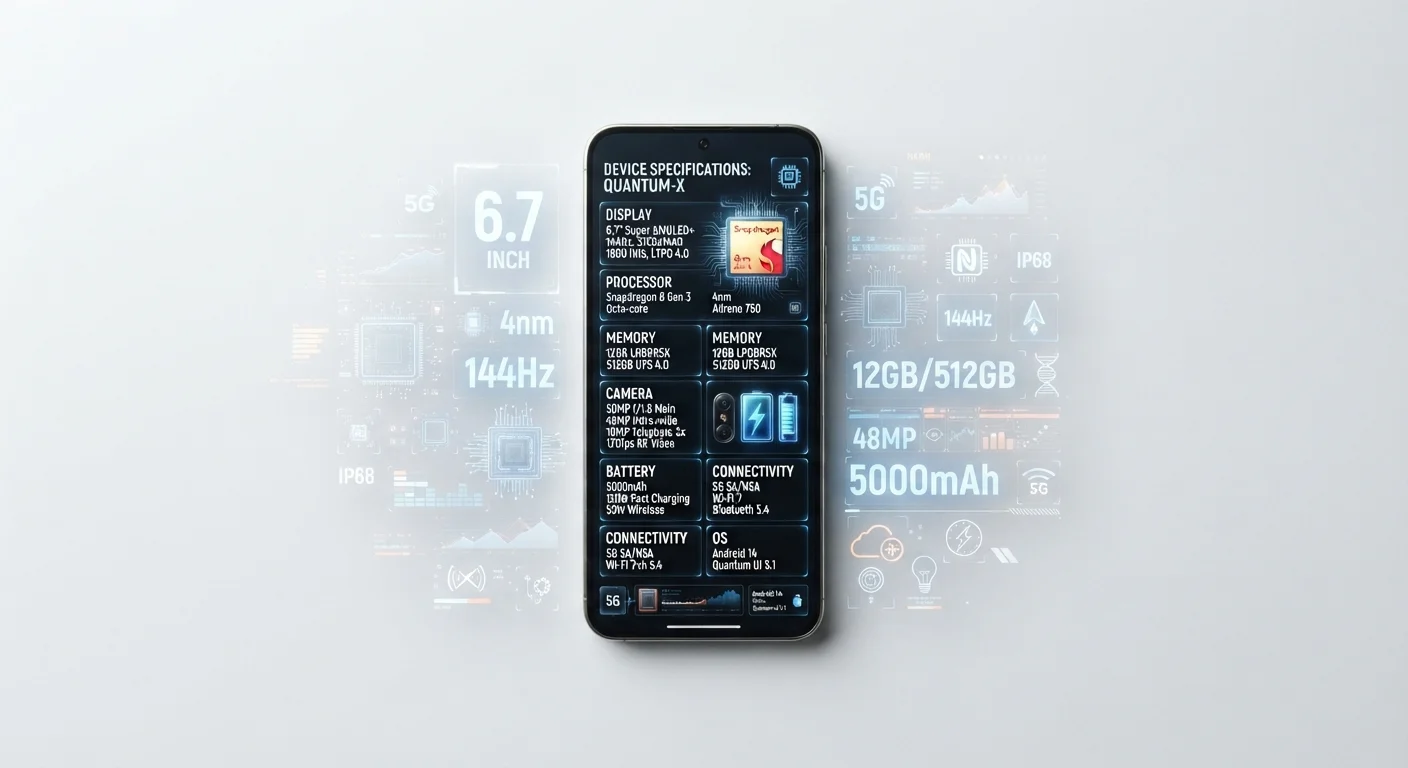
When the Numbers Run Ahead of Real Life
Every major device launch arrives with a cascade of specifications designed to impress: megapixels in the hundreds, storage measured in terabytes, and screen resolutions that sound like astronomy units. These numbers are real — the engineering behind them is often genuinely sophisticated. But a specification being technically impressive and a specification meaningfully improving daily life are two different things.
This distinction matters because device decisions are often made at the spec-sheet level. A larger number triggers confidence, even when the lived difference is imperceptible. The list below examines eight hardware features that consistently generate headlines and marketing copy, while delivering modest — or essentially zero — perceptible benefit to the average user. For a plain-language guide to what these terms actually mean, see the consumer electronics glossary covering everything from refresh rates to IP ratings.
200MP Smartphone Cameras
Megapixel count measures how many individual light-capturing pixels a sensor contains. More pixels can theoretically capture finer detail — but the relationship breaks down quickly on a phone-sized sensor. Packing 200 million pixels into a small sensor means each pixel is physically tiny, which reduces its ability to capture light effectively in anything less than ideal conditions.
Most 200MP phones use pixel-binning, combining groups of pixels into larger effective units to manage low-light noise. The resulting image is often 12MP or 50MP, not 200MP. For the vast majority of sharing contexts — social media, messaging, standard printing — the difference between a well-processed 12MP image and a binned 200MP image is indistinguishable. Persistent myths about smartphone cameras explain why this misconception remains so widespread.
More megapixels often means smaller pixels, which can hurt low-light performance rather than help it.
8K Video Recording on Phones
8K resolution captures footage at 7,680 × 4,320 pixels — sixteen times the pixel density of standard 1080p HD. It is a meaningful format for professional cinema production and very large commercial displays. On a smartphone, the practical limitations accumulate fast.
Recording 8K generates enormous file sizes, drains batteries significantly faster, and produces heat that can throttle the processor mid-recording. Most phone displays cannot render 8K natively. Most streaming platforms, televisions, and computers cannot play it back at full resolution. The overwhelming majority of people filming with their phones have no downstream workflow that benefits from 8K footage.
8K video on a phone creates huge files and heat — with almost no platform able to play them back at full resolution.
Extreme Refresh Rates Above 120Hz
Refresh rate describes how many times per second a screen redraws its image, measured in hertz (Hz). The jump from 60Hz to 120Hz is perceptible to most people — scrolling feels smoother, animations are more fluid. This is a specification that genuinely matters in everyday use.
Above 120Hz, the returns diminish sharply. Some flagship devices now advertise 165Hz or even 240Hz displays. Research on human visual perception generally suggests that most people cannot reliably detect differences above 90–120Hz in typical screen-viewing conditions. Higher refresh rates also increase power consumption, meaning the battery trade-off often outweighs any marginal smoothness gain for most users.
The 60Hz-to-120Hz upgrade is real and noticeable; beyond that, most people can no longer detect the difference.
Multiple Terabytes of Local Storage
Having ample storage matters — running out mid-trip or mid-project is a genuine problem. But the ceiling at which additional storage stops improving daily life arrives well before the multi-terabyte tiers now appearing in flagship devices.
Cloud services, streaming platforms, and automatic photo backups mean most users' local storage needs are far lower than their device's capacity. Someone who genuinely needs 1TB on a phone — editing 8K video files locally, archiving lossless audio libraries, working offline in bandwidth-constrained environments — exists. But for most people paying a premium for maximum storage, a meaningful portion of that capacity will remain unused for the device's entire lifespan.
Cloud storage and streaming mean most people's actual local storage use is a fraction of flagship device capacity.
Wi-Fi 7 on Devices Without Matching Infrastructure
Wi-Fi 7 (technically 802.11be) is a genuine advancement — it offers significantly higher theoretical throughput and lower latency than its predecessors. A device that supports Wi-Fi 7 is ready for future network upgrades. But the specification only delivers when the router, internet service, and network conditions also support it.
The vast majority of home routers in use today are Wi-Fi 5 or Wi-Fi 6. Internet service plans in most US markets deliver speeds that even Wi-Fi 5 handles comfortably. Buying a device partly on the strength of Wi-Fi 7 support is essentially paying for a feature that will sit dormant until the surrounding infrastructure catches up — which may be years away for most households.
Wi-Fi 7 is only as fast as your router and internet plan allow — and most home networks aren't there yet.
Satellite Connectivity as an Everyday Feature
Satellite messaging and emergency SOS capabilities — the ability to send texts or distress signals via satellite when cellular networks are unavailable — are genuinely valuable safety features in specific contexts: remote hiking, backcountry travel, disaster scenarios. For those use cases, the capability can be life-saving.
As a day-to-day specification, however, satellite connectivity is irrelevant for the overwhelming majority of users who spend their time in areas with reliable cellular coverage. It is a feature worth having if it comes at no extra cost or trade-off, but it should not be a deciding factor in device selection for urban or suburban users.
Satellite messaging is a meaningful safety feature for remote travel, but irrelevant for most everyday users.
Periscope Telephoto Lenses Beyond 10x Optical Zoom
Optical zoom that actually moves glass elements to magnify a scene — as opposed to digital zoom, which simply crops and enlarges a portion of the sensor — is a meaningful improvement. A 3x or 5x optical zoom lens on a phone enables genuinely sharper distant shots that digital zoom cannot replicate.
At 10x optical zoom and beyond, the real-world applications narrow considerably. Handheld camera shake becomes a dominant factor at extreme zoom levels, and stabilization can only compensate so much. Subjects that require 30x optical zoom on a phone are typically better served by dedicated telephoto equipment. For most users, a 3x–5x optical system covers the practical range of everyday telephoto needs.
Optical zoom up to 5x improves real shots significantly; beyond 10x, camera shake and use cases become limiting factors.
Foldable Form Factors Pitched as Productivity Tools
Foldable phones offer a genuinely larger display surface in a pocketable package, which has appeal for media consumption and some multitasking scenarios. But the current generation of foldables involves engineering trade-offs that rarely appear in launch presentations: the inner screen crease visible in many lighting conditions, increased thickness and weight compared to standard devices, and higher susceptibility to damage at the hinge point.
Software support for the expanded display format remains inconsistent across many apps, meaning the larger screen often renders a stretched version of a phone layout rather than a purpose-built tablet experience. The engineering trade-offs behind foldable phones go deeper into what the spec sheets leave out.
Foldable screens expand display real estate but come with weight, durability, and software maturity trade-offs that matter daily.
What Actually Moves the Needle
The specifications that reliably improve daily experience tend to be less glamorous: battery efficiency, software stability, thermal management, and display calibration. A well-tuned 12MP camera system with strong computational photography will outperform a 200MP sensor with mediocre optics and slow processing in virtually every real-world shooting scenario. A 1080p OLED panel with accurate colors and high peak brightness is often more satisfying than an 8K screen on a device too small to resolve the difference — for a deeper look at why panel technology shapes what you actually see, our display technology explainer breaks it down.
Focus on the Specs You'll Actually Use
Before a device decision, list the three or four things you do most on your current device, then identify which specifications directly affect those tasks. Battery life, processing speed, and display clarity affect almost everyone. Satellite zoom and 8K recording affect very few. Matching specifications to actual habits — rather than to a comparison chart — tends to produce more satisfying outcomes. Our guide on extending device lifespan covers the maintenance habits that matter more than headline specs.
None of this means high-end specifications are inherently fraudulent. Some translate directly to tangible improvements — faster processors that handle multitasking without lag, increased RAM that keeps apps from reloading, genuine IP68 waterproofing that protects a device in real conditions. The signal worth chasing is whether a specification solves a problem you actually encounter, not whether it wins a comparison chart. See also: the patterns behind gadget regret — because spec envy is one of the most common triggers.
The content on this site is for informational purposes only and is not a substitute for professional advice. Always consult a qualified professional for guidance specific to your situation.