

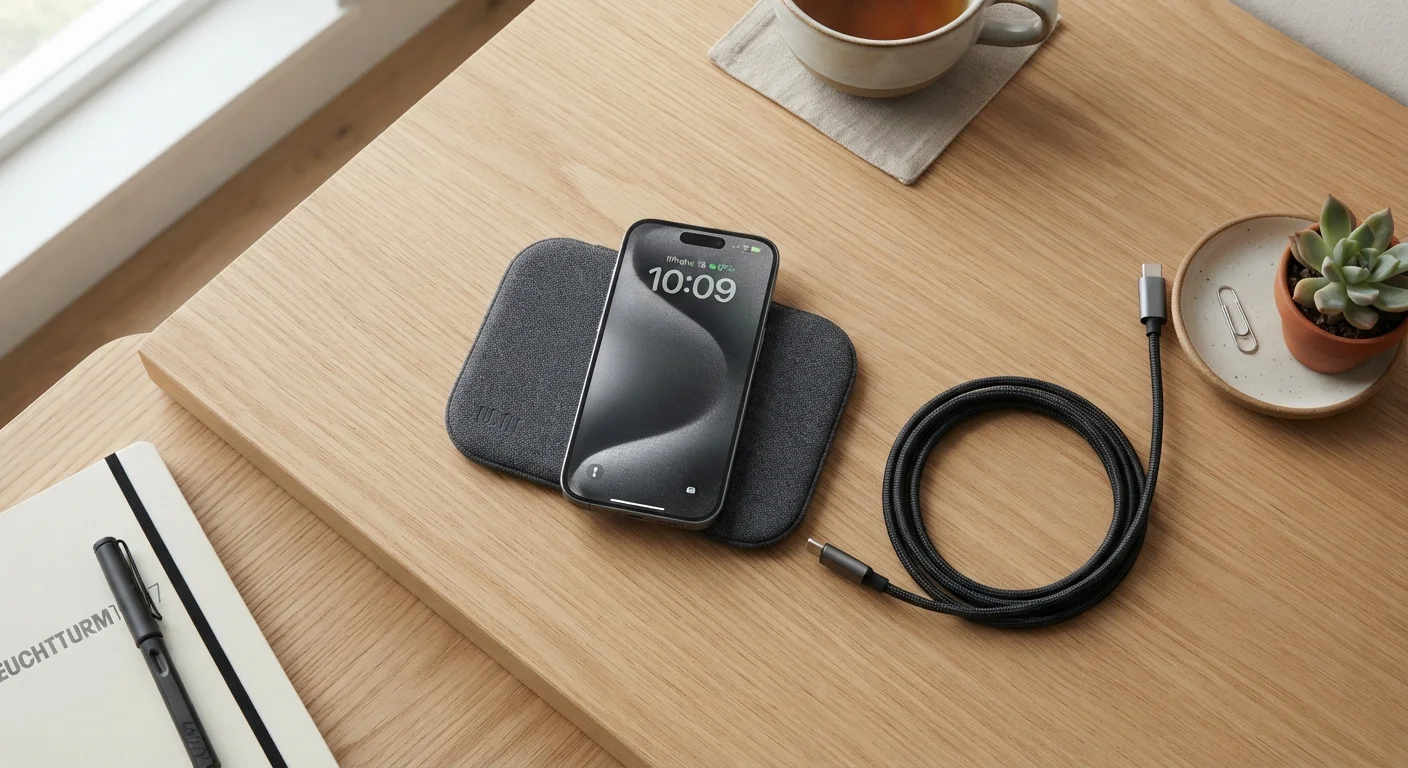
Option A
Wired Charging
The fast, direct, time-tested method.
Best for: Users who need the quickest possible charge and prioritize raw speed over convenience.
Option B
Wireless Charging
The cable-free, everyday convenience option.
Best for: Users who value ease of use and top-up charging throughout the day over maximum speed.
How Each Method Actually Delivers Power
Wired charging sends electrical current directly from a power source through a cable into your device's battery via its charging port. This direct transfer is highly efficient — most of the energy drawn from the wall reaches the battery with minimal loss.
Wireless charging, by contrast, uses electromagnetic induction. A charging pad contains a copper coil that generates a changing magnetic field; a second coil inside your phone converts that field back into electrical current. The Qi standard (pronounced "chee"), developed by the Wireless Power Consortium, governs how most consumer devices implement this today. Qi2, an updated standard released in 2023, improved alignment and power efficiency over the original.
The physics of induction means some energy is inevitably lost as heat during the conversion process. That inefficiency isn't dangerous, but it has real implications for both charging speed and battery health over time.
| Criterion | Wired Charging | Wireless Charging |
|---|---|---|
| Typical max speed (consumer devices) | 45W–120W+ | 15W–50W |
| Energy efficiency | High (~85–95%) | Moderate (~70–80%) |
| Heat generated | Lower per session | Higher per session |
| Convenience | Requires cable connection | Drop-and-charge simplicity |
| Multi-device support | One device per cable | Pads can charge multiple devices |
| Long-term battery impact | Marginally lower degradation | Slightly higher degradation (heat) |
| Port wear | Gradual connector wear | No port contact |
Speed: Where the Gap Is Real
The speed difference between wired and wireless charging is substantial and largely uncontested. Modern flagship smartphones support wired charging at 45W, 65W, or even higher on some Android devices, enabling a full charge in well under an hour. Apple's MagSafe delivers up to 15W wirelessly; standard Qi tops out lower for many devices. Even the best wireless chargers available to consumers typically max out around 50W, and real-world speeds are often throttled by device firmware for thermal management.
~15W
Standard Qi wireless charging ceiling
Most Qi-certified devices and pads are designed for up to 15W, though proprietary implementations from individual manufacturers can exceed this.
~80%
Typical wireless charging efficiency
Studies on inductive charging systems consistently find around 80% energy transfer efficiency, compared to 90%+ for direct wired connections.
20%
Estimated battery capacity loss threshold
Apple considers a battery "significantly degraded" when it retains less than 80% of its original capacity, a benchmark widely referenced across the industry.
For everyday users, the practical impact depends on behavior. If you charge overnight or at a desk for hours, wireless charging reaches 100% — just more slowly. If you routinely need a meaningful charge in 20–30 minutes, wired is the only realistic option with current technology.
Heat, Safety, and Battery Chemistry
Lithium-ion batteries — the type in virtually every modern smartphone — are sensitive to heat. Elevated temperatures accelerate a chemical process called electrolyte decomposition, which permanently reduces how much charge a battery can hold. This degradation happens gradually over hundreds of charge cycles regardless of method, but heat speeds it up.
Wireless charging generates more heat at the battery than wired charging does, because the induction process creates thermal losses that end up warming the device. Most phones have built-in thermal management that slows charging when temperatures rise, which is one reason wireless charging speeds are often conservative by default.
Fast wired charging also produces heat — this is unavoidable. However, because the energy transfer is more direct, the overall thermal footprint per charging session tends to be lower than a comparable wireless session of the same duration. For practical guidance on managing heat and preserving device longevity, see our guide on extending device life.
On safety: both wired and wireless charging meet rigorous international safety standards when you use certified accessories. Uncertified, counterfeit chargers — wired or wireless — are the primary source of genuine charging-related safety incidents. Always look for chargers certified to relevant standards such as UL or those bearing legitimate Qi or USB-IF certification marks.
Certified Accessories Matter
Using uncertified or counterfeit chargers — whether wired or wireless — introduces risks including overheating, inconsistent voltage delivery, and in rare cases fire hazard. Always verify that chargers carry recognized safety certifications such as UL Listed or authentic USB-IF compliance marks. Qi and Qi2 certification for wireless pads signals that devices have been tested to interoperate safely.
Which Method Is Better for Long-Term Battery Health?
Based on current research, wired charging has a modest edge for preserving battery capacity over time — primarily because it generates less residual heat. However, the difference is relatively small when both methods are used reasonably. More impactful factors include: keeping your phone out of direct sunlight while charging, avoiding consistently charging to 100% or discharging below 20%, and not leaving devices on chargers for extended periods in hot environments.
Many smartphones now include features — sometimes called "optimized" or "adaptive" charging — that learn your routine and pause charging at 80% overnight, completing the final 20% just before your alarm. This is more meaningful for battery longevity than choosing wired versus wireless.
The charging method debate mirrors broader questions about device ownership and longevity. Habits and environment consistently outweigh hardware choices. Whether you're thinking about smartphones or the expanding world of EV charging — where similar efficiency and heat trade-offs apply at much larger scale — the fundamentals of battery chemistry remain consistent. Curious about how these concepts scale up? Explore how EV charging infrastructure is evolving globally.
The content on this site is for informational purposes only and is not a substitute for professional advice. Always consult a qualified professional for guidance specific to your situation.