
How Local Words Go National
American English has always been a moving target — a living patchwork of regional accents, local idioms, and neighborhood vernacular stitched together into something constantly evolving. But the speed at which a phrase can travel from a small town in Georgia or a neighborhood in South LA to someone's group chat in Minnesota? That's genuinely new.
Social platforms have become the great equalizers of language. A video filmed in a Charleston kitchen or a Dallas barbershop can rack up millions of views overnight, carrying its vocabulary with it. Linguists who study language change describe this as accelerated diffusion — a process that once took generations now unfolds in weeks. The result is a national dialect that borrows freely and often, sometimes without credit to its origins.
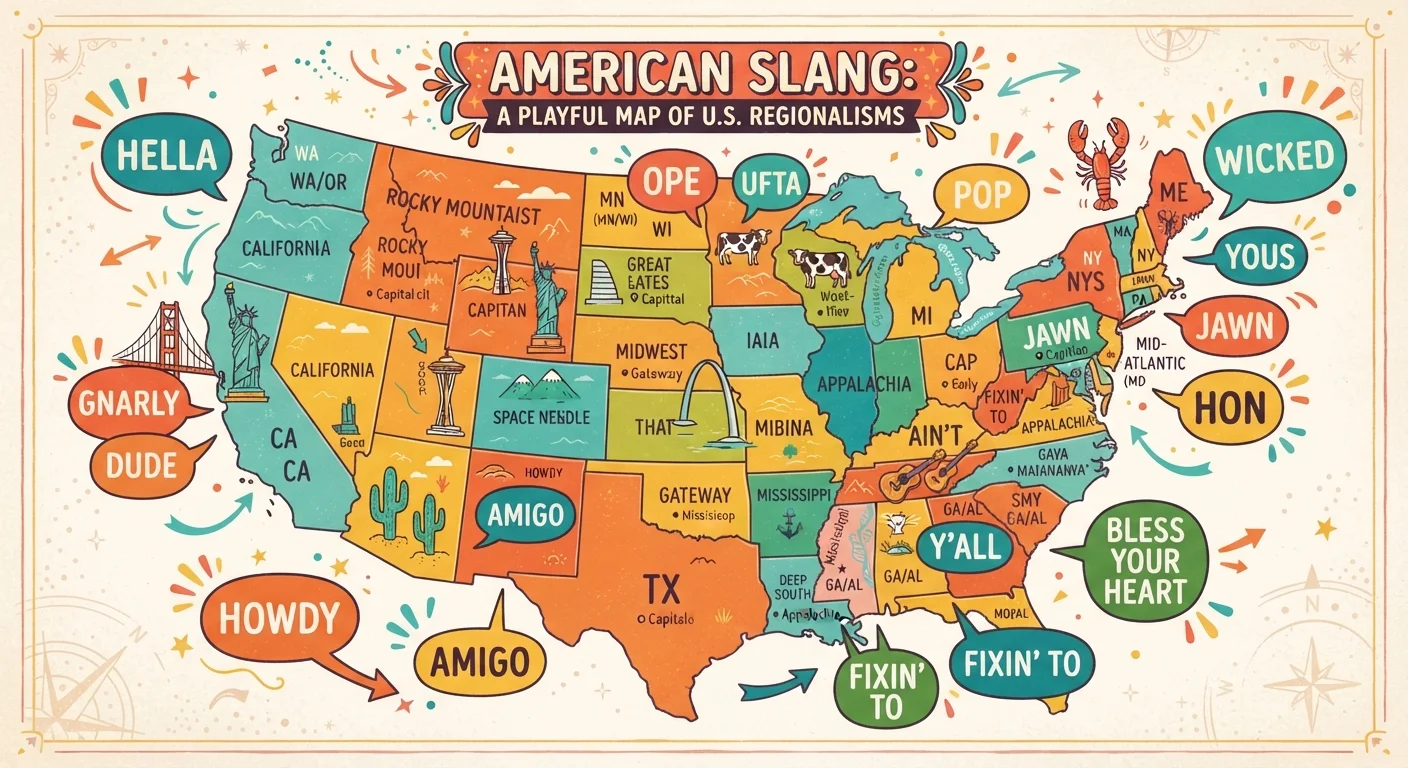
This kind of cultural exchange is worth tracking. As Americans travel more and connect digitally across regional lines — see our region-by-region travel guide for a sense of how distinct each area remains — the language we carry home from those experiences increasingly shapes everyday speech. Below are seven regional expressions that have made (or are making) that leap into the mainstream.
"Y'all" — The South's Gift to the Nation
Once firmly associated with Southern speech, y'all has become one of the most widely adopted second-person plural pronouns in American English. Its appeal is practical: English lacks a distinct plural "you," and y'all fills that gap naturally and warmly. Teachers, politicians, and TV hosts across the country now use it without irony. Linguists at universities including Stanford have noted its northward and westward migration for years, with digital media dramatically speeding the process.
Y'all fills a genuine grammatical gap English never solved — and America noticed.
"No Cap" — From AAVE to Everywhere
No cap — meaning "no lie" or "I'm being completely serious" — originates in African American Vernacular English (AAVE), with roots traceable to Black Southern communities and later hip-hop culture. It entered mainstream teen and young adult usage primarily through social media and music, and today appears in marketing copy, news headlines, and everyday conversation far removed from its origins. Linguists emphasize that borrowing AAVE without acknowledging its source community is a documented pattern worth naming honestly.
No cap traveled from AAVE to mainstream use — its origin community deserves recognition.
"Wicked" — New England's Favorite Intensifier
In much of New England, particularly Massachusetts, wicked functions as an intensifier meaning "very" or "extremely" — as in "wicked good" or "wicked cold." While it remains most at home in Boston-area speech, it has gained affectionate recognition nationwide, partly through film and television set in the region. It shows how hyper-local expressions can achieve a kind of cultural brand identity, becoming associated with a place's personality rather than just its vocabulary.
Wicked good is more than a phrase — it's a cultural personality marker for New England.
"Hella" — Northern California's Contribution
Another regional intensifier, hella (meaning "very" or "a lot of") is strongly associated with Northern California, particularly the Bay Area. It spread nationally through music and later social media, and while it remains most natural in West Coast speech, it's understood almost universally by younger Americans. Its journey mirrors the broader way West Coast culture — from fashion to food to language — tends to permeate national trends, a dynamic also visible in style movements tracked by fashion trend observers.
Hella started in the Bay Area and rode West Coast cultural influence straight into the national lexicon.
"Fixin' To" — A Southern Marker Holding Its Ground
Fixin' to (meaning "about to" or "preparing to do something") is a distinctly Southern and Midwestern expression that has resisted full national adoption — which itself tells a story. Some regional phrases spread; others remain markers of local identity. Linguists sometimes call these shibboleth expressions — words that signal where you're from almost as reliably as an accent. Fixin' to has shown up in national media often enough to be widely understood, even if few non-Southerners use it naturally.
Some regional phrases spread nationally; others stay local by choice — and that resistance is meaningful.
"On Fleek" and the Short Life of Viral Slang
Not every regional or subcultural phrase enjoys lasting adoption. On fleek — meaning perfectly executed or on point — exploded nationally around 2014 after a viral video and was almost immediately overused by brands and media outlets trying to sound current. Its rapid rise and fall illustrates how commercialization can accelerate the death of slang. When a phrase gets co-opted too quickly by advertising or mainstream media, the communities that originated it often abandon it. This tension between authenticity and mainstream adoption plays out in fashion and culture broadly.
When brands rush to adopt slang, they often accelerate its abandonment by the people who created it.
"Situationship" — Digital Communities Creating Their Own Dialect
Not all emerging slang comes from a geographic region anymore. Situationship — describing a romantic dynamic that isn't quite a relationship but isn't casual either — emerged primarily from online communities and spread through social platforms before appearing in mainstream journalism and conversation. This signals a newer linguistic phenomenon: digital subcultures functioning like regional dialects, generating their own vocabulary that then bleeds into everyday American speech. Language, like secondhand fashion trends, is increasingly shaped by communities outside traditional geography.
Online communities now generate slang the way regions once did — and it spreads just as fast.
Why Slang Adoption Is More Than Trend-Chasing
Language borrowing has always reflected cultural power, admiration, and connection. When a phrase spreads, it rarely travels in a vacuum — it often brings with it the community, the humor, or the worldview that generated it. That context matters. Viral moments that reshape behavior remind us that what looks like a passing trend can quietly rewire how we communicate and relate to one another.
Context Makes the Difference
When adopting slang from another region or community, a little awareness goes a long way. Understanding where a phrase comes from — and who created it — helps preserve the cultural meaning behind the words. Using language thoughtfully is one small way to honor the communities whose creativity shapes how we all communicate.
The expressions Americans share across regional lines are a small but real form of cultural exchange — proof that the country's diversity isn't just geographic but linguistic. Whether you grew up saying "y'all" or learned it from TikTok, you're participating in a living tradition of American reinvention.
The content on this site is for informational purposes only and is not a substitute for professional advice. Always consult a qualified professional for guidance specific to your situation.