

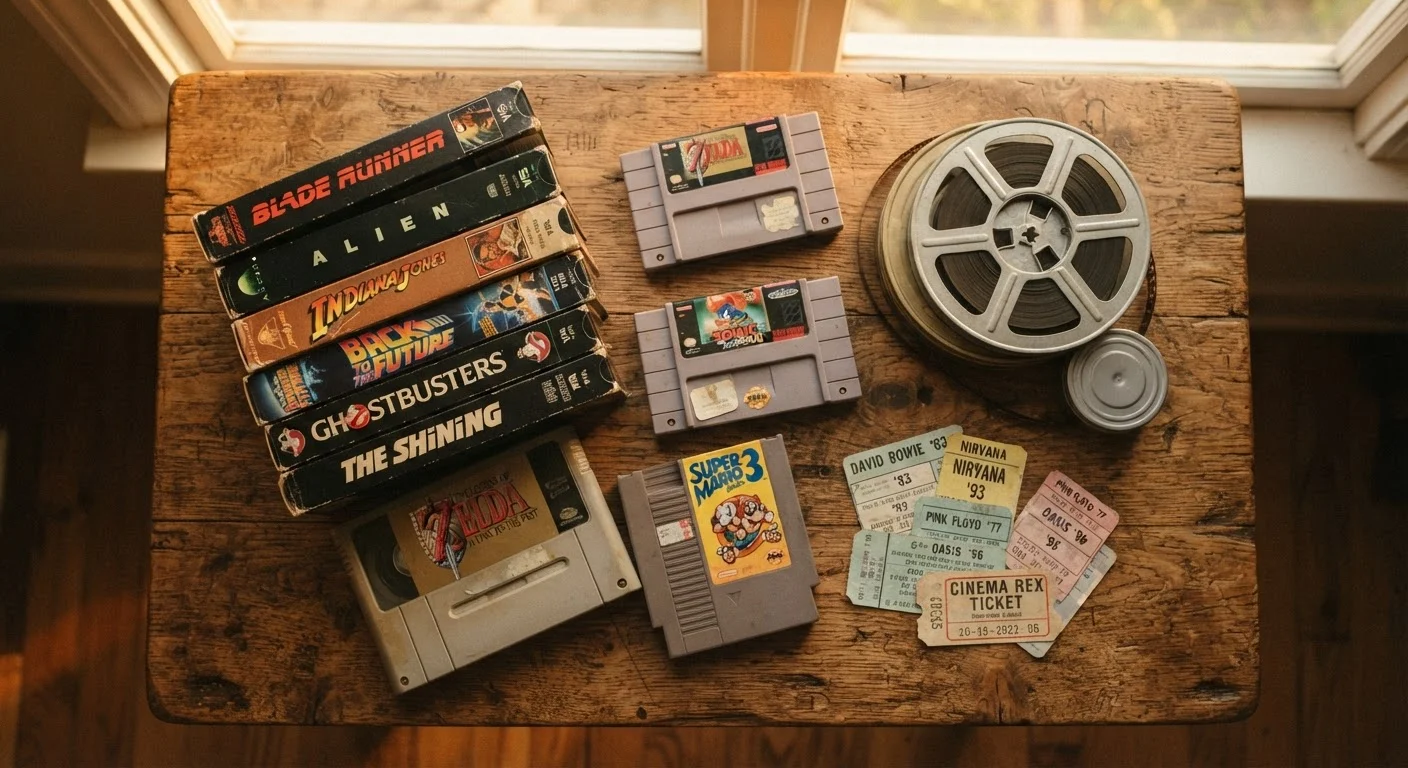
The Nostalgia Economy Is Real — and It's Enormous
Walk through any major retailer, scroll through a streaming menu, or glance at a movie marquee and the pattern is unmistakable: America can't stop looking backward. Sequels, reboots, and franchise revivals dominate entertainment spending, while retro aesthetics blanket everything from sneaker culture to interior design. This isn't accidental or purely sentimental — it's a commercially engineered phenomenon with deep psychological roots.
The numbers back it up. According to data tracked by entertainment industry analysts, the highest-grossing films in any given recent year are overwhelmingly drawn from pre-existing intellectual property — sequels, reboots, adaptations, or franchise extensions. Streaming platforms have compounded this by building entire marketing campaigns around legacy titles and legacy characters, betting that familiarity converts to subscriptions.
Top 10
Box office slots dominated by franchise or legacy IP
Industry tracking consistently shows that pre-existing intellectual property accounts for the vast majority of annual box office top-ten lists in the U.S.
43M+
Vinyl records sold in the U.S. in a recent year
According to the Recording Industry Association of America (RIAA), vinyl revenue has exceeded CD revenue for multiple consecutive years, reflecting sustained retro-format enthusiasm.
20 yrs
Average nostalgia cycle — now compressing
Cultural analysts have traditionally observed a roughly 20-year nostalgia loop; streaming platforms have accelerated this cycle significantly, with some trends returning within a decade.
This nostalgia economy touches more than film. The vinyl record market has sustained years of consecutive growth. Video game remasters regularly outsell original titles. Fashion cycles — already notoriously circular — have compressed, with trends from the early 2000s returning to stores within 20 years of their first run. Understanding why this is happening requires looking at psychology as much as economics.
The Psychology Behind the Pull of the Past
Nostalgia isn't weakness or passivity — it's a sophisticated emotional response. Psychologists at institutions including the University of Southampton have studied nostalgia extensively and found it serves important social and psychological functions: it reinforces identity, strengthens perceived social bonds, and buffers against feelings of meaninglessness or anxiety.
Crucially, nostalgia tends to spike during periods of collective uncertainty. Economic disruption, rapid technological change, and social fragmentation all push people toward the comfort of familiar cultural touchstones. The years following major social disruptions have historically produced strong nostalgia waves in entertainment — audiences gravitating toward stories, sounds, and aesthetics that feel stable and known.
“Nostalgia is a longing for a sanitised impression of the past — what in psychological research we sometimes describe as a bittersweet but overwhelmingly positive emotion that helps people feel continuity and meaning in their lives.”
— Constantine Sedikides, Professor of Social and Personality Psychology, University of Southampton
What's distinctly modern is the rise of what researchers term vicarious nostalgia — a longing for eras one never personally experienced. Gen Z audiences are demonstrably enthusiastic about 1990s and early 2000s aesthetics, music, and media despite having little or no lived memory of those periods. Platforms like TikTok accelerate this dynamic, surfacing retro content to algorithmically curious younger audiences who then adopt it as their own cultural identity.
How Streaming Changed the Speed of Nostalgia
Before streaming, cultural nostalgia operated on a roughly 20-to-30-year cycle. A film from the 1970s would find its revival audience in the 1990s; 1980s television would return to cultural prominence in the 2000s. That lag gave nostalgia its distinctive bittersweet quality — you had to wait, and the distance made the heart grow fonder.
Streaming collapsed that timeline entirely. When every decade of film and television is accessible on demand simultaneously, the nostalgia cycle can operate in real time. A show canceled in 2010 might develop a new cult following in 2018 and receive a revival greenlight by 2022. This compressed timeline is why nostalgia now feels omnipresent rather than periodic.
It also explains why studios have tilted so heavily toward legacy IP. When a platform can demonstrate that audiences are actively rewatching a 15-year-old franchise, the financial case for reviving it becomes almost irresistible. As shifting consumer values reshape spending in other categories, entertainment remains one arena where the pull of the familiar consistently wins.
Creative Costs and Cultural Conversations
The nostalgia wave is not without its critics. Many writers, directors, and industry observers argue that the commercial dominance of legacy IP is squeezing original storytelling out of mainstream pipelines. When development budgets flow overwhelmingly toward sequels and reboots, fewer resources remain for unproven ideas — particularly those from voices not historically centered in mainstream entertainment.
There's also the question of what nostalgia preserves and what it glosses over. Audiences who revisit beloved properties sometimes encounter troubling elements that earlier cultural moments normalized. Reboots must navigate this carefully — update the material and risk alienating original fans; preserve it unchanged and risk endorsing outdated attitudes. This tension is part of a broader cultural reckoning, connected to conversations about how American pop culture handles the past.
Nostalgia's power also intersects with community and identity in ways that go well beyond passive viewership. Fandoms built around legacy properties — sports teams, film franchises, musical artists — create real social bonds and rituals. That community dimension, explored in depth in discussions of sports fandom as American identity, helps explain why nostalgia content generates such fierce loyalty. The entertainment is almost secondary to the belonging it enables.
This article is for informational and educational purposes only. It reflects general cultural analysis and does not constitute professional advice of any kind.
Frequently Asked Questions
Studios and streaming platforms favor familiar intellectual property because pre-existing audience recognition reduces financial risk. A known brand or character requires less marketing spend to attract viewers. This economic calculus, combined with genuine audience demand for comfort content, has made reboots a dominant programming strategy.
Nostalgia has always influenced culture, but its current scale and speed are unprecedented. Digital streaming makes decades of content instantly available, collapsing the gap between eras and turbocharging nostalgia cycles. What once took a generation to revisit now recycles within a decade.
Researchers call this 'historical nostalgia' or 'vicarious nostalgia.' Exposure through social media, streaming libraries, and family culture allows younger audiences to develop genuine emotional attachment to past eras. Platforms like TikTok regularly surface decades-old music and aesthetics to Gen Z audiences who embrace them enthusiastically.
Many creative industry observers argue that over-reliance on nostalgia IP can squeeze original projects out of development pipelines. When sequels and reboots dominate release slates, fewer resources flow to new stories. However, original content still reaches audiences — the balance, critics say, has simply tilted.
Research in psychology suggests nostalgia provides a sense of continuity, belonging, and emotional warmth — particularly during periods of uncertainty or rapid social change. It functions as a coping mechanism, linking people to a self-image or community rooted in a more stable-feeling past.
The content on this site is for informational purposes only and is not a substitute for professional advice. Always consult a qualified professional for guidance specific to your situation.