

Start here
What Meditation Actually Is (and Isn't)
Understand the evidence
What the Research Says
Try it yourself
How to Start: The Practical Basics
Troubleshoot
Common Obstacles and How to Approach Them
Make it last
Building the Habit Over Time
What Meditation Actually Is (and Isn't)
Meditation is often pictured with incense, lotus poses, and spiritual vocabulary — imagery that puts off a lot of people who might otherwise benefit from the practice. Stripped of that cultural packaging, meditation refers broadly to a set of attention-training techniques. The most widely studied form involves deliberately focusing awareness on a chosen object — typically the breath — noticing when the mind wanders, and returning attention without judgment.
It is not a religion, not a relaxation technique per se, and not a practice that requires belief in anything beyond your own willingness to try it. The secular versions taught in clinical and educational settings — such as Mindfulness-Based Stress Reduction (MBSR) — were developed specifically to make these techniques accessible regardless of background. For a closer look at how mindfulness and meditation relate but differ, see this side-by-side breakdown.
Mindfulness meditation
A technique that involves paying deliberate, non-judgmental attention to present-moment experience — often the breath or body sensations. It is the most widely researched form of secular meditation.
MBSR
Mindfulness-Based Stress Reduction — an 8-week structured program developed at the University of Massachusetts Medical School that teaches mindfulness techniques in a secular, clinical context.
Attention training
The practice of deliberately directing and redirecting mental focus. Meditation is often described as a form of attention training because the core exercise involves noticing distraction and returning focus.
Body scan
A meditation technique that involves moving attention slowly through different areas of the body, noticing physical sensations without trying to change them.
Open awareness
A meditation style where attention is not fixed on a single object but allowed to rest with whatever arises — sounds, sensations, or thoughts — without following or engaging with any of them.
What the Research Says
The evidence base for meditation has grown considerably over the past two decades, though it remains a field where overstatement is common. Reviews published in peer-reviewed journals — including a widely cited 2014 meta-analysis in JAMA Internal Medicine — found moderate evidence that mindfulness meditation programs can reduce anxiety, depression, and pain. Effects on stress and attention have also been documented in multiple controlled studies.
Where the picture is less clear: many studies are small, use varying definitions of meditation, and rely on self-report measures. Researchers generally caution against treating meditation as a cure or replacement for clinical treatment. What the evidence does support is that regular, structured practice appears to have measurable effects on psychological wellbeing for many people — without meaningful risk for most healthy adults. If you're exploring meditation as part of a broader approach to mental wellness, building a sustainable daily routine offers a practical framework for layering habits effectively.
How to Start: The Practical Basics
You need almost nothing to begin. A quiet space, a timer, and a few uninterrupted minutes are sufficient. Here is a simple entry-point technique:
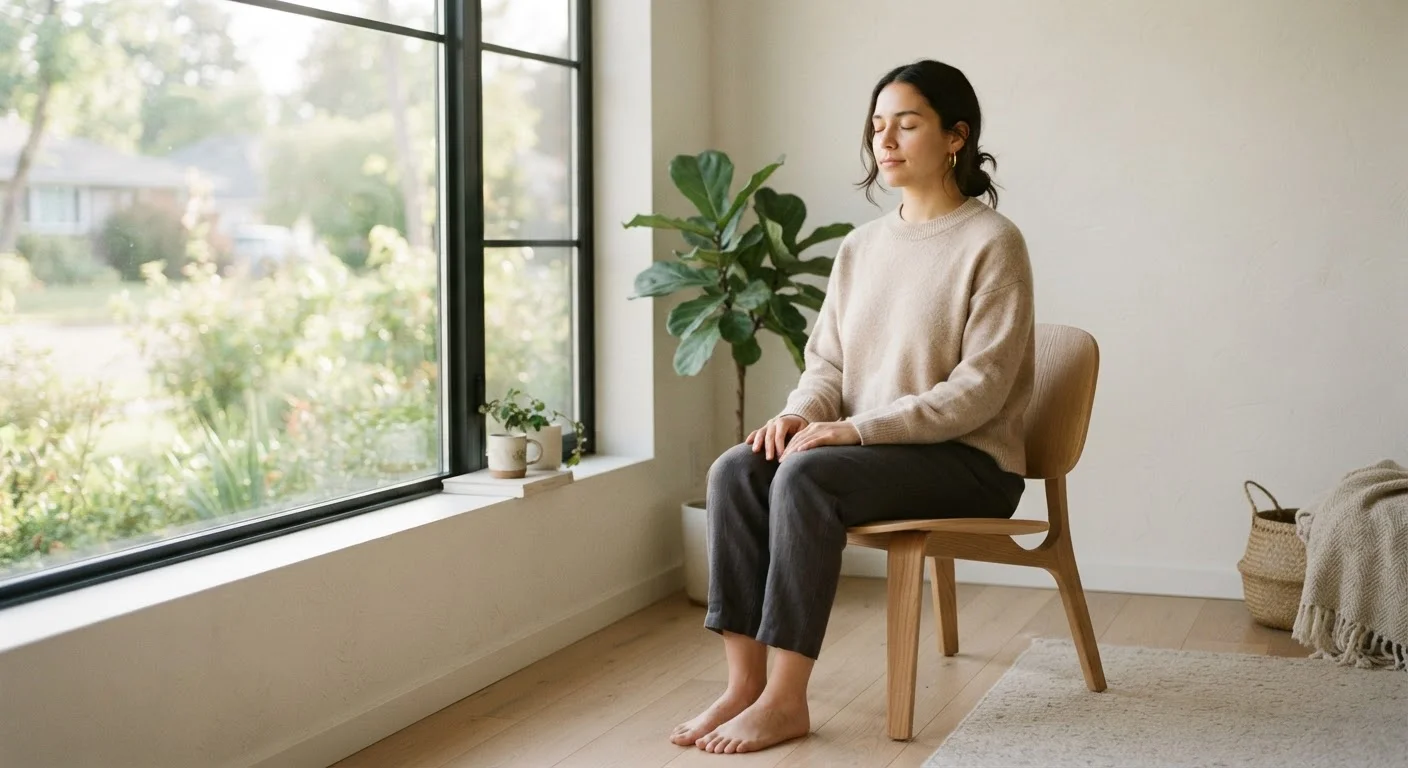
- Sit comfortably — on a chair, floor, or wherever you can hold an upright posture without strain. You do not need a meditation cushion.
- Set a timer for five minutes. Short sessions reduce the psychological barrier to starting.
- Focus on your breath — the sensation of air entering and leaving through your nose, or the rise and fall of your chest. You are not trying to control the breath, just observe it.
- When your mind wanders — and it will — gently note that it has, and return attention to the breath. This is the core of the practice.
- When the timer sounds, take a moment before resuming activity.
Guided audio sessions can be a useful scaffold. Many free recordings are available through health institutions, libraries, and apps. These provide structure without requiring you to hold the method in your head while you practice.
Anchor It to Something You Already Do
Pairing a new habit with an existing one — known as habit stacking — significantly improves retention. Try meditating immediately after pouring your morning coffee or before brushing your teeth at night. The existing habit acts as a reliable cue, reducing the effort needed to remember and begin.
Common Obstacles and How to Approach Them
The most universal beginner complaint is: "I can't stop thinking." This reflects a misunderstanding of what the practice involves. The goal is not a blank mind — it is the repeated, patient act of noticing distraction and returning focus. A session in which you redirect your attention twenty times is not a failed session; it is twenty repetitions of the exercise.
Other common friction points:
- "I don't have time." Five minutes is genuinely enough to begin. Many people find attaching meditation to an existing routine — immediately after waking or before a regular meal — makes it easier to sustain.
- "It feels awkward or pointless." Early sessions often feel unremarkable. This is normal. The effects, if they come, tend to emerge over weeks rather than in a single session.
- "I fall asleep." Meditating while upright and at a time when you are not already fatigued helps. Lying down increases the likelihood of dozing off.
If you find intense emotions or memories surfacing during practice, it is worth discussing this with a mental health professional before continuing. Starting with professional guidance is always a reasonable choice.
Building the Habit Over Time
Habit research consistently shows that consistency and environmental cueing matter more than willpower. Attaching meditation to an existing trigger — a morning coffee, the moment before a commute — gives it a natural anchor. Keeping your starting session length manageable reduces the chance that a busy day becomes a reason to skip entirely.
Tracking a simple streak — even on paper — can provide mild motivation without tipping into obsession. Missing a day is not a failure; resuming the next day is the practice. The approach mirrors what works in any new learning domain: steady, low-pressure repetition over time. If you find this kind of structured self-teaching appealing, this grounded introduction to self-education explores similar principles across different topics.
There is no single correct form of meditation, and the technique that holds your attention is the one most likely to become a lasting habit. Experimenting with breath-focused, body-scan, or open-awareness approaches — each of which is covered in detail in this plain-language explainer — can help you find what fits.
This article is for general informational purposes only and does not constitute medical or mental health advice. If you have concerns about your mental health, please consult a qualified healthcare professional.
Frequently Asked Questions
No. While meditation has roots in various spiritual traditions, the techniques used in most secular programs involve no belief system. You can practice purely as a mental training exercise, guided by breathing or body awareness, without any spiritual framing.
Most guidance suggests starting with five to ten minutes per session. Consistency matters more than duration at the outset. Building a regular short practice is generally more effective than infrequent longer sessions.
For most people, basic mindfulness-style meditation is low-risk. However, some individuals — particularly those with a history of trauma or certain mental health conditions — may find intensive practice uncomfortable. Consulting a qualified healthcare professional is advisable if you have concerns.
A wandering mind is entirely normal and not a sign that you're doing it wrong. The practice involves noticing when attention has drifted and gently returning it — that act of returning is itself the exercise.
Guided audio — whether through apps, podcasts, or recordings — can be a helpful scaffold for beginners. They provide structure and cues without requiring any prior knowledge. Over time, many practitioners transition to unguided sessions.
Research findings vary, but some studies suggest perceptible changes in stress response and attention can appear within a few weeks of regular practice. Individual results differ significantly, and outcomes are not guaranteed.
The content on this site is for informational purposes only and is not a substitute for professional advice. Always consult a qualified professional for guidance specific to your situation.