

Why Vocabulary Matters in Mental Health
Mental health conversations are often complicated by terminology that feels clinical, vague, or inconsistently used. A person might hear the word trauma in a therapy session, a news headline, and a workplace training — and encounter a slightly different meaning each time. That inconsistency can create confusion, or worse, discourage people from seeking information or support.
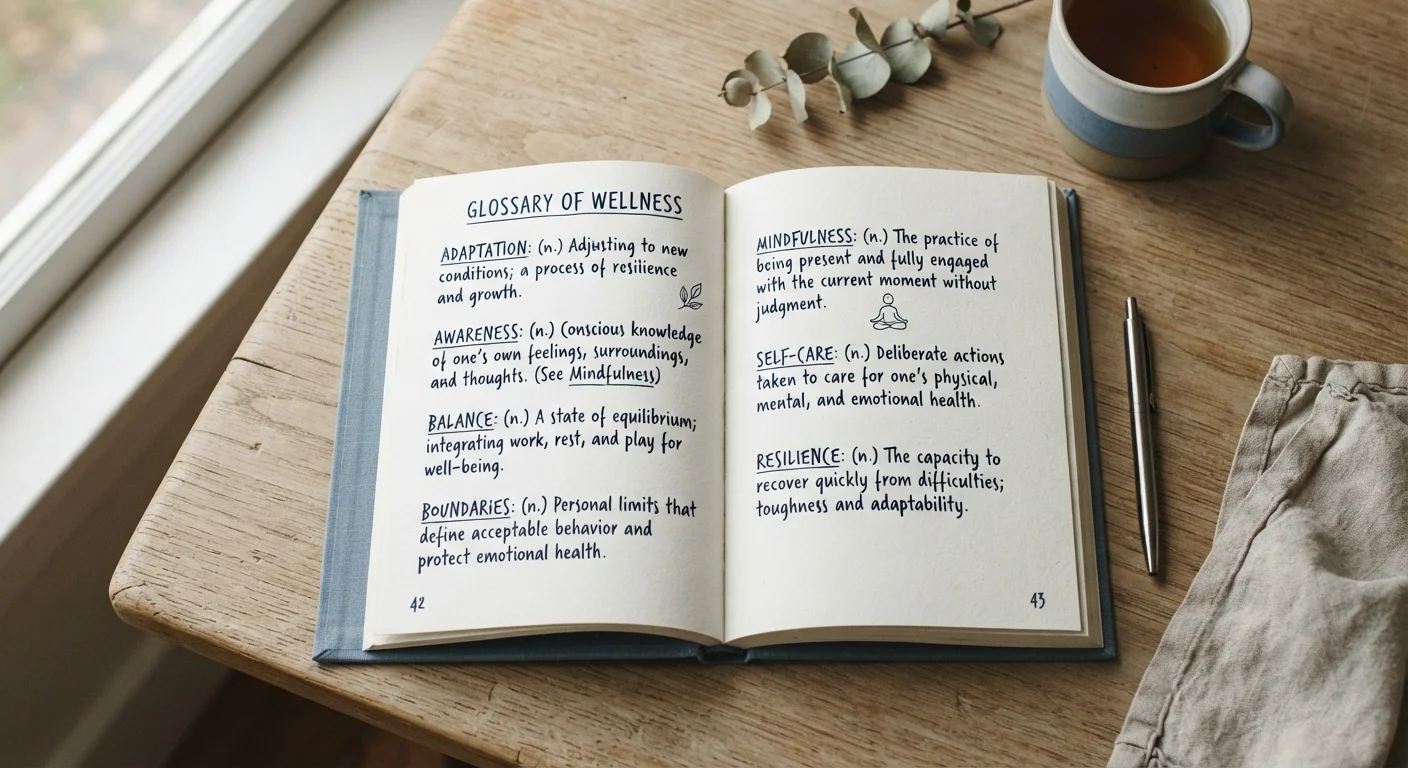
This reference guide offers plain-English definitions for some of the most commonly encountered mental health terms. It is intended as a starting point for understanding, not a clinical resource. For context on what mental health actually encompasses as a concept, see what mental health really means.
This article is for general informational and educational purposes only. It is not a substitute for professional mental health assessment, diagnosis, or treatment. If you have concerns about your mental health or that of someone you know, please speak with a qualified healthcare provider.
Cognitive Distortion
A pattern of thinking that is inaccurate, exaggerated, or not supported by evidence — such as assuming the worst will happen or viewing situations in all-or-nothing terms. Cognitive distortions are a key focus in cognitive behavioral therapy (CBT), where the goal is to identify and reframe these patterns.
Psychosocial
Relating to the intersection of psychological (mental/emotional) and social factors. A psychosocial approach to health considers how relationships, community, culture, and environment affect a person's mental well-being.
Trauma
A response to an event or series of events that a person experiences as deeply distressing or threatening. Trauma can affect thoughts, emotions, physical health, and behavior. Not everyone exposed to a difficult event develops trauma — individual responses vary widely.
Resilience
The capacity to adapt or recover following stress, adversity, or difficult experiences. Resilience is not a fixed trait — it can be supported and developed through social connection, coping skills, and other factors. It does not mean an absence of struggle.
Mental Health Disorder
A clinically recognized condition characterized by significant changes in thinking, emotion, or behavior that cause distress or impair functioning. Disorders are diagnosed by qualified professionals using established criteria; the term covers a wide spectrum of experiences and severities.
Stigma
Negative attitudes, stereotypes, or discrimination directed at people with mental health conditions. Stigma can discourage people from seeking help and can affect quality of care. Public health efforts often focus on reducing stigma through education and open conversation.
Coping Mechanism
A strategy — conscious or unconscious — that a person uses to manage stress, discomfort, or difficult emotions. Coping mechanisms may be adaptive (helpful in the long run) or maladaptive (providing short-term relief but causing longer-term harm).
Psychotherapy
A structured, evidence-informed approach to mental health support conducted by a trained professional. Also called 'talk therapy,' it encompasses many modalities — including CBT, dialectical behavior therapy (DBT), and others — each suited to different needs.
Burnout
A state of chronic exhaustion — emotional, physical, and mental — typically linked to prolonged workplace stress. The World Health Organization recognizes burnout as an occupational phenomenon. It is distinct from clinical depression, though the two can co-occur.
Psychiatric Medication
Medications prescribed by a qualified clinician to help manage the symptoms of mental health conditions. Categories include antidepressants, antipsychotics, mood stabilizers, and anxiolytics. Dosage, suitability, and monitoring should always be determined by a licensed prescriber.
Crisis
A state of acute distress in which a person's usual coping abilities are overwhelmed, often requiring immediate support. A mental health crisis may involve thoughts of self-harm, but it can also refer to other situations of severe emotional destabilization. Crisis lines and emergency services exist specifically for these moments.
Protective Factors
Conditions, resources, or characteristics that reduce the likelihood of mental health difficulties or support recovery. Examples include social support, access to care, stable housing, and a sense of purpose. Protective factors are a key focus in public mental health promotion.
Terms You'll Encounter Most Often
The following terms appear regularly in public health materials, media coverage, and clinical settings. Understanding them can help readers follow conversations more confidently and ask better questions when speaking with professionals.
| Global prevalence of mental health conditions | Approximately 1 in 8 people worldwide (World Health Organization, 2022) |
| Most common mental health conditions globally | Anxiety disorders and depression (World Health Organization, 2022) |
| Median delay between symptom onset and treatment | 11 years (World Health Organization global data) |
| Proportion of countries with a standalone mental health policy | Fewer than half (WHO Mental Health Atlas, 2020) |
| Mental health share of global disease burden | Around 13% (Institute for Health Metrics and Evaluation (IHME)) |
When mental health terminology appears in workplace contexts — such as discussions of burnout, psychological safety, or reasonable accommodations — the stakes of clarity are especially high. Mental health in the workplace involves its own layer of vocabulary that both employers and employees benefit from understanding.
Similarly, terms like mindfulness and resilience are frequently used in wellness spaces without precise definition. For a grounded look at what mindfulness actually involves and what the evidence says, see mindfulness without the jargon.
If you or someone close to you is trying to navigate mental health support for the first time, a plain-language starting point for mental health support can help clarify what to expect and where to look.
This article is for general informational and educational purposes only and does not constitute medical or mental health advice. Please consult a qualified professional for guidance specific to your situation.
The content on this site is for informational purposes only and is not a substitute for professional advice. Always consult a qualified professional for guidance specific to your situation.