

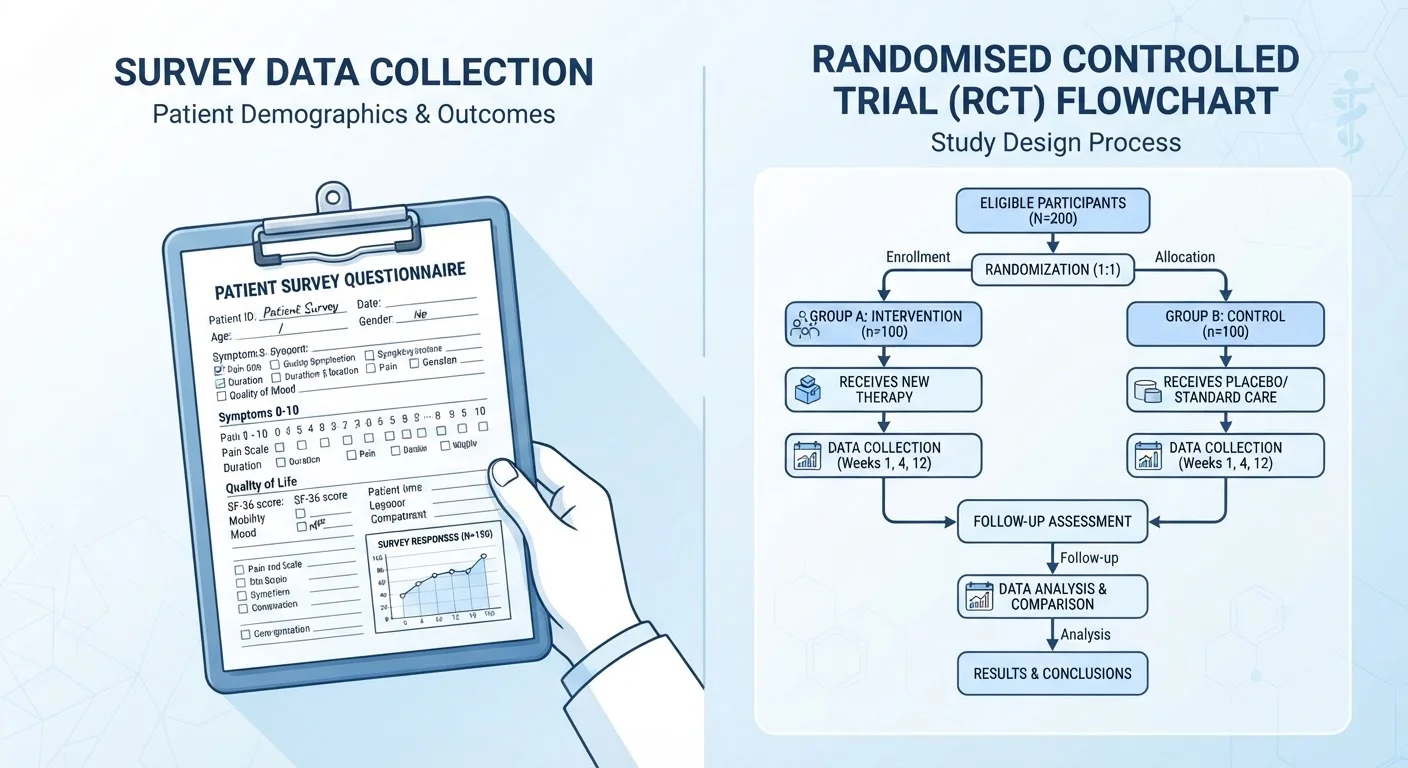
Option A
Observational Study
The real-world snapshot of health patterns.
Best for: Identifying associations between behaviours or exposures and health outcomes in large, diverse populations over time.
Option B
Randomised Controlled Trial (RCT)
The gold standard for testing cause and effect.
Best for: Determining whether a specific intervention — such as a drug, vaccine, or behaviour change — directly causes a health outcome.
What Each Study Type Actually Does
When a health story catches your eye, the type of study behind it shapes how seriously you should take its conclusions. Two designs appear most frequently in health news: observational studies and randomised controlled trials (RCTs).
In an observational study, researchers collect data on people without intervening in their lives. They might follow a large group over years, asking about diet, exercise, and medical history, and then look for patterns in who developed certain conditions. No one is assigned to a group or given a treatment; researchers simply observe what happens. Common forms include cohort studies, case-control studies, and cross-sectional surveys.
A randomised controlled trial works differently. Participants are randomly assigned to receive either the intervention being tested (such as a new medication) or a control condition (often a placebo or standard care). Randomisation is the critical step — it distributes known and unknown characteristics evenly across groups, so that differences in outcomes can more confidently be attributed to the intervention itself rather than to pre-existing differences between participants.
For a broader look at how research moves through testing stages, see our walkthrough of clinical trial phases.
The Core Limitation: Correlation vs. Causation
The most important distinction between the two designs comes down to what they can reasonably claim. Observational studies are well-suited to identifying associations — patterns suggesting that two things tend to occur together. But association is not causation.
Consider a classic example: studies have repeatedly found that people who drink moderate amounts of coffee are less likely to develop certain conditions. But coffee drinkers may also differ from non-drinkers in dozens of other ways — sleep habits, diet, income, activity levels — any of which could explain the pattern. These unmeasured differences are called confounders, and they are observational research's persistent challenge.
| Criterion | Observational Study | Randomised Controlled Trial (RCT) |
|---|---|---|
| Researcher intervention | None — participants observed as-is | Yes — active assignment to groups |
| Randomisation | No | Yes — core feature of the design |
| Can establish causation | No — shows association only | Yes — when well-designed |
| Controls for confounders | Partially, through statistical methods | More fully, through randomisation |
| Feasibility for rare/long-term outcomes | High — large datasets, long follow-up possible | Low — costly and often impractical |
| Ethical constraints | Fewer — no harmful exposures assigned | More — must justify withholding treatment |
| Position in evidence hierarchy | Moderate — valuable but lower certainty | High — considered gold standard |
RCTs address confounders directly through randomisation. Because participants are randomly placed into groups, the groups should be similar in both measured and unmeasured ways. That means a difference in outcomes is far more likely to reflect the intervention itself. This is why RCTs sit near the top of most evidence hierarchies used by researchers and clinical guideline bodies.
That said, RCTs have real-world limits. They can be expensive, time-consuming, and sometimes ethically impossible — you cannot randomly assign people to smoke for decades. For questions about long-term lifestyle exposures or rare outcomes, observational studies often provide the only available evidence.
For help spotting when health reporting conflates these two things, our guide to common errors in medical reporting walks through recurring blind spots in journalism.
Applying This to Health News You Encounter
Understanding study design turns you into a more discerning reader rather than a passive one. A few practical habits help.
Look for the study type. Most news stories will at least mention whether a finding came from a trial or an observational analysis. If the article uses phrases like "researchers followed participants" or "data were collected from health records," the study is likely observational. Words like "participants were randomly assigned" signal an RCT.
Be cautious with causal language in observational findings. Headlines claiming a food "causes" disease or "prevents" a condition based solely on observational data are overstating the evidence. The more accurate framing is that the food was associated with a higher or lower risk in the group studied.
~50%
Observational findings not replicated in RCTs
A frequently cited estimate in evidence-based medicine literature suggests roughly half of findings from observational studies are not confirmed when later tested in randomised trials, highlighting the importance of study design.
Top 3
Study types in clinical guideline evidence reviews
Most major clinical guideline bodies, including those affiliated with the US National Institutes of Health, rank systematic reviews of RCTs, individual RCTs, and high-quality cohort studies as the primary evidence sources.
Consider the size and source of the study. A small pilot RCT in a very specific population may be less generalisable than a well-designed large observational study. Evidence accumulates over time, across multiple studies and methods.
For additional guidance on parsing health headlines critically, see our plain-language guide to health study headlines. And if a finding prompts you to reconsider a health habit or treatment, discussing it with a qualified healthcare professional is always the appropriate next step — not acting on a single news report.
This article is for general informational and educational purposes only and does not constitute medical advice. Always consult a qualified healthcare professional for guidance about your personal health circumstances.
The content on this site is for informational purposes only and is not a substitute for professional advice. Always consult a qualified professional for guidance specific to your situation.