

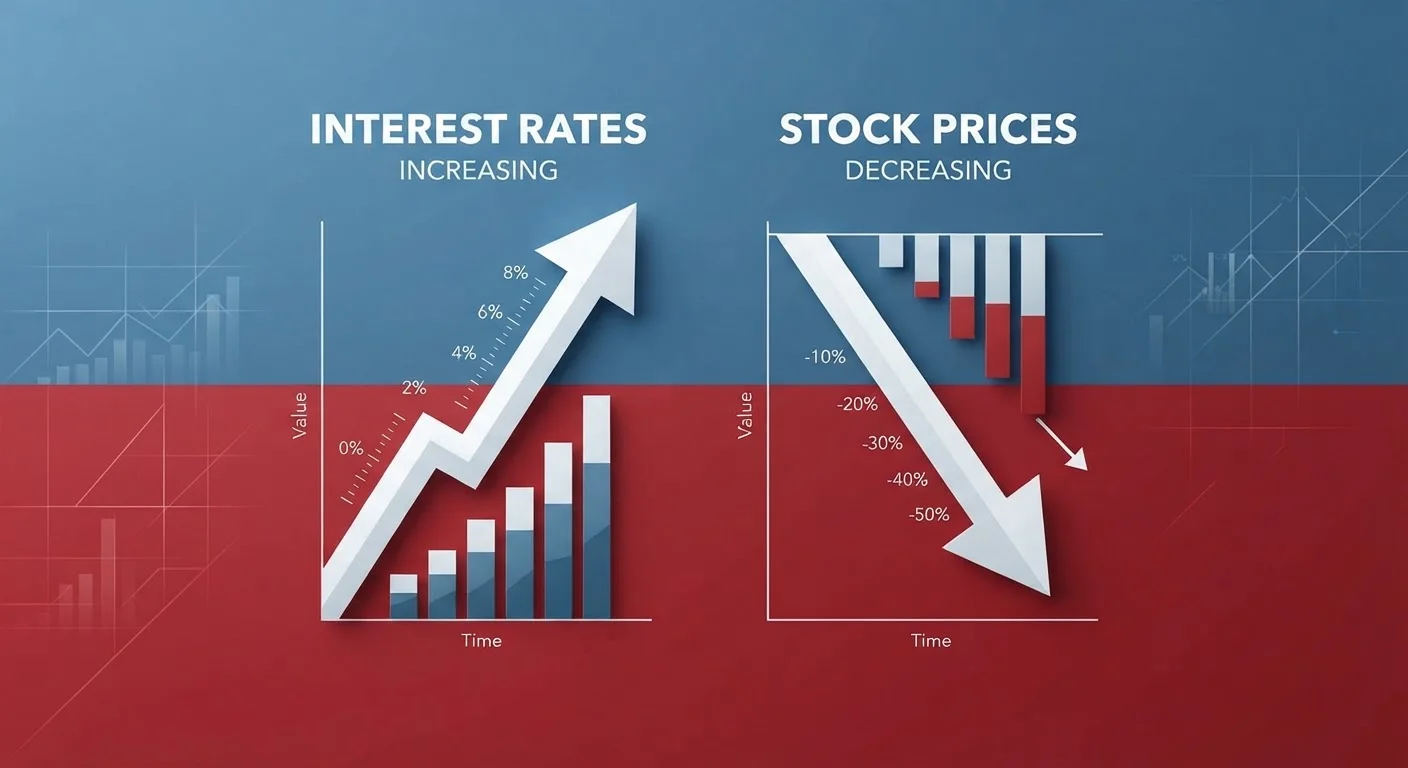
The Basic Logic: Why Rates and Stocks Pull Against Each Other
Every time the Federal Reserve signals a rate hike, financial headlines tend to follow with reports of stock market declines. The pattern is consistent enough that it shapes how investors, analysts, and everyday news readers interpret economic signals. But what actually drives it?
At the most fundamental level, interest rates represent the cost of money. When that cost rises, it becomes more expensive for businesses to borrow — whether to fund expansion, hire workers, or develop new products. Higher costs tend to weigh on profits, and lower profit expectations mean investors are less willing to pay premium prices for company shares. For a broader grounding in how these dynamics play out across markets, see how financial markets work.
The relationship is not mechanical or perfectly predictable, but the underlying logic is consistent enough that it functions as a reliable framework for reading financial news.
~18%
S&P 500 decline during 2022 rate hike cycle
The S&P 500 fell approximately 18% in 2022 as the Federal Reserve raised rates from near zero to above 4%, illustrating the inverse relationship under sustained tightening.
5.25–5.50%
Federal funds rate peak reached in 2023
The Federal Reserve raised its target range to 5.25–5.50% by mid-2023 — the highest level in over two decades — as part of its effort to reduce inflation.
3
Main channels linking rates to stock valuations
Economists generally describe three transmission mechanisms: borrowing costs, bond competition, and discounted earnings — each independently pressuring equity prices when rates rise.
Three Channels That Transmit Rate Changes to Stock Prices
Economists generally identify three main channels through which higher interest rates put pressure on equity valuations.
1. Borrowing Costs and Corporate Profitability
Companies routinely rely on debt to fund operations and growth. When rates rise, refinancing existing debt or taking on new loans becomes more expensive. This reduces net earnings — the figure investors care most about when deciding what a stock is worth. For capital-intensive industries like manufacturing, real estate, and infrastructure, the impact can be especially pronounced.
2. Competition From Bonds and Savings Accounts
Stocks are not the only place investors can put their money. When interest rates rise, government bonds and bank savings products offer higher yields, making them a more attractive alternative. This dynamic can pull capital out of equities and into fixed-income instruments, reducing demand for stocks and pushing prices down. The comparison between bonds and equities across economic cycles helps illustrate why these two asset classes often move in opposite directions.
3. Discounted Value of Future Earnings
Stock valuations are often built on estimates of what a company will earn years into the future. Investors calculate a "present value" for those future earnings by applying a discount rate — essentially asking: what is a dollar earned five years from now worth today? Higher interest rates mean higher discount rates, which mathematically reduce the present value of those future earnings. The result is lower calculated fair values for stocks, especially those in sectors like technology where significant earnings are projected far into the future.
Reading Rate News More Effectively
When you see a Federal Reserve rate decision in the headlines, look beyond the immediate market reaction. Consider whether the move was anticipated by investors (in which case markets may have already adjusted), what the stated rationale is, and how quickly further changes are projected. Context matters as much as the number itself. For more on how these decisions filter down to everyday financial products, see the explainer on Fed rate decisions and everyday banking costs.
Why the Pattern Is Not Absolute
Understanding this inverse relationship is useful, but treating it as a hard rule can lead to oversimplified reading of market events. Several conditions can disrupt or delay the typical pattern.
If the economy is growing rapidly and corporate earnings are surging, stocks may hold their ground or even rise despite rate increases. Markets also respond to expectations as much as to actual rate changes — if a hike was already anticipated, prices may have adjusted in advance and barely move on the announcement itself.
Conversely, rate cuts do not always trigger stock rallies. When central banks cut rates in response to economic weakness or recession fears, that underlying weakness can dominate investor sentiment, outweighing the mechanical benefit of cheaper borrowing. The dynamics of bull and bear markets reflect exactly this kind of interplay between rate signals and broader economic conditions.
Central banks also have limited tools and face complicated trade-offs — a reality explored in depth in coverage of common misconceptions about how central banks control inflation.
This article is for general informational and educational purposes only and does not constitute financial, investment, or tax advice. Readers should consult a qualified financial professional before making any investment decisions.
Frequently Asked Questions
Several forces work together. Higher rates increase borrowing costs for companies, squeezing profits. Bonds become more attractive at higher yields, drawing money away from stocks. And the mathematical models investors use to value stocks assign lower present values to future earnings when discount rates are higher.
No. While it is a common and well-documented tendency, it is not a fixed law. Stocks can rise even as rates climb if corporate earnings are strong enough, or if investors believe rate hikes will be short-lived. Multiple variables influence markets simultaneously.
Rate-sensitive sectors include real estate, utilities, and financial companies. Technology and growth stocks, whose valuations depend heavily on projected future earnings, also tend to react sharply to rate moves because higher discount rates reduce those future projections significantly.
The Federal Reserve sets the federal funds rate, which ripples through the economy by influencing borrowing costs, consumer spending, and corporate investment. Investors closely monitor Fed announcements because rate decisions directly affect the economic environment in which public companies operate.
Rate cuts typically reduce borrowing costs and make bonds less competitive, which can encourage investment in equities. Lower discount rates also increase the calculated present value of future earnings, making stocks look more attractive on paper. That said, cuts often occur during economic slowdowns, which complicates the picture.
The content on this site is for informational purposes only and is not a substitute for professional advice. Always consult a qualified professional for guidance specific to your situation.