

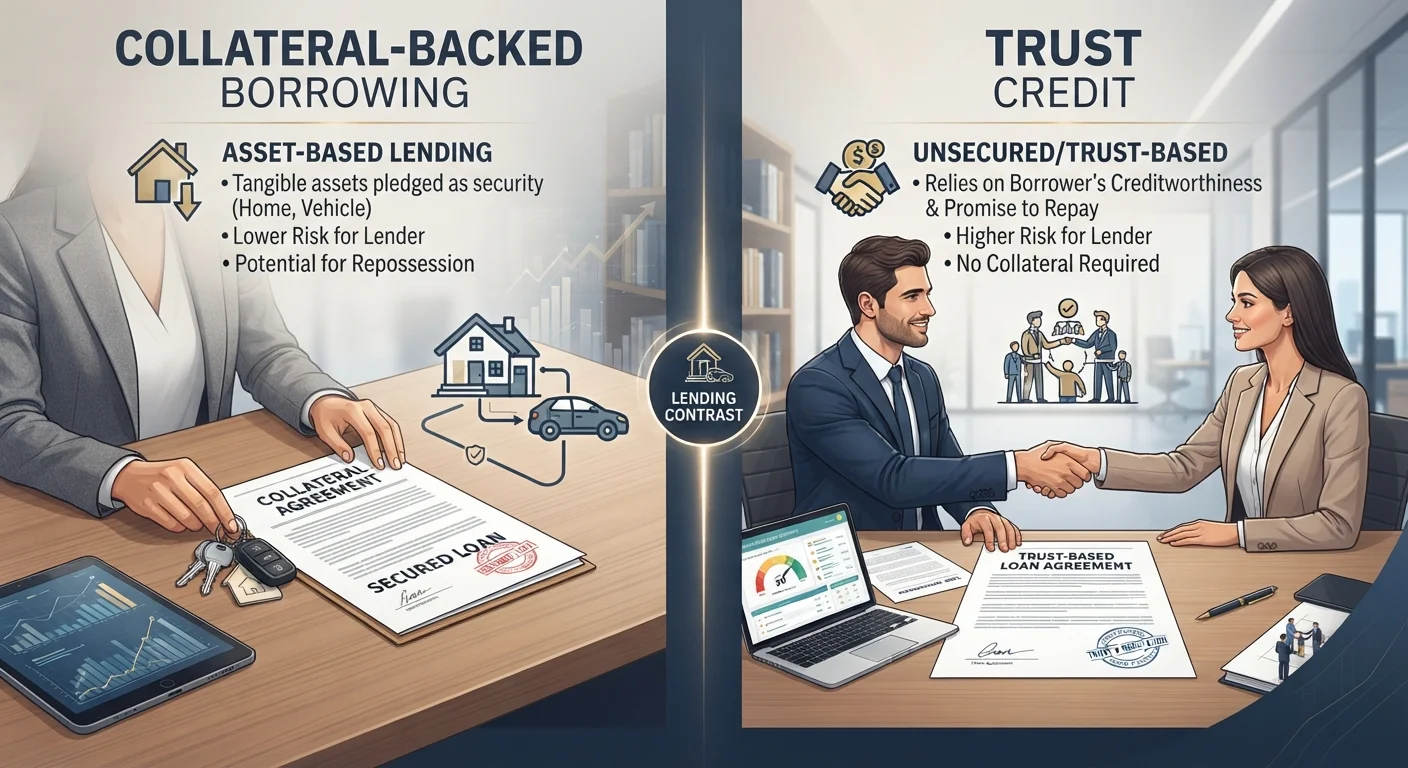
Option A
Secured Credit
The collateral-backed, lower-cost borrowing structure.
Best for: Borrowers who own eligible assets and want lower interest rates or access to larger loan amounts.
Option B
Unsecured Credit
The asset-free, flexibility-first lending option.
Best for: Borrowers who lack collateral or prefer not to risk assets, and who qualify based on creditworthiness alone.
What Collateral Actually Does in a Lending Agreement
The single structural difference between secured and unsecured credit is collateral — an asset the borrower pledges that the lender can claim if the loan goes unpaid. That one variable reshapes nearly every term of a loan: the interest rate, the amount available, the eligibility threshold, and the consequences of default.
With secured credit, the lender holds a legal interest (called a lien) in the pledged asset for the life of the loan. Common examples include mortgages, where the home itself secures the debt, and auto loans, where the vehicle title is held until the balance is paid. Because the lender has a defined recovery option, they assume less risk — and that reduced risk is generally passed to borrowers in the form of lower rates and higher borrowing limits.
Unsecured credit carries no such backstop. A lender extending an unsecured personal loan or a credit card line has no specific asset to recover if the borrower stops paying. Their only recourse is to pursue repayment through collections or legal judgment — a slower, less certain process. To compensate, lenders price unsecured credit at higher interest rates and apply more stringent qualification standards. For a broader introduction to how credit relationships are structured, see our guide to how credit and debt connect.
| Criterion | Secured Credit | Unsecured Credit |
|---|---|---|
| Collateral required | Yes — specific asset pledged | No — creditworthiness only |
| Typical interest rates | Generally lower | Generally higher |
| Borrowing limits | Often higher | Often lower |
| Qualification difficulty | Can be more accessible | Usually requires stronger credit |
| Default consequence | Asset repossession or foreclosure | Credit damage; legal collections |
| Common examples | Mortgage, auto loan, HELOC | Credit card, personal loan, student loan |
| Good for building credit | Yes (secured cards, secured loans) | Yes (if approved and used responsibly) |
Risk, Rates, and What Happens When You Default
The risk distribution in secured versus unsecured credit runs in opposite directions for borrower and lender. With a secured loan, the lender's risk is lower but the borrower's downside is concrete: missed payments can trigger repossession of a vehicle or foreclosure on a home. That direct consequence is what makes secured credit both valuable and worth approaching carefully.
~2–5%
Typical mortgage rate range (secured)
Federal Reserve data consistently shows secured mortgage rates tracking well below average unsecured personal loan rates in comparable rate environments.
20%+
Average credit card APR (unsecured)
The Federal Reserve's consumer credit data has shown average credit card interest rates exceeding 20% in recent years, illustrating the unsecured premium.
~1 in 5
US adults with no credit score
The Consumer Financial Protection Bureau has estimated roughly 26 million Americans are "credit invisible," making secured entry-level products especially relevant.
With unsecured credit, the lender absorbs more risk — reflected in interest rates that can run substantially higher than secured equivalents. Credit cards, for example, frequently carry rates far above those of home equity loans. If a borrower defaults on unsecured debt, the damage is primarily to their credit profile and finances; they do not automatically lose a specific asset, though creditors can pursue legal remedies.
Home equity products, such as home equity lines of credit (HELOCs), occupy a particularly important place in this framework because they use an already-owned asset — your home's equity — as collateral. That can unlock favorable rates, but it also means your home is at stake. Our overview of HELOCs examines how that trade-off works in practice.
Eligibility, Credit History, and Choosing the Right Structure
Because unsecured lenders rely entirely on a borrower's credit history, income, and debt-to-income ratio, qualifying is generally harder. Borrowers with limited or no credit history often find unsecured products difficult to access — or available only at high rates. Secured credit, by contrast, can be more accessible precisely because the collateral provides a lender with an alternative form of assurance.
This is why secured credit cards are a common tool for building a credit profile from zero. The cardholder deposits funds as collateral, the bank extends a credit line, and responsible use builds a record that can eventually qualify the borrower for unsecured products.
Both Types Affect Your Credit Report
Whether a loan is secured or unsecured, it generally appears on your credit report and influences your credit score. On-time payments build positive history; missed payments cause damage regardless of collateral. Lenders reporting to the major credit bureaus — Equifax, Experian, and TransUnion — do so for both product types, so responsible use of either contributes to your overall credit profile.
Rate structure is a separate but related decision. Both secured and unsecured loans can carry fixed or variable rates — a distinction that affects how your payment may change over time. Our comparison of fixed and variable rate loans covers that layer of the decision. Student loans — largely unsecured federal debt — add further nuance; the student loan overview explains how that category works.
Neither secured nor unsecured credit is universally better. The right choice depends on what assets you own, how strong your credit profile is, what you are borrowing for, and how much risk — in the form of a pledged asset or a higher rate — you are prepared to take on. Consulting a licensed financial professional before taking on significant debt is always advisable for decisions specific to your circumstances.
This article is for general informational and educational purposes only and does not constitute personalized financial or legal advice. Consult a qualified financial professional before making borrowing decisions.
The content on this site is for informational purposes only and is not a substitute for professional advice. Always consult a qualified professional for guidance specific to your situation.