

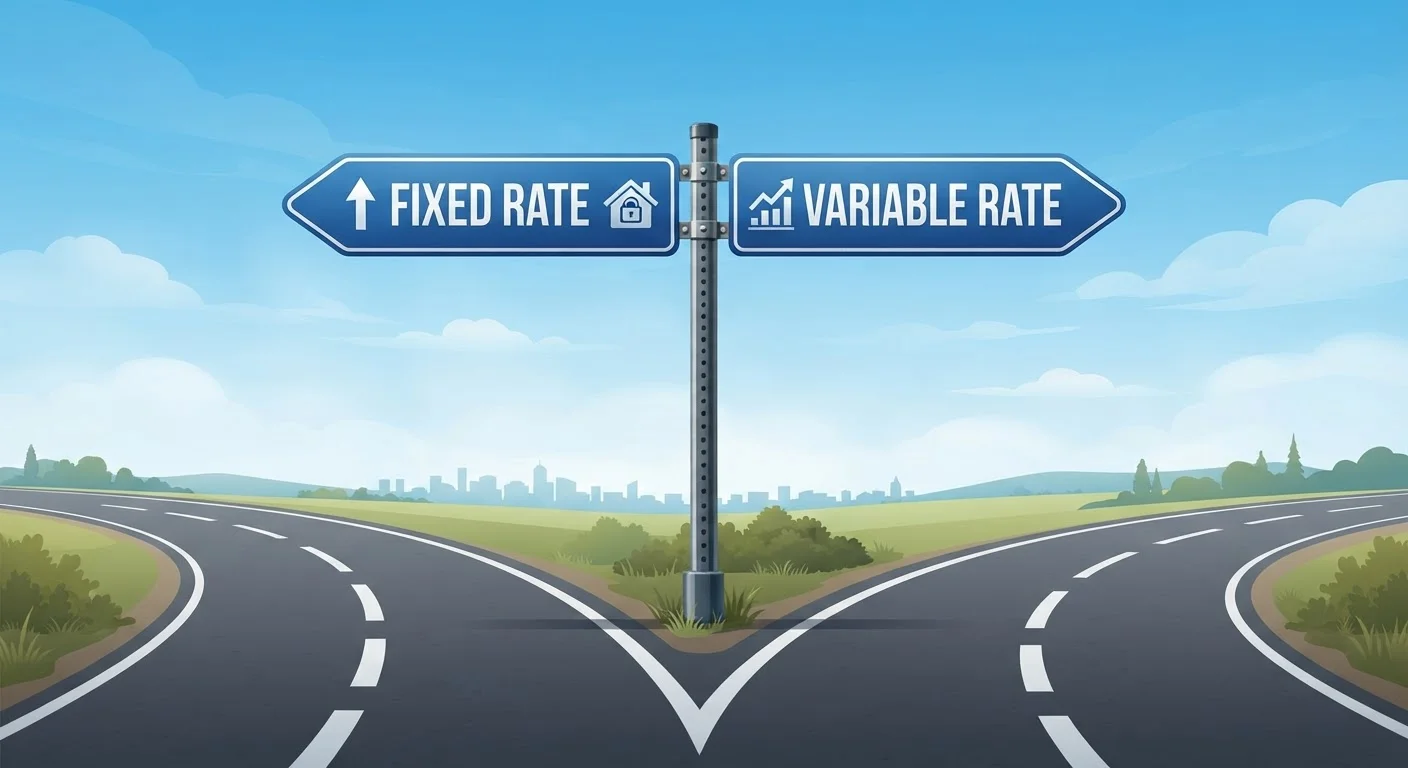
Option A
Fixed-Rate Loan
The predictable, stable choice for long-term planning.
Best for: Borrowers who value payment consistency and want protection from rising interest rates.
Option B
Variable-Rate Loan
The flexible, potentially lower-cost alternative.
Best for: Borrowers who expect rates to fall or plan to repay the loan quickly.
How Each Structure Works
A fixed-rate loan carries an interest rate set at origination that does not change for the life of the loan. Whether you borrow for a home, a car, or personal expenses, your rate — and therefore your monthly payment — stays the same from the first payment to the last. This predictability is the defining feature.
A variable-rate loan (also called an adjustable-rate loan) ties your interest rate to a benchmark index — commonly the Secured Overnight Financing Rate (SOFR) or the prime rate — plus a fixed margin set by the lender. As that index moves, so does your rate. Most variable-rate products include periodic adjustment caps (limiting how much the rate can change per period) and lifetime caps (the maximum it can ever reach), but neither eliminates rate risk entirely.
Understanding how the Federal Reserve's policy decisions flow through to loan rates is essential context here. When the Fed moves rates, savings yields, mortgage rates, and credit card APRs all shift — and variable-rate borrowers feel that transmission most directly.
| Criterion | Fixed-Rate Loan | Variable-Rate Loan |
|---|---|---|
| Interest Rate Stability | Constant throughout loan term | Fluctuates with benchmark index |
| Initial Rate | Typically higher at origination | Typically lower at origination |
| Payment Predictability | Payments never change | Payments can rise or fall |
| Risk Exposure | Lender absorbs rate-rise risk | Borrower absorbs rate-rise risk |
| Best Loan Term Fit | Long-term (15–30 years) | Short-term or near-payoff horizon |
| Common Products | Fixed mortgages, auto loans, federal student loans | HELOCs, ARMs, private student loans, credit cards |
| Rate Drop Benefit | Requires refinancing to capture savings | Automatically benefits from falling rates |
Trade-Offs That Actually Matter
The initial rate gap is real. Variable-rate loans typically open lower than fixed-rate loans on comparable products. That discount is the lender transferring interest-rate risk to you — you accept uncertainty in exchange for a potentially cheaper starting point.
For short-term loans or borrowers with strong cash flow flexibility, that trade can work in their favor. For a 30-year mortgage, the same gamble carries considerably more weight. A rate that climbs steadily over a decade can erase years of early savings and push monthly payments well beyond the original projection.
~65%
Share of US mortgages that are fixed-rate
Federal Reserve data consistently shows the vast majority of outstanding US residential mortgage balances carry fixed interest rates.
2–3%
Typical initial rate discount for variable vs. fixed
Variable-rate products have historically opened at a discount to comparable fixed-rate loans, though the gap narrows in volatile rate environments.
5+ pts
Maximum lifetime rate increase on some ARM products
Adjustable-rate mortgages (ARMs) often carry lifetime caps, but those caps can still mean substantially higher payments over time.
Fixed-rate loans also carry a hidden cost: if market rates fall after you borrow, you remain locked in at the higher rate. Refinancing is an option, but it involves closing costs, qualification requirements, and time — it is not a frictionless escape hatch.
Variable-rate products are frequently found in home equity lines of credit (HELOCs), where flexible borrowing and variable rates create real exposure. They also appear in many private student loans. If you are weighing borrowing options for education, the differences between subsidized, unsubsidized, and private loans matter significantly — federal loans currently carry fixed rates, while private lenders offer both structures.
Making the Decision in Practice
No formula spits out the right answer, but a few questions clarify the decision considerably:
- How long will you carry this loan? Shorter timelines reduce the window in which variable rates can move against you.
- How stable is your income? If a higher monthly payment would create real financial stress, a fixed rate offers important protection.
- What is the current rate environment? Starting a variable-rate loan when benchmark rates are already elevated means limited downside protection and meaningful upside risk.
- What are the caps on the variable product? A lifetime cap of 5 percentage points above your starting rate is very different from one with no ceiling.
The loan structure question also intersects with collateral. Secured and unsecured credit differ in risk, cost, and eligibility in ways that compound the rate-structure decision — a variable rate on a secured loan like a mortgage carries different stakes than the same structure on an unsecured personal loan.
This article provides general financial information and education. It is not personalized financial or investment advice. Consult a licensed financial professional before making borrowing decisions based on your specific circumstances.
This article is for informational purposes only and does not constitute financial, legal, or investment advice. Readers should consult a qualified financial adviser before making decisions about loan products or their personal financial situation.
The content on this site is for informational purposes only and is not a substitute for professional advice. Always consult a qualified professional for guidance specific to your situation.