

Start here
What Credit Actually Is
Next
How Debt Is Created When You Borrow
Then
Interest, Fees, and the Real Cost of Borrowing
Go deeper
Your Credit Report and Credit Score
Finally
How Borrowing Behavior Shapes Your Financial Future
What Credit Actually Is
Credit, at its most basic, is a lender's willingness to let you use money now with a promise to pay it back later. When a bank approves a credit card, it's not giving you money — it's extending trust, capped at a specific limit. When a lender approves a car loan, it's advancing funds on the expectation of repayment over a defined period.
That trust isn't offered blindly. Lenders evaluate applicants using financial history, income, and other signals to judge how likely repayment is. For someone just starting out with no borrowing history, that evaluation can be challenging — but having no credit history is a different problem from having a troubled one. See our guide to building credit from zero for approaches lenders recognize.
Principal
The original amount of money you borrow, before any interest or fees are added.
APR (Annual Percentage Rate)
The yearly cost of borrowing expressed as a percentage, including interest and certain fees, used to compare loan or credit card offers.
Credit utilization ratio
The percentage of your total available credit that you are currently using; a lower ratio generally signals lower risk to lenders.
Hard inquiry
A formal check of your credit report triggered when you apply for a loan or credit card; it can cause a small, temporary decrease in your credit score.
Revolving credit
A type of credit, like a credit card, that lets you borrow repeatedly up to a set limit as you pay down the balance.
Credit bureau
A company that collects and maintains consumer credit data reported by lenders; the three major US bureaus are Equifax, Experian, and TransUnion.
How Debt Is Created When You Borrow
The moment you draw on credit — swipe a credit card, accept a loan disbursement, or take out a line of credit — you create debt. Debt is the legal obligation to repay what you borrowed, called the principal, along with any interest and fees the lender charges.
Debt comes in two broad forms. Revolving debt, like a credit card, lets you borrow up to a limit repeatedly as you pay it down. Installment debt, like a student loan or auto loan, is a fixed amount repaid in regular, scheduled payments until the balance reaches zero. Both are valid financial tools; what matters is whether the debt fits your ability to repay it.
Match the Debt Type to the Purpose
Installment loans work well for large, one-time purchases with a defined repayment timeline, like a car or education. Revolving credit is more flexible but requires discipline to avoid carrying expensive balances. Choosing the right structure for the purpose can reduce the total cost of borrowing.
Interest, Fees, and the Real Cost of Borrowing
Interest is the price lenders charge for letting you use their money. It's typically expressed as an Annual Percentage Rate (APR) — a standardized figure that includes interest and certain fees, making it easier to compare offers. A credit card carrying a 24% APR costs far more over time than one at 18% if you carry a balance month to month.
Compounding is what makes interest powerful — and potentially costly. On revolving debt, unpaid interest is added to the principal, and future interest is then calculated on that larger amount. Fees — late payment charges, annual fees, origination fees on loans — stack on top. Before borrowing, it's worth understanding the full payment picture, not just the monthly amount. Pairing this understanding with a solid spending plan is essential; our guide to building your first budget walks through that process.
Your Credit Report and Credit Score
Every time you open a credit account, make a payment, or miss one, that information is reported to one or more of the three major credit bureaus: Equifax, Experian, and TransUnion. These bureaus compile your borrowing history into a credit report — a detailed file that lenders, landlords, and sometimes employers use to evaluate you.
From the data in your report, scoring models produce a credit score — a three-digit number, typically ranging from 300 to 850, that summarizes your creditworthiness. Payment history carries the most weight, followed by your credit utilization ratio (how much of your available credit you're actually using). Federal law gives you important rights over this data, including the right to dispute errors — our article on your rights under the Fair Credit Reporting Act explains what protections apply to you.
You Have Three Credit Reports, Not One
Because each bureau operates independently, your three credit reports may contain slightly different information — lenders don't always report to all three. It's worth reviewing each report periodically rather than checking just one. Under federal law, you can access all three for free through AnnualCreditReport.com.
How Borrowing Behavior Shapes Your Financial Future
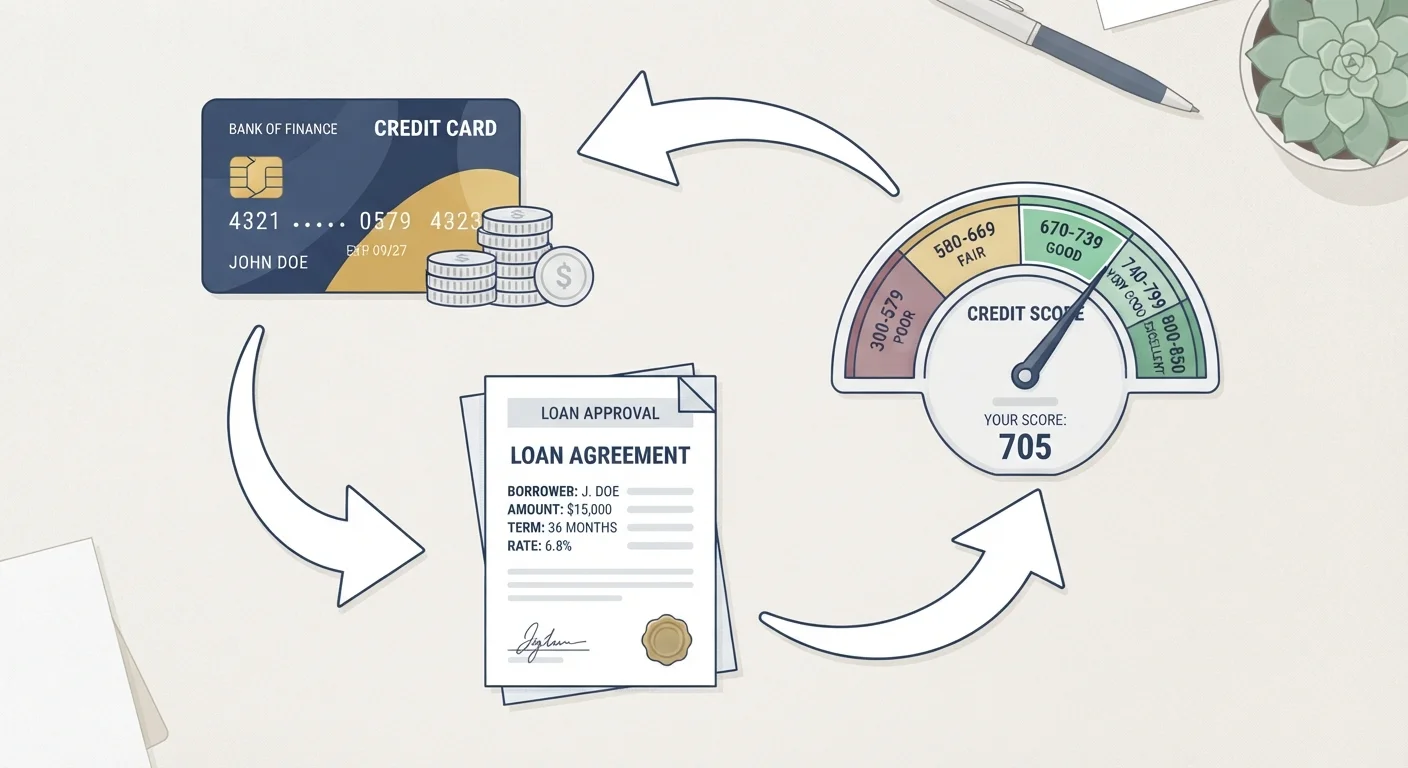
Your history with credit and debt creates a feedback loop. On-time payments and low balances strengthen your credit profile over time, which can translate into access to lower interest rates on future borrowing. Missed payments or high utilization weaken it, potentially increasing what you pay to borrow — or limiting your access altogether.
This feedback loop extends beyond loans. Landlords commonly review credit when considering rental applications — understanding this connection is relevant for anyone navigating independent living for the first time. Our personal finance guide for first-time renters covers how financial decisions interact with renting. Credit and debt aren't abstract concepts — they're practical levers that affect housing, transportation, and long-term financial flexibility.
This article is for general informational and educational purposes only and does not constitute personalized financial or legal advice. Readers should consult a qualified financial professional for guidance specific to their circumstances.
Frequently Asked Questions
Credit is the capacity a lender grants you to borrow money, such as a credit card limit or an approved loan amount. Debt is what you actually owe once you use that capacity — it's the outstanding balance you're obligated to repay, including interest.
Credit scores are calculated using factors drawn from your credit report, most heavily weighted toward payment history and how much of your available credit you're using. Other factors include the length of your credit history, the types of accounts you hold, and recent applications for new credit.
APR stands for Annual Percentage Rate and represents the yearly cost of borrowing, including interest and certain fees. It allows you to compare the true cost of different loan or credit card offers on a standardized basis.
Under federal law, US consumers are entitled to one free credit report per year from each of the three major bureaus — Equifax, Experian, and TransUnion — through AnnualCreditReport.com. Reviewing your reports regularly helps you catch errors or signs of fraud.
A hard inquiry — the type triggered when you formally apply for a loan or credit card — can cause a small, temporary dip in your credit score. Multiple applications in a short window can have a more noticeable effect, so it's worth being selective.
Paying only the minimum keeps your account in good standing but leaves most of your balance accruing interest each month. Over time this can cost significantly more than the original purchases and extend your repayment period by years.
The content on this site is for informational purposes only and is not a substitute for professional advice. Always consult a qualified professional for guidance specific to your situation.