

Our Verdict
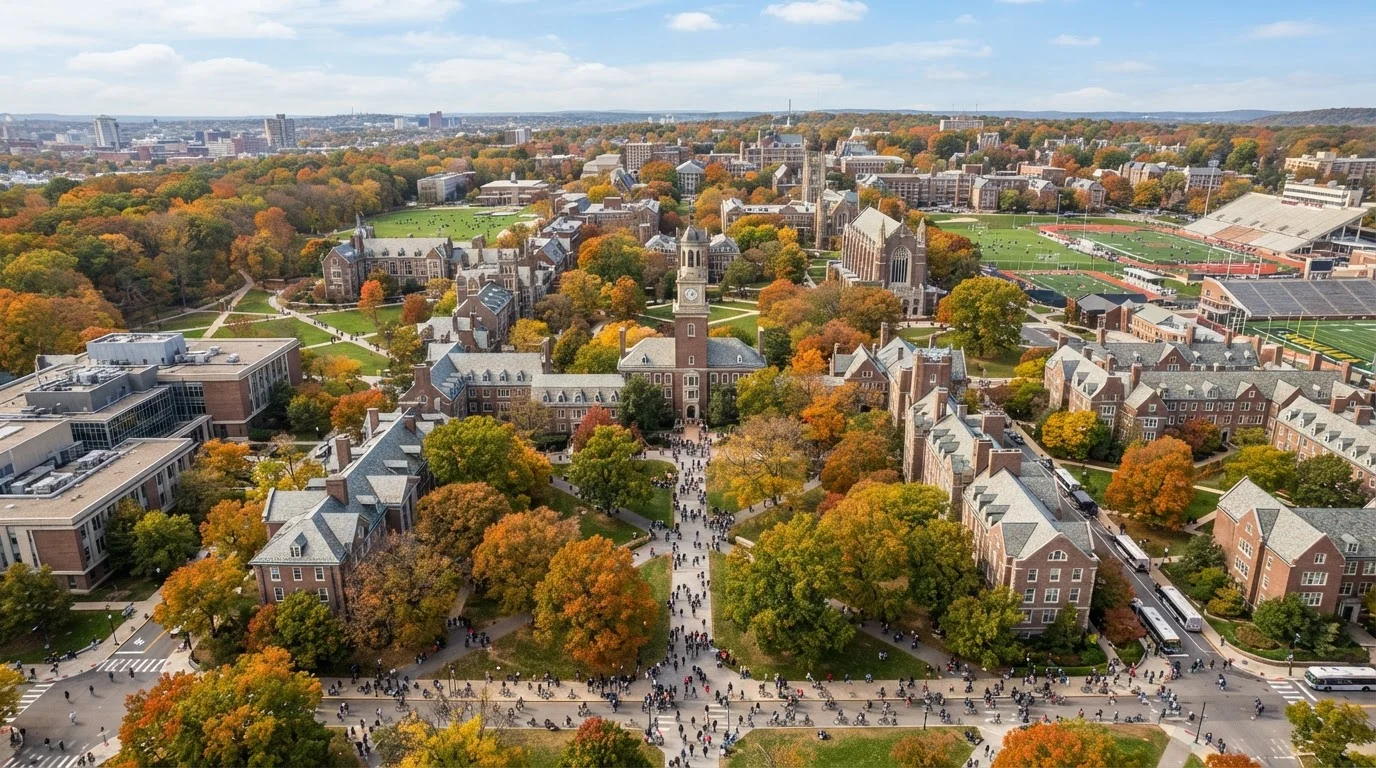
Large research universities deliver unmatched breadth — in programs, facilities, research access, and social variety — but that scale comes with real trade-offs around class sizes, bureaucracy, and the risk of feeling lost. Students who arrive with a clear sense of direction and the confidence to seek out resources tend to flourish; those who need close guidance may find the environment overwhelming.
Best suited to self-motivated students who want access to specialized research, a wide range of majors, and a vibrant campus community — and who are prepared to advocate for themselves.
What Defines a Large Research University?
A large research university is typically a four-year institution that enrolls more than 15,000 students and dedicates significant resources to faculty-led research across disciplines. Many are public flagship schools — such as state universities — though several private institutions also fall into this category. They tend to offer hundreds of undergraduate majors, graduate and professional programs, and dedicated research centers funded by government agencies, corporations, and private foundations.
Understanding this structure matters because it shapes nearly every aspect of the student experience, from how courses are taught to how career services are staffed. The evolving landscape of higher education is making these institutions adapt, but their core characteristics remain consistent enough to weigh meaningfully before enrolling.
The Advantages of Attending a Large Research University
Large research universities offer a set of benefits that smaller institutions often cannot match in scale or variety.
Access to world-class research facilities and labs
Students at research universities can work alongside faculty conducting nationally funded studies — experience that carries significant weight on graduate school applications and in competitive job markets.
Hundreds of majors and interdisciplinary programs
Students who enter undecided or change direction mid-program benefit from the sheer breadth of offerings, including niche specializations rarely found at smaller institutions.
Large and active alumni networks
Tens of thousands of graduates spread across industries mean stronger recruiting pipelines, mentorship opportunities, and professional connections that can open doors after graduation.
Robust campus resources and student services
Well-funded counseling centers, career offices, libraries, recreation facilities, and health services are more common at large institutions, which benefit from economies of scale.
Diverse social and cultural environment
A student body of 20,000 or more brings together people from varied backgrounds, regions, and countries, enriching the intellectual and social experience of campus life.
200+
Average undergraduate majors offered
Many large public research universities list over 200 undergraduate degree programs, according to institutional data from flagship state schools.
$67B+
Annual R&D spending at U.S. universities
The National Science Foundation has reported that U.S. colleges and universities spend tens of billions annually on research and development, with the largest research institutions accounting for the majority of that spending.
Beyond academics, the social environment at a large university is hard to replicate. Hundreds of student organizations, Division I athletics, performing arts groups, and cultural centers give students the chance to find communities that fit them. Choosing where to live is also a major decision — see our comparison of on-campus and off-campus housing options for a fuller picture of how that choice plays out at large schools.
The Disadvantages Worth Considering
The same scale that creates opportunity can also create friction. Students who underestimate these challenges may find their first year particularly difficult.
Large introductory classes with limited personal attention
Introductory courses at flagship universities routinely seat 200 to 500 students, meaning early interactions are often with teaching assistants rather than tenured faculty.
Bureaucracy can slow down simple processes
Registering for courses, accessing financial aid, or resolving administrative issues can involve multiple offices and extended wait times, which is particularly frustrating for first-generation students navigating the system for the first time.
Competitive atmosphere may increase academic stress
High-achieving peers, grade curves in large lecture courses, and limited seats in popular majors create an environment that some students find motivating and others find damaging to their confidence.
Risk of anonymity and disengagement
Without deliberate effort to connect with faculty and peers, students at large schools can spend four years feeling invisible — a dynamic that research has associated with lower retention rates.
Higher cost, especially at out-of-state tuition rates
Public flagship universities carry significantly higher tuition for out-of-state students, and large private research universities often carry the highest sticker prices in higher education, even before accounting for room and board.
Choosing a major at a large university adds another layer of complexity — with so many options, indecision is common. Our piece on what to consider when choosing a college major covers structural and financial factors that brochures rarely mention, which are especially relevant when hundreds of programs are on the table.
How Large Universities Compare to Other Paths
A large research university is not the right fit for every student. Community colleges and smaller four-year schools serve different needs and constraints equally well. Cost, flexibility, class size, and transfer pathways all factor into that comparison — our breakdown of community college vs. four-year university trade-offs walks through the real differences in depth.
Research Activity Varies by Department
Not every department at a large research university is equally research-active. STEM fields and social sciences tend to have more funded research opportunities for undergraduates than humanities departments. Students interested in undergraduate research should investigate specific departments and faculty labs — not just the institution's overall research ranking — during their college search.
For adults considering a return to formal education, large research universities may offer part-time enrollment, online programs, and continuing education divisions — but they also carry the bureaucratic complexity that can frustrate non-traditional students. See our look at returning to formal education as an adult for a realistic picture of that path.
The content on this site is for informational purposes only and is not a substitute for professional advice. Always consult a qualified professional for guidance specific to your situation.