

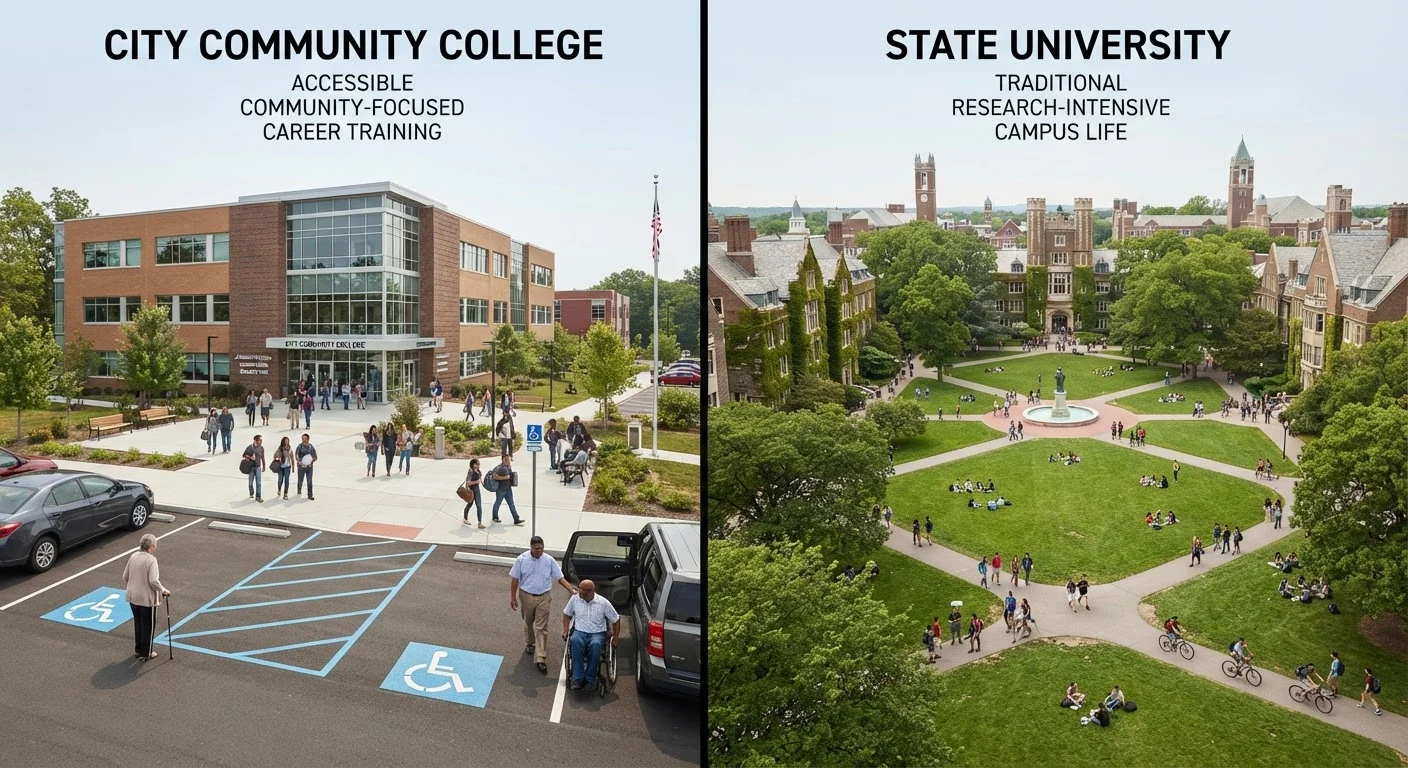
Option A
Community College
The affordable, flexible starting point for many students.
Best for: Students seeking lower costs, local access, career-focused programs, or a bridge to a four-year degree.
Option B
Four-Year University
The traditional, comprehensive degree pathway.
Best for: Students ready to pursue a bachelor's degree in a structured campus environment with broader academic and social resources.
The Cost Gap Is Significant — but Not the Whole Story
Tuition is usually the first number families compare. According to the College Board's Trends in College Pricing reports, average in-state tuition and fees at public two-year colleges have historically run well below those at public four-year institutions — often by thousands of dollars per year. When room, board, and living expenses enter the equation, the four-year path can cost two to three times more annually.
That gap matters, but it doesn't tell the full story. Financial aid — including grants, scholarships, and work-study — can meaningfully reduce what a student actually pays at a four-year school. Students considering either route should complete the FAFSA to understand their full aid picture before comparing sticker prices. For a practical look at mapping out those expenses, see building a realistic college budget before committing to either path.
| Criterion | Community College | Four-Year University |
|---|---|---|
| Average annual tuition (public, in-state) | ~$3,900 (two-year public) | ~$11,600 (four-year public) |
| Degree offered | Associate's degree or certificate | Bachelor's degree (and beyond) |
| Typical time to credential | 2 years (full-time) | 4 years (full-time) |
| Transfer pathway | Often available via articulation | Accepts transfer students |
| Schedule flexibility | High — evening, part-time, hybrid | Moderate — growing but limited |
| Campus housing | Rare or unavailable | Standard offering |
| Class sizes (lower-division) | Typically smaller | Often large lecture format |
| Research & specialized majors | Limited | Broad range available |
Transfer Pathways: Opportunity With Real Hurdles
One of the most compelling arguments for starting at a community college is the transfer pathway — completing two years locally, then transferring to a four-year university to finish a bachelor's degree. Many states have formal articulation agreements (structured credit-transfer contracts between institutions) that ease this process. California's TAG program and Florida's statewide common course numbering system are two well-known examples.
However, transfer is rarely seamless. Credits earned in career-technical programs may not transfer. Some competitive universities admit transfer students at lower rates than first-year applicants. Financial aid at the receiving institution often resets, requiring a new application and potentially a different aid package. Students considering this route should investigate the stages of transferring between colleges well in advance.
~40%
U.S. undergraduates enrolled at community colleges
According to the American Association of Community Colleges, roughly four in ten undergraduate students in the U.S. attend a community college.
~80%
Community college students intending to transfer
Research from the Community College Research Center suggests a large majority of entering community college students express intent to earn a bachelor's degree, though actual transfer rates are lower.
2x+
Cost gap between two- and four-year public institutions
College Board data consistently shows that average published tuition and fees at public four-year institutions exceed those at two-year colleges by more than double.
Academic Environment, Flexibility, and Student Life
Four-year universities offer a depth of academic infrastructure — specialized majors, research opportunities, libraries stocked for graduate-level work, and faculty who often hold terminal degrees in narrow fields. Class sizes at large research universities can be substantial in lower-division courses, while community colleges typically offer smaller classes and more direct faculty access. For a balanced read on what large institutions involve, the article on the pros and cons of attending a large research university is worth reviewing.
Community colleges, by design, serve a broader population — recent high school graduates, working adults returning to school, career-changers, and students with family obligations. Evening and weekend courses, hybrid formats, and part-time enrollment are standard rather than exceptions. Four-year universities are building more flexible options too, but their scheduling and culture still generally assume a full-time traditional student. Campus social life — clubs, residential housing, athletics, and networking events — is far more developed at four-year institutions, which matters to students for whom that environment is a priority. See our comparison of on-campus living vs. off-campus apartments if housing is a key factor in your decision.
Making the Decision: What to Actually Weigh
Neither path is objectively superior — the right choice depends on a student's specific financial situation, career goals, and life circumstances. Students who know their intended major and have the funding or financial aid to support a four-year experience may benefit from starting there directly. Those who are undecided, need flexibility, or want to reduce debt before committing should seriously evaluate the community college route, particularly where strong articulation agreements exist with target universities.
Before deciding, it's worth getting clear on the major question itself. Structural and financial factors that often go unexamined are covered in what no one tells you about choosing a college major. High school students may also have earlier options worth considering — dual enrollment programs can allow college credit to accumulate before graduation, sometimes reducing costs on either subsequent path. Higher education itself is also shifting; trends reshaping the campus experience are creating new formats and credential types that blur the traditional two-year versus four-year distinction.
The goal isn't to find the more prestigious option — it's to find the one that fits your goals, finances, and circumstances without creating unnecessary barriers to completion.
The content on this site is for informational purposes only and is not a substitute for professional advice. Always consult a qualified professional for guidance specific to your situation.