

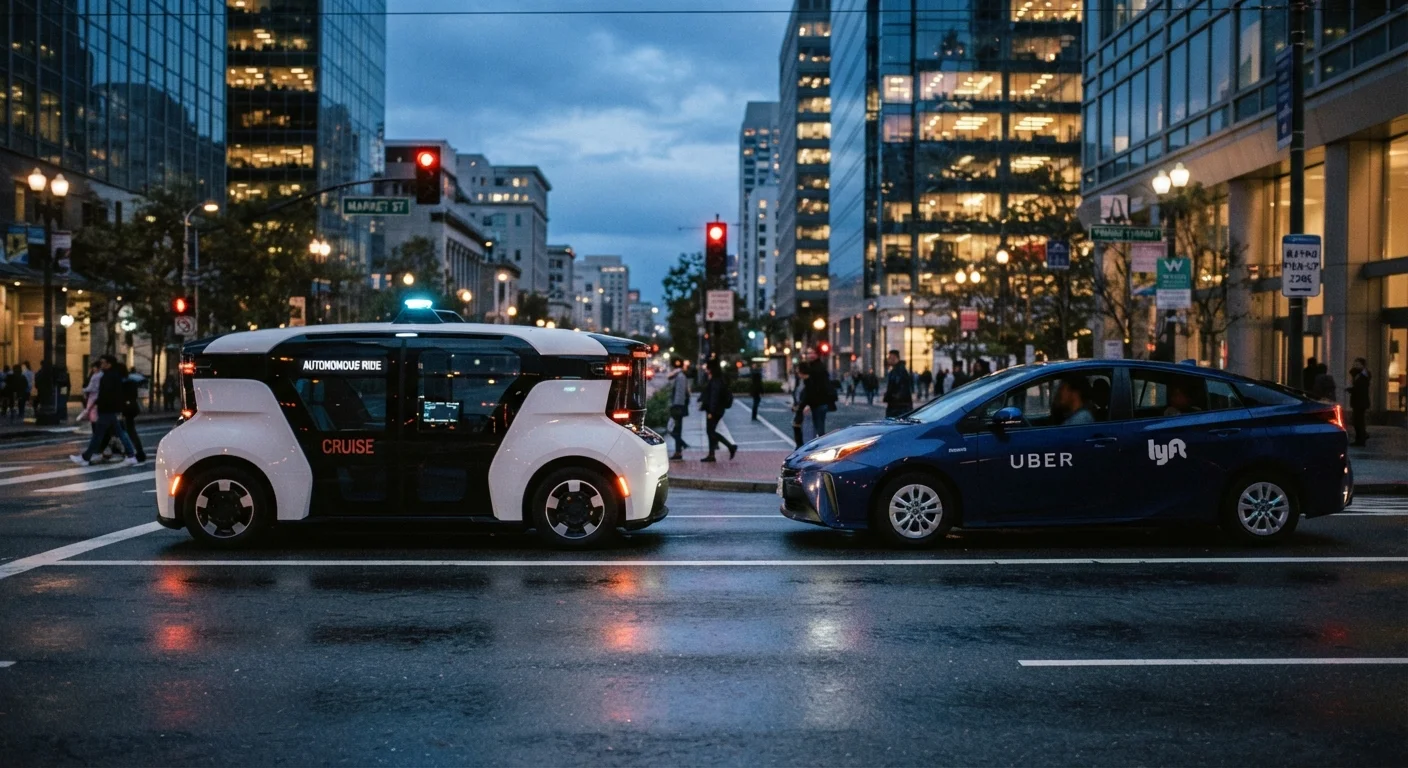
Option A
Robo-Taxis
The software-driven, driverless mobility service.
Best for: Tech-forward urban commuters comfortable with fully automated, app-dispatched point-to-point travel in approved geofenced areas.
Option B
Human-Driven Ride-Shares
The familiar, flexible, and widely available option.
Best for: Everyday travelers seeking broad geographic coverage, flexible trip types, and a human driver who can handle unexpected situations.
The Core Difference: How Each Gets You There
Both services let you request a vehicle, watch it arrive on an app, and pay without cash — yet the underlying systems couldn't be more different. A human-driven ride-share pairs you with a contracted driver who steers, judges, and communicates in real time. A robo-taxi replaces that driver entirely with a stack of hardware — LiDAR, radar, cameras, and high-definition mapping — controlled by proprietary software.
That shift has cascading effects. A human driver improvises when a pedestrian darts across the road unexpectedly or when a detour sign appears. Autonomous systems must have anticipated such scenarios in their training data or rely on remote assistance. Most commercial robo-taxi operators today maintain a fleet-monitoring center where human operators can intervene remotely — a safety layer that passengers never see but regulators scrutinize closely. For a deeper look at how governments are approaching these systems, see how regulators worldwide are responding to self-driving cars.
| Criterion | Robo-Taxis | Human-Driven Ride-Shares |
|---|---|---|
| Driver | None — software and sensors | Contracted human driver |
| Geographic coverage | Approved geofenced zones only | Broad — cities, suburbs, rural |
| Liability framework | Operator/manufacturer — still evolving | Driver + platform — more established |
| Pricing model | High capital costs; often subsidized | Dynamic, labor-driven surge pricing |
| Regulatory status (U.S.) | State-by-state permits, federal gap | Regulated across most jurisdictions |
| Edge-case handling | Remote operator backup required | Driver judgment in real time |
Safety Design, Liability, and Regulation
Safety architecture is where the two services diverge most sharply. Ride-share platforms carry commercial auto insurance, and liability in a crash typically involves the driver's personal policy, the platform's coverage, and the circumstances of the trip. That framework, while imperfect, is familiar to courts and insurers alike.
Robo-taxi liability is more unsettled. When no driver is present, responsibility for an incident shifts toward the operating company and, in some interpretations, the vehicle manufacturer. The National Highway Traffic Safety Administration (NHTSA) has expanded its reporting requirements for autonomous vehicles involved in crashes, but a comprehensive federal framework governing robo-taxi liability does not yet exist. Several U.S. states — including California and Arizona — have issued their own operating permits and incident-reporting rules, creating a patchwork that companies must navigate market by market.
What 'Geofencing' Means in Practice
A geofence is a digitally defined boundary within which a robo-taxi is permitted to operate autonomously. These boundaries correspond to areas that have been extensively mapped and tested. If a vehicle approaches the edge of its operational zone, it may stop and request remote assistance or pull over safely. Passengers are typically informed of service area boundaries before booking.
It's also worth separating myth from reality on autonomous capabilities. Common misconceptions about self-driving cars persist in public debate, including the idea that current robo-taxis can handle all road conditions — they cannot, which is precisely why geofencing exists.
Pricing, Coverage, and What Comes Next
Human-driven ride-shares price dynamically, factoring in driver supply, demand, distance, and time — producing the familiar surge-pricing experience. Labor is the dominant cost, which is why driver pay and platform commission have been flashpoints in policy debates.
Robo-taxis eliminate the labor line item but substitute enormous capital expenses: sensor suites, software development, HD map maintenance, and remote-monitoring centers. Current commercial deployments are not yet profitable at scale, and pricing to riders has often been introductory or subsidized. Whether removing driver labor eventually produces lower fares at scale remains an open question rather than a certainty.
50+
U.S. cities with active AV testing programs
According to the Eno Center for Transportation, autonomous vehicle testing has expanded significantly across American cities as of recent years, though commercial robo-taxi zones remain far fewer.
~1,500
AV crash reports filed with NHTSA (2021–2023)
NHTSA's Automated Driving Systems crash reporting program recorded roughly 1,500 incidents involving vehicles with automated systems during that period, underscoring ongoing safety scrutiny.
36%
of U.S. adults open to riding in a driverless vehicle
A Pew Research Center survey found that roughly one-third of American adults said they would be comfortable riding in a fully self-driving vehicle, reflecting cautious but growing public interest.
Coverage is the most immediate practical limitation. Robo-taxi operations are confined to geofenced zones — specific city districts where mapping and testing have been completed. Human ride-shares work across metropolitan areas, suburbs, airports, and rural corridors where autonomous vehicles have never turned a wheel. For travelers weighing mobility trade-offs more broadly, the broader ride-sharing versus car ownership debate adds useful context. And for those tracking where autonomous tech is gaining traction first, autonomous freight on long-haul routes offers a telling parallel.
The content on this site is for informational purposes only and is not a substitute for professional advice. Always consult a qualified professional for guidance specific to your situation.