

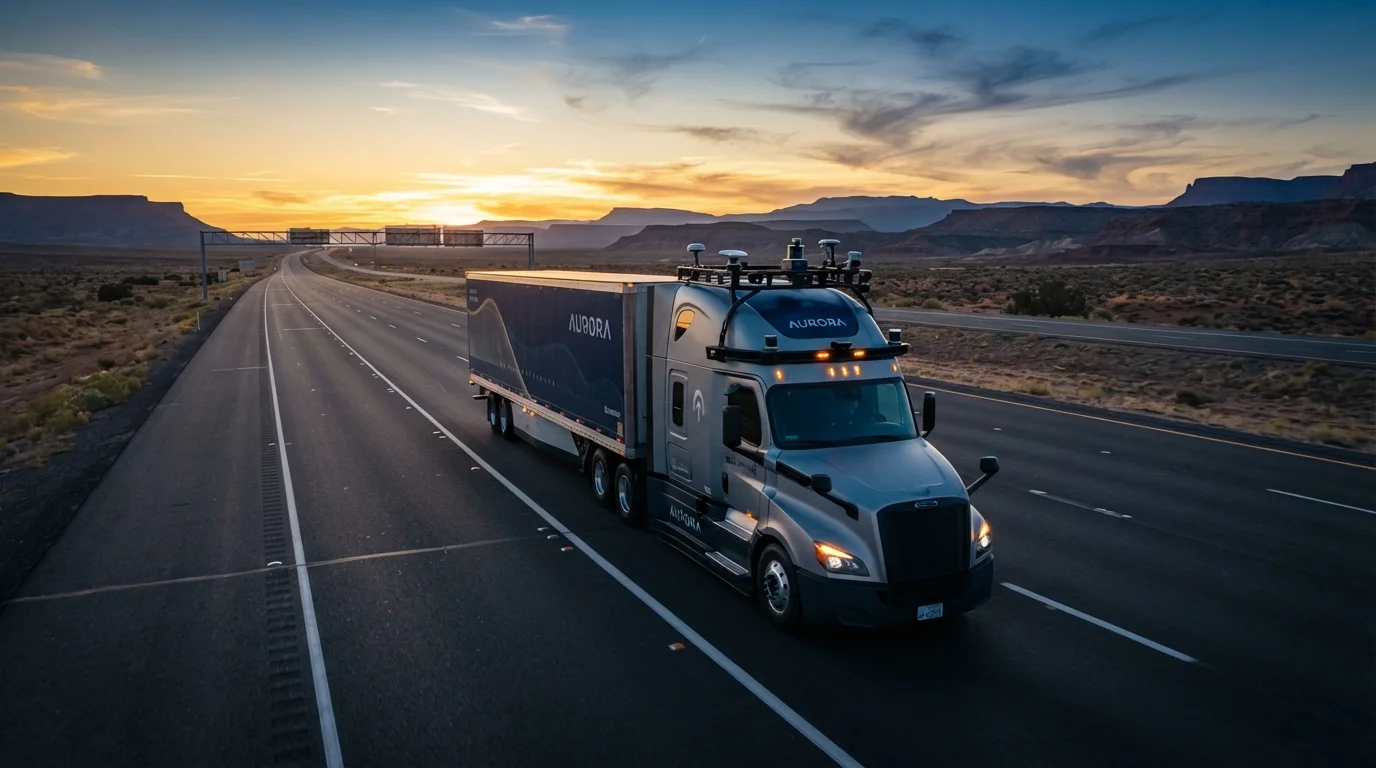
Why Highways, Not City Streets, Are the First Frontier
When most people picture self-driving vehicles, they imagine urban robotaxis navigating dense intersections. But the real leading edge of autonomous deployment is happening on America's interstate system, hauling freight at 65 mph between distribution hubs. The reason is straightforward: highways are dramatically simpler environments for machine perception and decision-making.
On an interstate, the number of unpredictable variables — jaywalking pedestrians, cyclists, sudden lane changes by distracted commuters, complex signal timing — drops sharply. Lane markings are consistent, speeds are relatively uniform, and the operational design domain (the defined set of conditions a system must handle) can be scoped tightly. That narrower scope is what allows engineers to push autonomous systems toward genuine commercial reliability far faster than in urban environments.
This is part of a broader transformation in how goods and people move, explored in depth in our comprehensive mobility overview. Freight logistics may be unglamorous, but it is where self-driving technology is proving itself at scale.
500,000+
Estimated U.S. truck driver shortage
The American Trucking Associations has cited a driver deficit exceeding 500,000 positions, a figure projected to grow without structural intervention.
Millions
Autonomous freight miles logged in U.S. trials
Multiple autonomous trucking developers have publicly reported accumulating millions of test miles on U.S. highways as of recent years, though figures vary by company and verification methodology.
~70%
Share of U.S. freight moved by truck
According to the American Trucking Associations, trucks carry approximately 70 percent of all freight tonnage in the United States, underscoring the sector's economic scale.
The Commercial Pressure Driving Adoption
The U.S. trucking industry faces a structural labor challenge. The American Trucking Associations has reported a persistent driver shortage running into the hundreds of thousands, a gap that demographic trends suggest will widen rather than close. Hours-of-service regulations limit how long a human driver can be behind the wheel without rest, capping how much ground a single truck can cover in a day.
An autonomous system does not need sleep. On a dedicated highway run, it can operate continuously within legal and safety parameters, potentially covering far more miles per 24-hour period than a human driver legally could. For shippers and carriers managing thin margins on high-volume routes, that efficiency difference is a powerful incentive to invest in the technology despite its current limitations.
Fuel efficiency is another factor. Autonomous systems can apply highly consistent throttle and braking inputs — so-called smooth driving — that reduce fuel consumption compared to the variability of human driving. As these platforms increasingly integrate with electric vehicle technology, route and energy optimization can be managed holistically by the same software stack.
Understanding the Hub-to-Hub Model
When evaluating autonomous trucking claims, look for whether a company is describing full door-to-door driverless operation or a hub-to-hub model where humans handle the first and last miles. Most current commercial deployments use the latter, which is a meaningful distinction for assessing how mature the technology actually is.
How the Technology Actually Works on a Long-Haul Run
A typical autonomous trucking system relies on a layered sensor suite: forward-facing radar for long-range object detection, lidar (light detection and ranging) for precise 3D mapping of the immediate environment, cameras for lane-keeping and sign recognition, and GPS combined with high-definition pre-mapped routes. These inputs feed into an AI decision system that interprets the environment and controls steering, acceleration, and braking in real time.
Most current deployments follow a hub-to-hub model. A human driver handles the first and last miles — pulling out of a warehouse, navigating local roads, and docking at a distribution center — while the autonomous system takes over for the highway segment in between. This division of labor sidesteps the hardest edge cases while delivering real operational value on the stretches where automation performs most reliably.
It is worth setting realistic expectations here. Common misconceptions about self-driving technology often overstate current capabilities. No commercial system today handles every road scenario without human backup, and the gap between a controlled highway demonstration and nationwide all-weather deployment remains significant.
The Regulatory and Workforce Landscape
Federal oversight of autonomous vehicles in the U.S. sits primarily with the National Highway Traffic Safety Administration (NHTSA), which issues guidance and safety standards but has not yet established a comprehensive federal framework specifically for autonomous commercial trucks. Several states — including Texas, Arizona, and Arkansas — have moved proactively to allow driverless commercial truck testing and, in some cases, limited commercial operation on designated corridors.
The workforce question is more nuanced than headlines often suggest. Rather than replacing drivers wholesale, the near-term trajectory appears to involve redefining the driver's role. Short-haul, local delivery, and terminal operations require human judgment that current autonomous systems cannot replicate. Industry observers generally expect a transition period measured in years or decades, not months — though the long-term labor market impact remains genuinely uncertain and contested among economists and transportation researchers.
For a comparison of how autonomous freight contrasts with the passenger side of the self-driving story, see our breakdown of robo-taxis vs. human-driven ride-shares. The commercial freight and passenger robotaxi worlds are developing along separate timelines, with different regulatory challenges and risk profiles.
Frequently Asked Questions
Interstate highways offer a far more controlled environment than city streets — fewer pedestrians, predictable lane structures, and consistent speeds. This narrows the range of scenarios the autonomous system must handle, making it easier to achieve reliable performance. The commercial incentive is also enormous, given persistent driver shortages and high operating costs in freight logistics.
Some companies have conducted driverless runs on specific highway segments under supervised conditions, but widespread commercial deployment without a safety driver remains limited. Most operations still involve a human monitor either in the cab or remotely. Full SAE Level 4 deployment across diverse conditions is still an active area of development and regulatory negotiation.
The industry picture is more nuanced than simple job elimination. Autonomous systems tend to handle the monotonous highway leg while human drivers manage pickups, deliveries, and complex urban maneuvers. Some analysts expect a shift toward shorter-haul and last-mile roles rather than a net loss of all driving jobs, though the long-term workforce impact remains a subject of genuine debate.
Adverse conditions like heavy snow, heavy rain, or unusual road debris remain a known challenge for current sensor suites. Most operational design domains restrict autonomous operation to specific weather windows and geographic zones. Companies are actively working to improve sensor fusion and AI decision-making under degraded conditions, but this is not yet fully solved.
Increasingly, yes. Several technology developers are designing autonomous systems specifically for battery-electric truck platforms, where precise speed and route optimization can directly extend driving range. The combination of electrification and automation is seen by many in the industry as complementary rather than separate trends.
The content on this site is for informational purposes only and is not a substitute for professional advice. Always consult a qualified professional for guidance specific to your situation.