

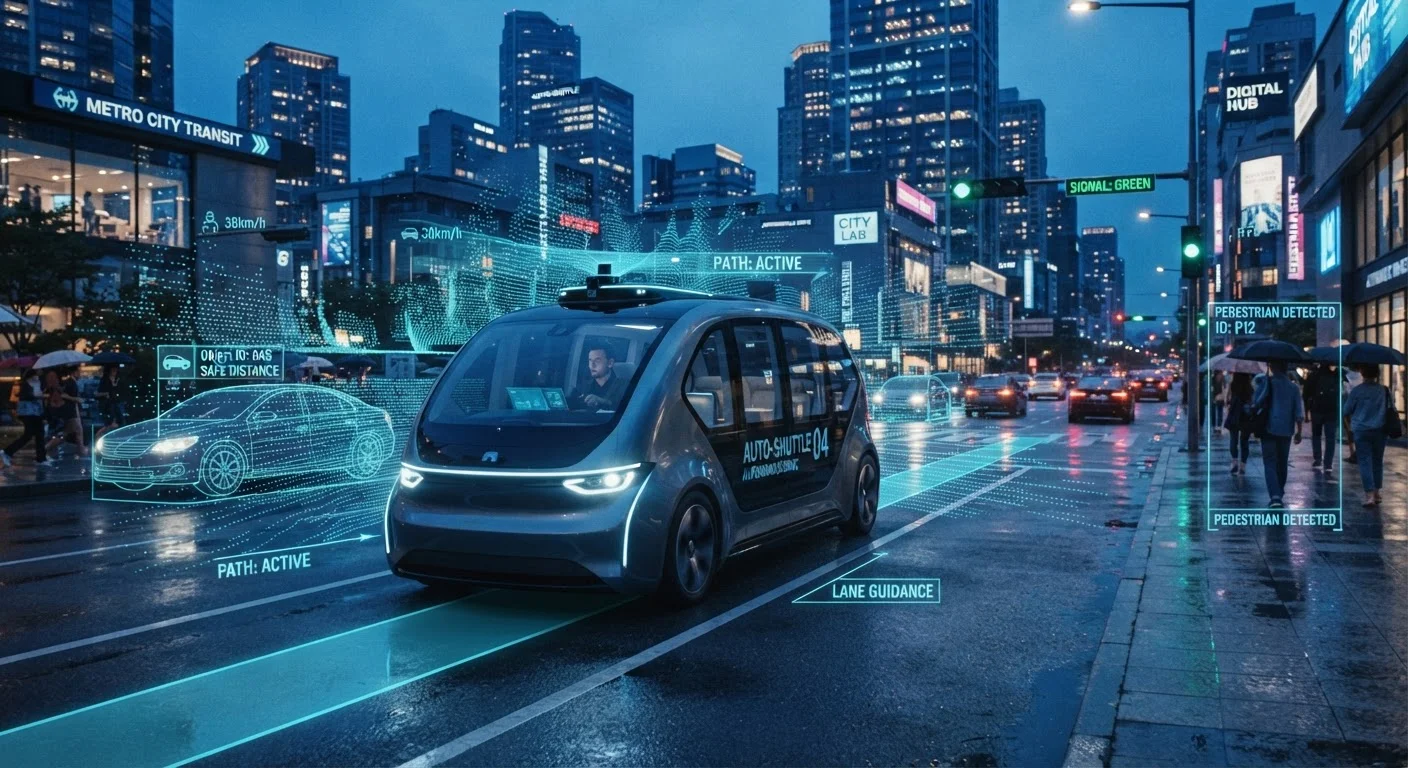
The Automation Gap: Where the Technology Actually Stands
Public conversation about self-driving cars often runs well ahead of the engineering reality. Headlines toggle between utopian promises and alarming crashes, leaving most readers without a grounded sense of where the technology genuinely stands. The starting point for any honest discussion is the SAE International automation scale — a 0-to-5 framework that defines what a vehicle can and cannot do without human input. For a deeper look at what each tier requires, see the six levels of vehicle automation explained.
Most vehicles sold to U.S. consumers today operate at Level 1 or Level 2, meaning the car can assist with steering or acceleration — but the driver must remain engaged and ready to take control at any moment. A handful of models offer Level 3 conditional automation in narrow use cases, but even these require the human to resume control when the system requests it. A true Level 5 vehicle — one that can handle any road, any weather, any situation without a human — does not exist in production form.
Myth
Self-driving cars are already available for consumers to buy and use without any driver involvement.
Fact
No consumer vehicle sold today operates without requiring human attention and readiness to intervene.
Systems marketed with names suggesting full autonomy — like "Autopilot" or "Full Self-Driving" — are, under SAE definitions, driver-assistance tools. They can handle highway lane-keeping or navigate certain urban scenarios, but the driver remains legally and practically responsible. Regulators in multiple U.S. states still classify these as Level 2 systems, meaning the human must supervise at all times.
Myth
Autonomous vehicles can handle any road condition, including heavy snow, dense fog, and torrential rain.
Fact
Adverse weather remains one of the most significant unresolved technical challenges for autonomous driving systems.
Cameras, radar, and lidar — the primary sensors in self-driving systems — all degrade in challenging weather. Snow obscures lane markings; heavy rain scatters lidar pulses; glare confuses camera-based systems. Engineers are actively developing sensor fusion strategies and heated sensor housings to address these limits, but no system today handles severe weather with the consistency of an experienced human driver. Why autonomous vehicles struggle in bad weather covers the research in detail.
Myth
Self-driving software can respond to every possible road scenario because it has been trained on vast datasets.
Fact
Edge cases — rare, unexpected situations — remain a fundamental challenge that training data alone cannot fully solve.
Machine learning models for autonomous driving are trained on billions of miles of data, yet roads present nearly infinite variation: an unusual hand signal from a construction worker, a child's ball rolling into the street, a fallen traffic light lying flat on the pavement. Each of these "edge cases" requires the system to generalize beyond what it has seen. Current AI architectures can fail unpredictably in novel situations, which is a core reason Level 4 and 5 deployments remain geographically constrained to mapped, controlled environments.
Myth
Once autonomous vehicles are widespread, traffic accidents will be eliminated.
Fact
Autonomous vehicles are expected to reduce certain crash types significantly, but eliminating accidents entirely is not a realistic near-term outcome.
Human error contributes to a large share of traffic crashes, and autonomous systems could meaningfully reduce incidents caused by distraction, fatigue, or impairment. However, autonomous vehicles introduce their own failure modes — sensor errors, software bugs, and cybersecurity vulnerabilities among them. A mixed environment where autonomous and human-driven vehicles share roads for many decades also creates new interaction challenges. Safety gains are plausible and meaningful; a zero-accident guarantee is not.
Myth
Self-driving regulations are uniform across the United States, so what's legal in one state applies everywhere.
Fact
Autonomous vehicle regulation in the U.S. is a patchwork, with each state setting its own testing and deployment rules.
Federal guidelines from the National Highway Traffic Safety Administration (NHTSA) provide a framework, but actual permitting, testing requirements, and liability rules differ substantially by state. California, Arizona, and Texas have emerged as major testing hubs with distinct regulatory environments. Internationally, the divergence is even wider. What regulators around the world are saying about self-driving cars maps the global landscape.
Myth
Autonomous vehicles are purely a software problem — better code means a self-driving car is ready to deploy.
Fact
Hardware reliability, sensor integration, mapping infrastructure, and regulatory approval are equally critical — and slower to develop than code.
High-definition mapping, which autonomous vehicles depend on to understand precise road geometry, must be continuously updated and is not globally available. Sensor hardware must meet reliability standards across temperature extremes and vibration. Liability frameworks must be established before insurers and manufacturers will support broad deployment. Software is essential, but it operates within a much larger system of physical and institutional requirements that take years to build out. Connected vehicle technology illustrates how infrastructure itself must evolve alongside the vehicles.
What the Myths Get Wrong — and Why It Matters
Misconceptions about autonomous vehicles are not harmless. Overconfidence in current driver-assistance technology has been linked to driver inattention and accidents. At the same time, unfounded fears can slow adoption of genuine safety improvements. Getting the facts right shapes how drivers behave today and how policymakers approach tomorrow.
Overreliance on Driver-Assistance Systems Is a Real Safety Risk
Investigators at the National Transportation Safety Board (NTSB) have flagged driver overreliance on partial automation as a contributing factor in several high-profile crashes. If your vehicle has a driver-assistance feature, read the owner's manual carefully to understand exactly what the system can and cannot do. Do not assume the car is monitoring the road on your behalf.
For a fuller picture of how sensors, machine learning, and decision algorithms combine to make autonomous driving possible, autonomous vehicles explained. And if you're curious how the same technology is being deployed in logistics before it reaches your driveway, autonomous freight is entering long-haul trucking first — for reasons that reveal a lot about the technology's real strengths and limits.
Misconceptions about self-driving cars share something in common with electric vehicle myths that keep circulating: both tend to collapse a nuanced, evolving technology into an oversimplified story that serves neither consumers nor progress.
The content on this site is for informational purposes only and is not a substitute for professional advice. Always consult a qualified professional for guidance specific to your situation.