

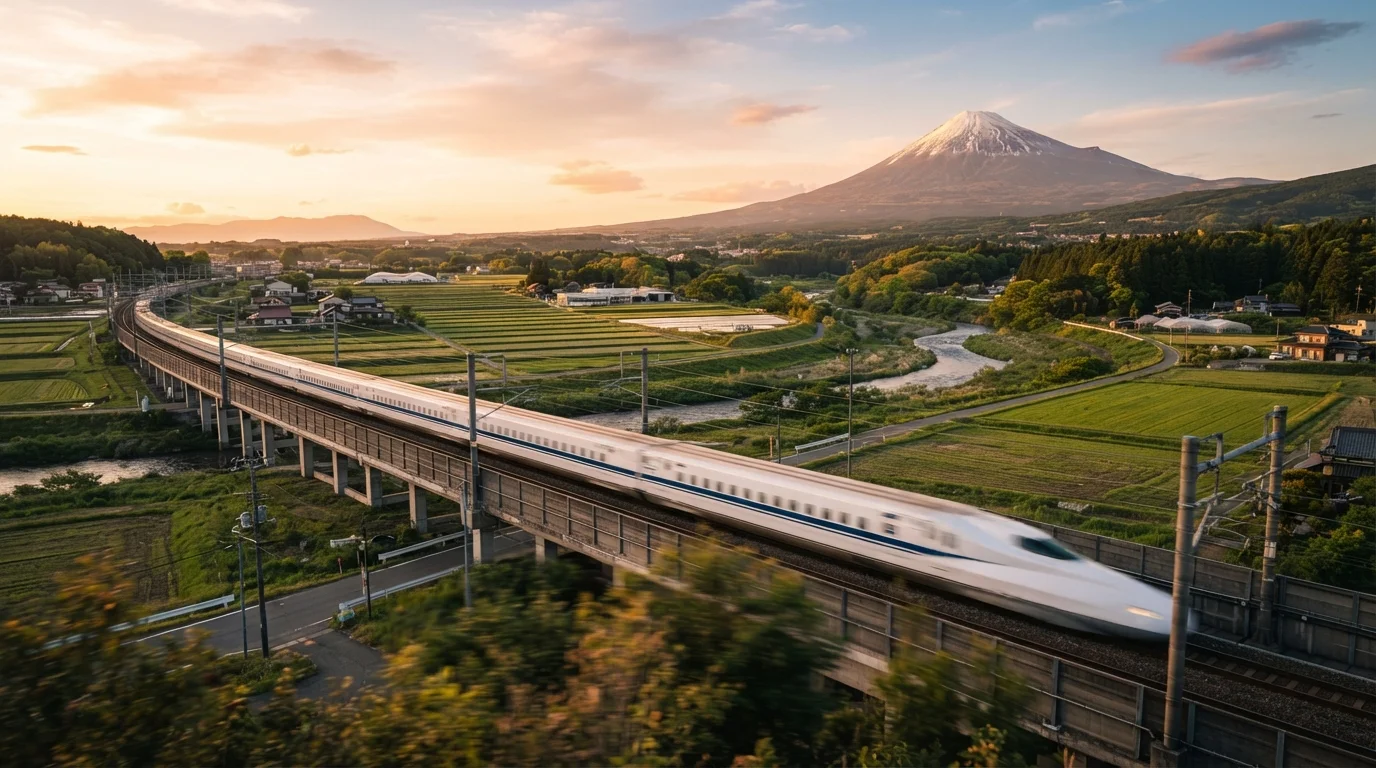
What the Shinkansen Network Covers
Japan's Shinkansen — commonly called the bullet train — is a network of high-speed rail lines operated primarily by Japan Railways (JR) Group companies. The network spans the main island of Honshu and extends north into Hokkaido and south into Kyushu. For independent travellers, understanding which line serves which corridor is the starting point for planning any multi-city itinerary.
The network does not cover all of Japan. Several regions, including much of Shikoku and the more remote prefectures of the Chugoku interior, are not directly served by Shinkansen. Conventional limited-express trains fill those gaps, and holders of the Japan Rail Pass can use both modes on eligible services. Travellers should verify pass coverage for each specific service before departure through official JR sources, as eligibility details change periodically.
Major Lines and the Regions They Serve
The Tokaido Shinkansen is the busiest and most historically significant line, running between Tokyo and Osaka via Nagoya and Kyoto. Opened in 1964, it anchors the Pacific coast corridor and carries more passengers annually than any other high-speed rail line in the world. The Tokaido connects directly to the Sanyo Shinkansen, which continues westward from Osaka through Hiroshima to Hakata station in Fukuoka.
Heading north from Tokyo, the Tohoku Shinkansen is the backbone of northeastern Honshu travel, reaching Aomori at the northern tip of the island. It branches at Sendai toward Yamagata via the Yamagata Shinkansen and further north toward Akita via the Akita Shinkansen — both of which use a hybrid of Shinkansen and conventional tracks known as mini-Shinkansen.
The Hokkaido Shinkansen extends the Tohoku line through the Seikan Tunnel — the world's longest undersea railway tunnel — to Shin-Hakodate-Hokuto in Hokkaido. Extension to Sapporo remains under construction as of mid-2020s planning, with anticipated completion dates subject to revision; travellers should check current timelines through official sources.
The Joetsu Shinkansen connects Tokyo to Niigata on the Sea of Japan coast, serving as a gateway to ski regions including Yuzawa. The Hokuriku Shinkansen links Tokyo to Kanazawa and continues toward Tsuruga, opening the historic Hokuriku coast — including the well-preserved city of Kanazawa — to faster connections. In Kyushu, the Kyushu Shinkansen runs from Hakata south to Kagoshima-Chuo, with a newer segment forming the Nishi-Kyushu Shinkansen connecting Takeo-Onsen to Nagasaki as of 2022.
Mini-Shinkansen: A Distinct Category
The Yamagata and Akita Shinkansen lines are technically classified as mini-Shinkansen, running standard Shinkansen rolling stock on tracks that have been gauge-converted from conventional rail. This means they share infrastructure with local trains in some sections. Travel times are longer than on fully dedicated Shinkansen corridors, and maximum speeds are lower — typically around 130 km/h on the conventional sections.
Practical Considerations for Travellers
Shinkansen services are divided into speed categories. Nozomi and Mizuho trains are the fastest on the Tokaido-Sanyo corridor but are not covered by the standard Japan Rail Pass — a point many first-time visitors overlook. Hikari and Kodama services on the same corridor are pass-eligible and stop at more stations. On other lines, service tiers vary by route.
Reserved seating is available on all Shinkansen services, and unreserved cars exist on most trains. During peak travel periods — Golden Week in late April to early May, the Obon holiday in mid-August, and the year-end New Year period — unreserved cars can become crowded. Travellers expecting to ride without a reservation during these windows should plan accordingly.
For broader context on how rail compares to air travel as a primary mode, see our coverage of how Europe's rail networks stack up against flying — a useful frame for understanding the trade-offs common to high-speed rail travel globally. For route-planning strategies and general logistics, the Travel Tips hub offers practical guidance applicable to itineraries of all lengths.
Entry requirements, rail pass eligibility rules, and timetable details are subject to change. Travellers are advised to verify current conditions through official JR Group websites and their country's relevant government travel authority before booking.
The content on this site is for informational purposes only and is not a substitute for professional advice. Always consult a qualified professional for guidance specific to your situation.