

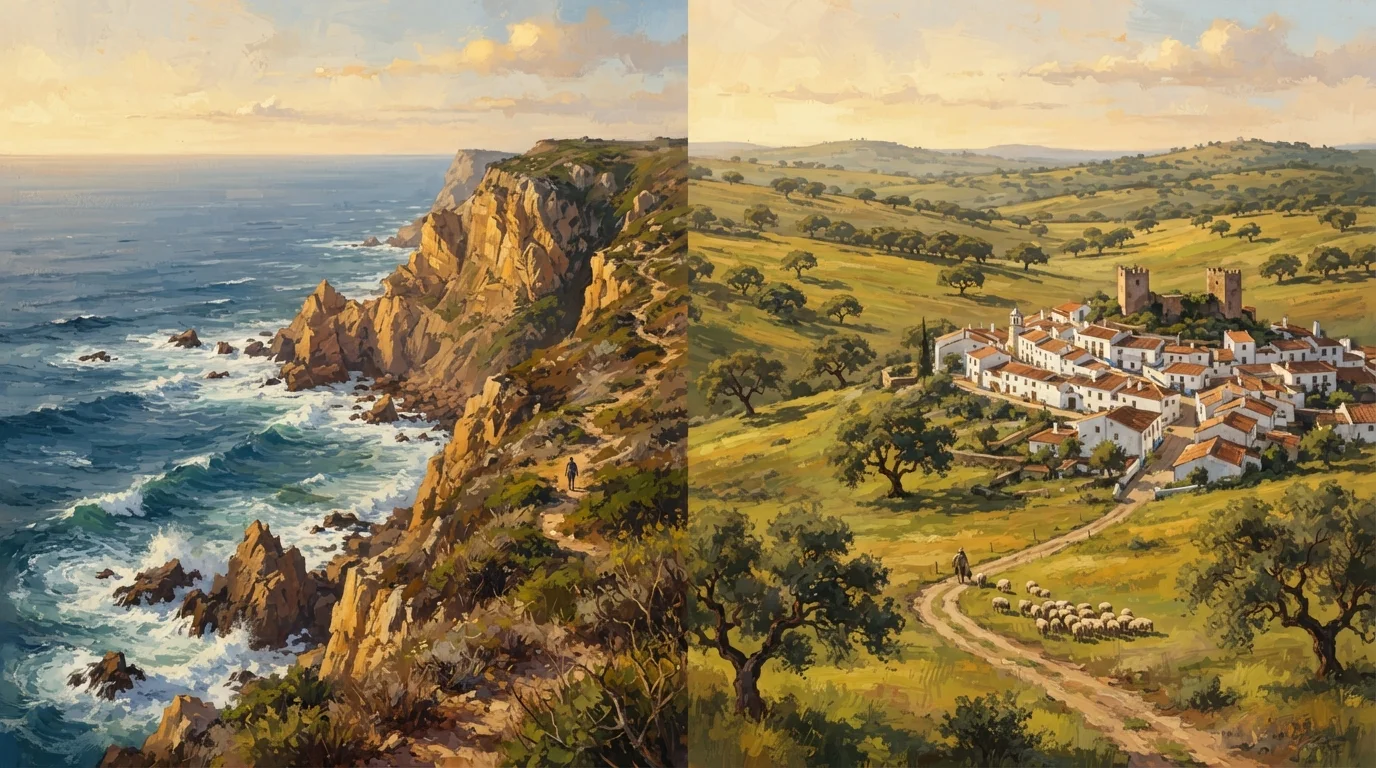
Option A
Coastal Portugal
The sun-drenched, surf-ready Atlantic frontier.
Best for: Travelers drawn to dramatic scenery, beach culture, seafood, and vibrant resort towns along the Atlantic shore.
Option B
The Alentejo Interior
The unhurried, cork-scented heart of the country.
Best for: Visitors seeking slow travel, local gastronomy, wine culture, and authentic village life away from tourist crowds.
Two Faces of One Country
Portugal is often sold as a single destination, but the country contains distinct travel worlds within a few hours' drive of each other. Along the Atlantic coast, the landscape is defined by towering limestone cliffs, long sand beaches, and towns built around surfing and seafood. Drive inland toward the Spanish border, and the scenery shifts entirely — the terrain opens into vast cork oak plains, medieval hilltop villages, and a cultural pace that moves to an entirely different rhythm.
Both regions share a Portuguese identity, yet they attract different travelers and reward different travel styles. Understanding those differences is what makes the choice between them meaningful. For those considering alternatives beyond mainland Portugal, the Azores offer yet another distinct Portuguese experience worth exploring.
| Criterion | Coastal Portugal | The Alentejo Interior |
|---|---|---|
| Landscape | Cliffs, beaches, surf breaks | Plains, cork forests, vineyards |
| Peak Season | July–August | Spring and autumn |
| Crowd Level (peak) | High in resort towns | Moderate even in summer |
| Food Culture | Seafood, grilled fish, pastries | Black pork, bread soups, olive oil |
| Wine Scene | Vinho Verde in the north; regional wines | Alentejo DOC, internationally recognized |
| Accommodation Style | Resorts, surf hostels, hotels | Rural guesthouses, agritourism estates |
| Distance from Lisbon | 1.5–3 hours (varies by destination) | 1.5–2 hours to Évora |
| Summer Temperatures | Mild coastal temperatures | Intense inland heat possible |
The Coast: Atlantic Energy and Scenic Drama
Portugal's coastline runs for roughly 1,800 kilometers, but its most traveled sections are concentrated in two main corridors: the Algarve in the south and the Silver Coast north of Lisbon. The Algarve draws the largest share of international visitors, owing to its sandstone sea stacks, protected coves, and reliable summer sun. Towns like Lagos, Tavira, and Sagres range from lively resort hubs to quieter fishing villages that retain their working character.
The Silver Coast — stretching from Cascais through Peniche to Nazaré — appeals to travelers who prefer an edgier, less resort-oriented Atlantic experience. Nazaré has earned a global profile for its extreme surf waves, while Peniche functions as a base for surfers traveling to the nearby Baleal peninsula. Water temperatures along Portugal's coast remain cooler than the Mediterranean, a factor worth noting for travelers who prioritize warm swimming conditions.
~1,800 km
Length of Portugal's Atlantic coastline
Portugal's coastline is one of the longest in Western Europe, spanning from the Minho River in the north to the Algarve's southern tip.
~33%
Share of Portugal's land area covered by Alentejo
Despite covering roughly a third of the country, Alentejo holds a small proportion of Portugal's total population, contributing to its uncrowded character.
Top 5
Alentejo's ranking among Europe's emerging slow-travel destinations
Industry travel reports and tourism bodies have increasingly highlighted Alentejo as a leading example of rural and experiential tourism growth in southern Europe.
The Alentejo: Slowness as a Feature
The Alentejo region covers roughly a third of Portugal's land area but holds a small fraction of its population. That low density is precisely what draws a growing segment of travelers — those seeking space, quiet, and a connection to rural Portuguese life that coastal resorts cannot offer. The regional capital, Évora, is a UNESCO World Heritage city with Roman ruins, a medieval cathedral, and a compact historic center walkable within an afternoon.
Beyond Évora, smaller towns such as Monsaraz, Marvão, and Estremoz offer castle views, local markets, and agritourism properties set among vineyards and olive groves. Alentejo wines — particularly from the Alentejo DOC appellation, one of Portugal's most recognized wine regions — have gained international respect. The region's food culture, built around slow-cooked dishes, local black pork, and traditional bread-thickened soups called açordas, gives it a culinary identity that stands apart from coastal seafood traditions.
Practical Differences: Timing, Access, and Pace
Both regions are reachable from Lisbon, which serves as the primary international gateway to Portugal. The Algarve is approximately 2.5 to 3 hours by road or train from the capital; Évora in the Alentejo sits about 1.5 hours east by road. This proximity makes a combined itinerary genuinely practical for travelers with 10 days or more.
Timing shapes the experience considerably. The coast peaks in July and August, when resort towns fill rapidly and accommodation prices rise. The Alentejo interior, by contrast, rewards shoulder-season travel — spring brings wildflower blooms across the plains, and autumn coincides with grape and cork harvests. Summers in Alentejo can be intensely hot, with inland temperatures regularly exceeding those on the coast, which is a practical consideration for itinerary planning.
Travelers interested in broader travel trends shaping Portugal's visitor landscape will note that rural and slow-travel tourism has grown measurably across southern Europe, and Alentejo is frequently cited as a leading example of that shift. For general planning guidance, verifying local entry requirements, accommodation availability, and seasonal road conditions with official or provider sources before travel remains essential.
Travel conditions, pricing, and local regulations can change. Readers are encouraged to verify entry requirements, safety advisories, and destination-specific details with official government sources and travel providers before booking.
The content on this site is for informational purposes only and is not a substitute for professional advice. Always consult a qualified professional for guidance specific to your situation.