

Our Verdict
No single machine learning paradigm is universally superior — each is purpose-built for different problem types and data conditions. Supervised learning excels when labeled examples are plentiful. Unsupervised learning surfaces structure when labels don't exist. Reinforcement learning handles sequential decision-making where outcomes unfold over time. Understanding these differences helps consumers make better sense of what AI systems can and cannot do.
| Best for | Recommended |
|---|---|
| Problems with clear, labeled training data | Supervised Learning |
| Exploring unknown structure in large, unlabeled datasets | Unsupervised Learning |
| Training agents to make sequences of decisions | Reinforcement Learning |
| Complex real-world AI systems combining multiple needs | Hybrid or combined approaches |
The Core Idea: How Machines Learn at All
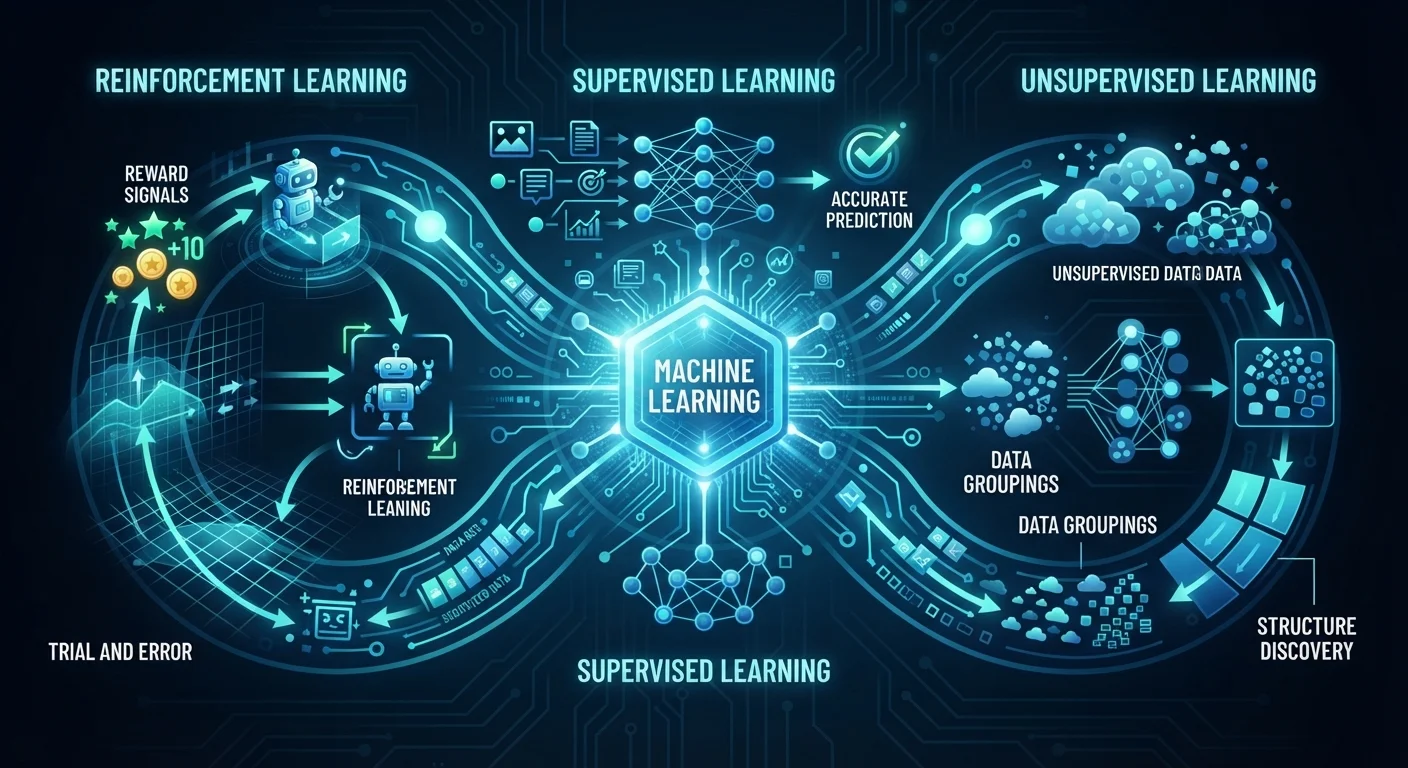
Machine learning is the field in which computer systems improve their performance by processing data rather than following hand-coded rules. But "machine learning" is an umbrella term that covers several fundamentally different strategies. Three of the most foundational are supervised learning, unsupervised learning, and reinforcement learning. Each starts with a different assumption about what data is available and what kind of problem needs solving.
To understand why this distinction matters, consider an analogy: a student given a textbook with an answer key is learning differently from one asked to organize a pile of unlabeled documents — and both are learning differently from a player improving at chess through practice and feedback. That intuition maps closely onto how these three paradigms actually work. For more on why machine learning systems behave so differently from traditional software, see how neural networks differ from conventional code.
Supervised Learning: Training With Answers Provided
Supervised learning is the most widely deployed paradigm in commercial AI today. The model is trained on a dataset where every input example is paired with a correct output label. A spam filter, for instance, learns from thousands of emails already tagged as "spam" or "not spam." An image classifier learns to identify cats because it has seen millions of images labeled "cat" or "not cat." The model adjusts its internal parameters until its predictions closely match the known answers.
The defining constraint of supervised learning is that labeled data must exist before training can begin. Labeling is often expensive and time-consuming — it typically requires human reviewers to manually annotate examples. Despite this, supervised learning powers a broad range of everyday tools: credit risk scoring, medical image analysis, voice recognition, and predictive text all rely on it to varying degrees.
| Supervised Learning | Unsupervised Learning | Reinforcement Learning | |
|---|---|---|---|
| Data requirement | Labeled input-output pairs | Unlabeled data only | No dataset — learns from interaction |
| Primary goal | Predict or classify outputs | Discover patterns or groupings | Maximize cumulative reward |
| Human input needed | High — labeling is costly | Low — no labeling required | Medium — reward function design |
| Typical use cases | Spam filters, image recognition | Customer segmentation, anomaly detection | Game AI, robotics, optimization |
| Interpretability | Generally clearer outputs | Outputs require human interpretation | Policy logic can be opaque |
| Training complexity | Moderate with sufficient labels | Moderate — no labels needed | High — requires many interactions |
Unsupervised Learning: Finding Structure Without Labels
Unsupervised learning takes a different starting point: the training data has no labels at all. The algorithm's task is to find meaningful structure, groupings, or patterns entirely on its own. Common techniques include clustering (grouping similar data points together) and dimensionality reduction (compressing complex data into simpler representations that preserve its essential shape).
A practical example is customer segmentation. A retailer might feed purchase history into an unsupervised algorithm with no predefined categories. The model may independently identify clusters — say, occasional buyers versus frequent high-value customers — without ever being told those groups exist. Recommendation engines also lean on unsupervised methods to detect latent patterns in user behavior. The tradeoff is interpretability: because no labels anchor the output, understanding what the discovered clusters actually mean requires additional human judgment.
When Labels Don't Exist, Start Unsupervised
If you're working with a large dataset and don't know what categories or structures exist within it, unsupervised learning is often the right first step. Clustering can reveal natural groupings that then inform whether labeled data collection — and a subsequent supervised approach — is even worth pursuing. Think of it as exploratory analysis before committing to a specific prediction task.
Reinforcement Learning: Learning Through Consequence
Reinforcement learning operates on a third model entirely. An agent — the system doing the learning — interacts with an environment, takes actions, and receives rewards or penalties based on those actions. Over many iterations, the agent learns a policy: a strategy for choosing actions that maximizes cumulative reward. There is no labeled dataset; experience itself is the teacher.
This approach is particularly effective for sequential decision-making tasks where outcomes depend on chains of actions rather than single predictions. Game-playing AI systems have demonstrated reinforcement learning's power in controlled environments. Robotics, logistics optimization, and certain types of financial modeling also employ the technique. The major practical challenge is that effective training often requires enormous numbers of interactions — in real-world applications, that can mean significant computational cost or physical risk during training.
To see where all three paradigms show up in daily life — from fraud detection to music recommendations — explore how machine learning shapes everyday decisions.
Choosing the Right Approach: It Depends on the Data
In practice, the choice of learning paradigm is largely dictated by what data exists and what question is being asked. Supervised learning requires labeled data but delivers precise, measurable outputs. Unsupervised learning works when labels are absent but the goal is discovery rather than prediction. Reinforcement learning fits when the problem is about optimizing a sequence of decisions under uncertainty.
Many real-world AI systems blend approaches. A recommendation engine might use unsupervised clustering to group users, then apply supervised methods to predict ratings within each group. Understanding these distinctions equips consumers to ask better questions — not just "does this AI work?" but "what kind of learning is it doing, and does that suit the problem it's solving?" Those who want to explore these ideas further through structured courses can compare formats in our overview of MOOCs, bootcamps, and community learning options.
The content on this site is for informational purposes only and is not a substitute for professional advice. Always consult a qualified professional for guidance specific to your situation.